Sunday, July 26, 2026

“I Am Doing a Great Work”: Stay on the Wall and Finish What God Called You to Do

“I Am Doing a Great Work”: Stay on the Wall and Finish What God Called You to Do

“I Am Doing a Great Work”

Stay on the Wall and Finish What God Called You to Do
Come, Follow Me—July 27–August 2 | Ezra 1; 3–7; Nehemiah 2; 4–6; 8


There are some distractions that do not look dangerous because they look quite reasonable. 

They arrive as invitations, conversations, controversies, urgent notifications, unexpected opportunities, and demands for our immediate attention. They ask us to take a moment and step away from what God may have placed before us - not necessarily forever, just long enough for us to lose our concentration and focus. 

This was the very strategy used against Nehemiah. 

Nehemiah’s enemies did not begin by openly commanding him to abandon the rebuilding of Jerusalem. Instead, they repeatedly invited him to leave the work and meet them in the plain of Ono. Such a proposal sounded quite diplomatic; however, Nehemiah recognized the deception beneath. He was able to discern and understood that not every invitation deserved an answer. Nor every controversy deserved his attention and presence. 

His response has become one of the most significant and clearest declarations of spiritual focus in scripture: “I am doing a great work, so that I cannot come down” (Nehemiah 6:3). Nehemiah was not boasting about his personal importance. What he did is declare the significance of the assignment - or calling - God had entrusted to him. More to the point, Nehemiah took seriously the stewardship of what God called him to accomplish. 

The wall was more than stone and timber. Jerusalem’s restoration represented covenant renewal, spiritual protection, communal identity, temple worship, and the fulfillment of God’s promises. 

This week’s Come Follow Me Study for the Old Testament is about more than rebuilding a temple or repairing a city wall. It is regarding how we are open and willing to recognize the work God has placed before each of us, resisting whatever pulls us away from it, and trusting that the Lord will strengthen our hands as we remain faithful and obedient to His will, purpose, and plans. 

Tuesday, July 21, 2026

Satan's Counter-Mission: The Ancient Playbook Behind Modern Social Media Gainsayers

Satan's Counter-Mission: The Ancient Playbook Behind Modern Social Media Gainsayers

How First-Century Religious Polemics Reappear in the Digital Age

Did you know that long before YouTube exposés, TikTok reaction videos, livestream debates, and thumbnails announcing that someone's faith tradition had been "destroyed" or they "got cooked," religious opponents were already employing a variety of tactics? These tactics included not only labels and ridicule but also the strategic use of selective evidence, harsh accusations of deception, and appeals to the prevailing orthodoxy of the time.

Throughout history, individuals and groups have engaged in polemical discourse, employing familiar patterns that transcend modern technology and social media platforms. While social media may amplify these exchanges and offer new avenues for expression, the fundamental dynamics of polemics—debate and dispute—are anything but new. They are deeply rooted in the fabric of human communication and interaction.

Understanding these historical parallels can offer valuable insights. However, it is crucial to recognize that for Latter-day Saints, acknowledging these patterns should not devolve into a license to demonize every critic. Instead, it calls upon us to foster a more nuanced approach to dialogue and engagement. This means we must strive for discernment without slipping into paranoia. We can hold firm convictions without succumbing to contempt for others.

In our conversations and debates, we want to aim to express truth in a manner that reflects the charity of Jesus Christ. This challenges us to engage thoughtfully and respectfully, even when faced with opposition. We are invited to navigate the complexities of faith, belief, and skepticism with a spirit of love and understanding, creating space for constructive dialogue rather than animosity. Ultimately, our response to criticism can be a powerful testament to the principles we uphold, embodying a spirit that upholds truth while also extending grace to those with whom we may disagree.

Sunday, July 19, 2026

When You Don’t Know What to Do, Keep Your Eyes on God | 2 Chronicles 14–20; 26; 30

When You Don’t Know What to Do, Keep Your Eyes on God | 2 Chronicles 14–20; 26; 30

Come, Follow Me — July 20–26, 2026: “Our Eyes Are Upon Thee”

What do you do when the opposition is greater than your strength, the pressure is greater than your wisdom, and you honestly do not know what to do next?

This week’s Come, Follow Me study takes us into the lives of kings, prophets, reformers, worshippers, and ordinary families who faced that very question. Their stories reveal that peace does not come from pretending the battle is small. It comes from knowing where to turn when the battle is bigger than you.

Through the accounts of Asa, Micaiah, Jehoshaphat, Uzziah, and Hezekiah, 2 Chronicles invites us to examine where we place our trust, how we respond to correction, and whether our eyes remain fixed upon the Lord when fear, success, pride, or division threaten to pull them away. Each of these figures faced formidable challenges—be it external armies, internal strife, or the temptations of power—and their responses provide valuable lessons for our own lives.

Asa, for instance, shows how reliance on God in times of trouble can lead to unexpected victories, while Micaiah reminds us of the importance of courage in standing for truth, even in the face of overwhelming opposition. Jehoshaphat’s alliance-building and pursuit of divine guidance highlight the significance of seeking God's will in decision-making, especially when circumstances seem dire. Uzziah's rise to power illustrates the fine line between humility in success and the dangers of pride, reminding us that acknowledgment of our dependence on God is crucial. Lastly, Hezekiah's prayer in times of crisis demonstrates that sincere reliance on divine help can yield miraculous outcomes.

This week's study encourages us to reflect deeply on our own lives. When confronted with overwhelming pressure, do we allow our fears to overshadow our faith? Are we quick to seek advice from sources that may not align with our beliefs? Or do we, like these biblical figures, turn our attention steadfastly to God, trusting that He will guide us through our fiercest battles? Through these narratives, we learn that true peace comes from steadfast faith and a commitment to seek God's wisdom relentlessly, no matter how insurmountable the obstacles may appear.

Tuesday, July 14, 2026

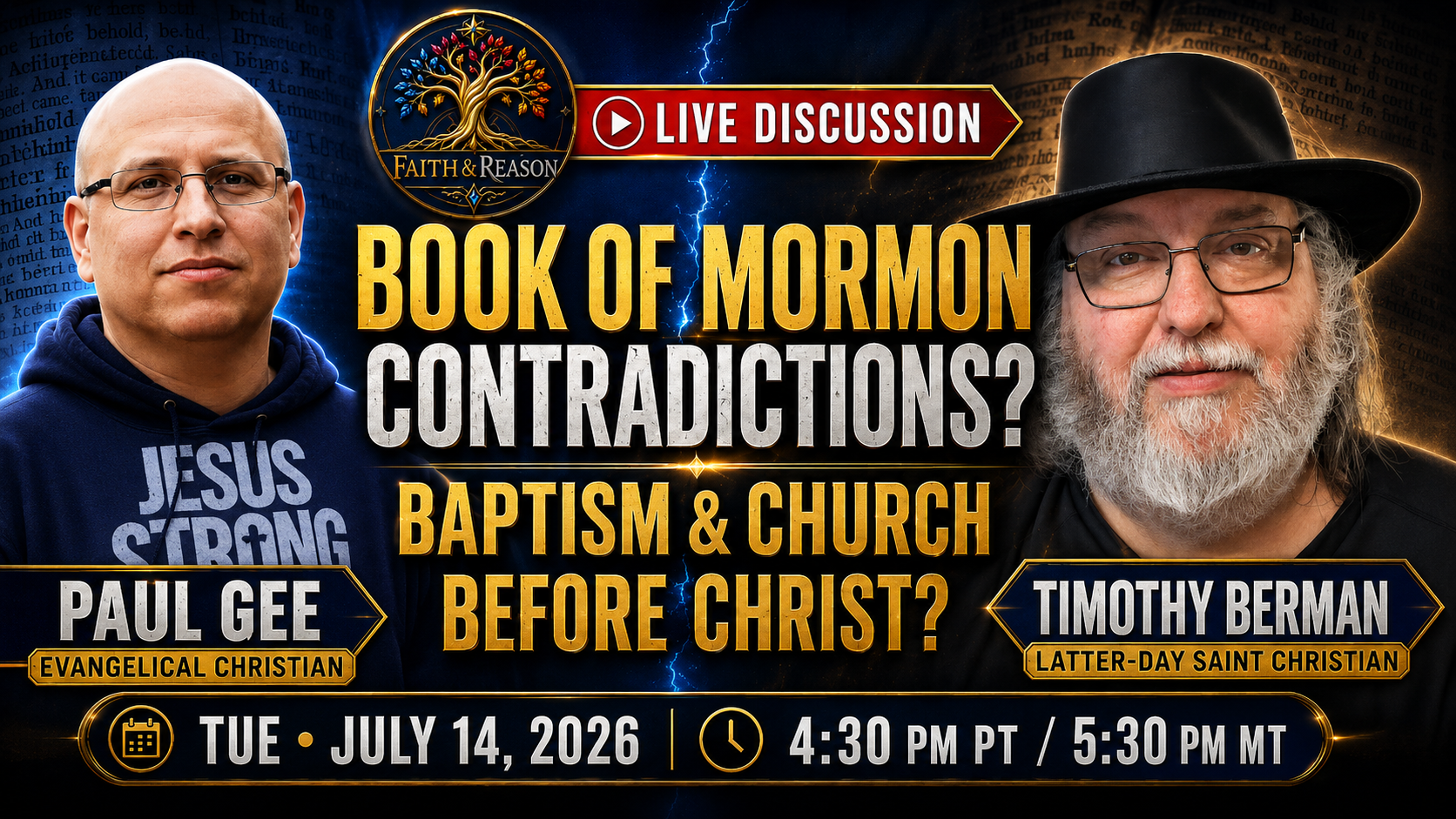
Book of Mormon Contradictions? Paul Gee and Timothy Berman Discuss Mosiah 18

Book of Mormon Contradictions? Paul Gee and Timothy Berman Discuss Mosiah 18

Tonight, Faith & Reason hosts a focused livestream discussion between Paul Gee and Timothy R. Berman examining one of the central arguments raised against the Book of Mormon: the claim that Mosiah 18 contains biblical and historical contradictions.

The discussion will stream live directly on this page.

Watch the Livestream

Date: July 14, 2026
Time: 4:30 PM Pacific / 5:30 PM Mountain
Participants: Paul Gee and Timothy R. Berman
Topic: Baptism and the Church in Mosiah 18

The livestream video is embedded below. The broadcast will begin automatically when the event goes live.

Sunday, July 12, 2026

He Trusted in the Lord: When Faith Is Challenged and Reform Becomes Necessary | Come Follow Me 2 Kings 16–25

He Trusted in the Lord: When Faith Is Challenged and Reform Becomes Necessary | Come Follow Me 2 Kings 16–25

Let's face the reality and truth: Our faith is going to be tested time and time again. Much of the time, there are going to be those seasons where our faith is not tested through seasons of silence. Instead, they are going to be tested through seasons where there are clamor and noise.

The Assyrian voice outside the wall is quite loud. The threat is very public. The accusation is calculated. And the enemy does not merely attack Jerusalem's defenses; the enemy attacks Jerusalem's confidence in God. I want to say this again: The enemy does not merely attack Jerusalem's defenses because the enemy attacks Jerusalem's confidence in God. This becomes a powerful tension in 2 Kings 16-25. For good reason, because the issue is not only whether Judah is capable of surviving Assyria or Babylon. The deeper question is whether God's people will trust the Lord when worldly power looks more practical than covenant faithfulness.

This week's Come Follow Me lesson, "He Trusted in the Lord God of Israel," places us in some of the darkest years of Israel and Judah's history. The Northern Kingdom is conquered and scattered by Assyria. Whereas the Southern Kingdom struggles with idolatry, compromise, fear, reform, and eventual destruction. Yet in the middle of spiritual rebellion and decline, two kings stand out: Kink Hezekiah, who trusted the Lord when Jerusalem was threatened, and King Josiah who seemed to turn to scripture and renew covenants when the Book of the Law was rediscovered. The latter resulting in what scholars refer to as the Deuteronomist Reform or the Josiah Reformation. Bridging first temple Judaism with the movement toward what will become the Second Temple era of Jewish history.

The contrast here is quite sobering as Ahaz looked to Assyria for security and compromised the First Temple - or Solomon's Temple. While Hezekiah seemed to turn to look unto the Lord and went to the temple in prayer. Josiah heard the scriptures, humbled himself, and led a reform that reshaped Jewish history and religious worship. Zedekiah rebelled and Babylon rose up - bringing destruction upon Jerusalem. It's destruction of the city and temple a fulfillment of prophecy the Jew's of First Temple Jerusalem refused to accept.

These chapters teach that trust is not something built upon sentimental optimism. Trust is built on covenantal loyalty while under pressure and enduring the refiner's fire.

Tuesday, July 7, 2026

Afflicted, Yet Highly Favored | Finding God’s Goodness in a Broken World — 1 Nephi 1

Afflicted, Yet Highly Favored | Finding God’s Goodness in a Broken World — 1 Nephi 1

What does it truly mean to be highly favored of God?

Many of us carry an underlying assumption that if we are faithful, life should become easier. We expect obedience to produce comfort, clarity, answered prayers, and protection from suffering. Yet Jesus never promised a life without hardship. He said, “In the world ye shall have tribulation,” but then added, “be of good cheer; I have overcome the world” (John 16:33). Nephi begins his record with this same tension. He had “seen many afflictions,” and yet he described himself as “highly favored of the Lord” (1 Nephi 1:1).

How can both be true?

Perhaps God’s favor is not proven by the hardships He prevents, but by His presence within the hardships we endure. Joseph was falsely accused and imprisoned, yet even there “the Lord was with Joseph, and shewed him mercy” (Genesis 39:20–21). Divine favor does not always mean receiving the life we hoped to have. Sometimes it means discovering the life God is forming within us through His goodness, grace, and sustaining presence.

Nephi does not deny or minimize his afflictions. Instead, he interprets them through his “great knowledge of the goodness and the mysteries of God” (1 Nephi 1:1).

That distinction matters.

Affliction was part of Nephi’s story, but it was not the final meaning of his story. As Paul later taught, tribulation can produce patience, experience, and hope because the love of God is poured into our hearts through the Holy Ghost (Romans 5:3–5).

First Nephi chapter 1 begins with affliction and divine favor, but it ends with faith and divine deliverance. Between those two declarations, Jerusalem receives a prophetic warning (1 Nephi 1:4). Lehi prays “with all his heart” on behalf of his people (1 Nephi 1:5). Heaven opens, revelation comes, and Lehi is called to testify of the Messiah and “the redemption of the world” (1 Nephi 1:19).

The people reject his message, mock him, and seek his life. Yet rejection does not have the final word. Nephi concludes by declaring that “the tender mercies of the Lord” are over those who exercise faith, making them mighty “unto the power of deliverance” (1 Nephi 1:20). Even God’s warnings reveal His mercy. The Lord declares that He takes no pleasure in destruction but desires that the wicked turn from their ways and live (Ezekiel 33:11). God warns because He loves. He confronts because He desires repentance, healing, and restoration.

God’s warnings are expressions of His mercy, and those who respond in faith will discover His power to deliver.

Today, we will walk through 1 Nephi chapter 1 and examine how Nephi interpreted his afflictions through God’s goodness and tender mercies.

We will see Lehi respond to a broken world with intercessory prayer rather than condemnation. We will examine how revelation led him to proclaim Jesus Christ and redemption. And we will discover why the rejection of God’s message could not overcome His power to preserve and deliver the faithful.

As we study, we must also ask ourselves: How are we interpreting our own afflictions? Are we measuring God’s goodness only by the circumstances we want Him to change? Could the correction or warning we are resisting actually be an expression of His mercy? Scripture does not promise that the righteous will avoid affliction. It declares, “Many are the afflictions of the righteous: but the Lord delivereth him out of them all” (Psalm 34:19).

God’s favor is not measured by the absence of hardship. It is revealed through His faithful presence, His goodness made known, and His sustaining mercy through every affliction. We may experience many afflictions and still be highly favored of the Lord. The hardship is real—but so are His tender mercies. And because His mercy is real, affliction does not have the final word.

Sunday, July 5, 2026

There Is a Prophet in Israel: When You Feel Surrounded, God Is Still Working | Come Follow Me 2 Kings 2–7

There Is a Prophet in Israel: When You Feel Surrounded, God Is Still Working | Come Follow Me 2 Kings 2–7

There were moments in my own life when the challenges seemed larger than the promise. The overall pressure felt immediate. Fear seemed quite rational. The surrounding issues seemed visible, measurable, and impossible to ignore. This is where Elisha's servant saw when he woke and found the city surrounded by horses and chariots. The servant's question was not dramatic, it is quite human: "Alas, my master! How shall we do?"

Elisha did not deny the reality of the danger. He did not pretend the army was not there. He simply saw more than the servant saw. His answer is one of the great faith-building declarations of scripture: "Fear not: for they that be with us are more than they that be with them." Elisha, then, prayed that the Lord will open the young man's eyes, and suddenly the mountain was filled with heavenly help. The issue had not changed, the servant's vision had.

This is the very heart of this week's Come Follow Me lesson in 2 Kings 2-7. The title of the lesson is, "There is a Prophet in Israel," and it walks us through the ministry of Elisha, the successor of Elijah. These chapters are filled with miracles: water healed, oil multiplied, a child raised, poisoned food purified, bread multiplied, Naaman cleansed, an ax head recovered, armies restrained, and prophetic words fulfilled. Yet the deeper message is not merely how miracles happened, nor how long ago they happened, because the deeper message is that the Lord still works through covenant faith, prophetic authority, humble obedience, and spiritual eyes that learn to see beyond fear and doubt.

The official Come Follow Me material notes that although Elisha's record does not preserve much of his direct teaching, his miracles testify of Christ's life-giving, nourishing, and healing power. These miracles point us to the Savior who raises, feeds, cleanses, restores, and opens up eyes. They invite us to ask the same prayer Elisha offered: Lord, open our eyes, that we may see.