Showing posts with label Sunday School Lessons. Show all posts

Sunday, September 6, 2026

Every Season Under Heaven: Ecclesiastes, Temple Covenants, and the Journey to Immortality

Every Season Under Heaven: Ecclesiastes, Temple Covenants, and the Journey to Immortality

Ecclesiastes is not Scripture’s surrender to meaninglessness. It is the wisdom of mortality—the testimony of a world east of Eden, where work exhausts, injustice wounds, pleasure fades, and death exposes the limits of every human attempt at permanence. Yet Qoheleth’s repeated word hebel is better pictured as vapor than as absolute nihilism: life “under the sun” is fleeting, elusive, and impossible to master. Through the poem of appointed times in Ecclesiastes 3, the book teaches disciples to receive mortal seasons as gifts they cannot control but can faithfully inhabit. Read within the full canon and through a Restoration lens, Ecclesiastes traces a temple-shaped movement from Edenic belonging, through mortal descent and covenant formation, toward judgment, resurrection, immortality, and life in Christ. Its final summons— “Fear God and keep his commandments”—does not solve every riddle. It teaches us how to live faithfully within them.

Some seasons arrive with invitations; others arrive with diagnoses, funerals, layoffs, broken trust, unanswered prayers, or the slow realization that the future will not look like the life we planned. We gladly quote, “A time to weep, and a time to laugh,” but the beauty of Ecclesiastes 3 can make us forget how severe the poem really is. It includes birth and death, planting and uprooting, healing and killing, embracing and separation, war and peace. Qoheleth is not decorating a calendar. He is naming the mortal world in which change is relentless and control is largely an illusion.

Ecclesiastes meets us precisely there. Its burden is not that nothing matters, but that nothing mortal can be made permanent by human grasping. Achievement cannot arrest death. Wealth cannot guarantee enjoyment. Wisdom cannot control outcomes. Even righteousness does not make mortality predictable. The Hebrew word hebel, traditionally rendered “vanity,” literally evokes breath or vapor: visible for a moment, real but ungraspable, present and already passing. Qoheleth dismantles the fantasy that we can secure eternal identity with temporary things.

That dismantling can become sacred preparation. When the false foundations collapse, the disciple can receive identity as covenant gift rather than personal construction. Ecclesiastes moves from Edenic echoes to dust, from dust to reverence, and from reverence toward divine judgment. Christian Scripture then answers Qoheleth’s deepest ache in the resurrected Christ, who entered the mortal descent, passed through death, and ascended in immortal glory. Restoration scripture widens that canonical horizon by locating earthly life between premortal belonging and resurrected continuation. Every season becomes neither random fate nor automatic blessing, but a mortal sphere in which agency, grace, covenant loyalty, and holy desire form a people capable of dwelling with God.

Ecclesiastes Is the Wisdom of Mortality

The 2026 Come, Follow Me manual places Proverbs and Ecclesiastes in productive tension. Proverbs often teaches that divine wisdom produces flourishing; Ecclesiastes replies that lived experience is not always so tidy. Qoheleth can devote himself to wisdom and still discover grief and “vexation of spirit” (Ecclesiastes 1:17–18). The manual therefore asks whether meaning is possible when life appears “vain, temporary, and uncertain,” and it answers by joining Ecclesiastes 12:13 to Proverbs 3:5: fear God, keep His commandments, and trust the Lord. Life with Christ is better, though mortality is not thereby made painless or predictable.

That distinction prevents two opposite misreadings. Ecclesiastes is neither a manifesto of atheistic despair nor a sentimental promise that every event will become pleasant if we wait long enough. It is wisdom spoken from within creaturely limits. The title identifies its speaker as Qoheleth, a term related to assembly and conventionally translated Teacher or Preacher. His royal Solomonic persona tests wisdom, pleasure, projects, wealth, reputation, and labor. Each experiment exposes the same boundary: human beings cannot produce lasting “gain” from beneath the sun because time, contingency, and death eventually take everything from their hands.

The phrase “under the sun” is therefore a crucial boundary marker. It names life as experienced from within the closed horizon of mortality. From that vantage point, generations come and go, the sun rises and sets, rivers run endlessly, memory disappears, and human striving circles back upon itself (Ecclesiastes 1:3–11). The world resembles Eden and yet is no longer Eden. Gardens can be planted, fruit enjoyed, marriage cherished, wisdom pursued, and work accomplished; nevertheless, thorns remain, sweat accompanies bread, domination distorts relationships, and everybody returns to dust. Ecclesiastes is the wisdom of Genesis 3 experienced from the inside.

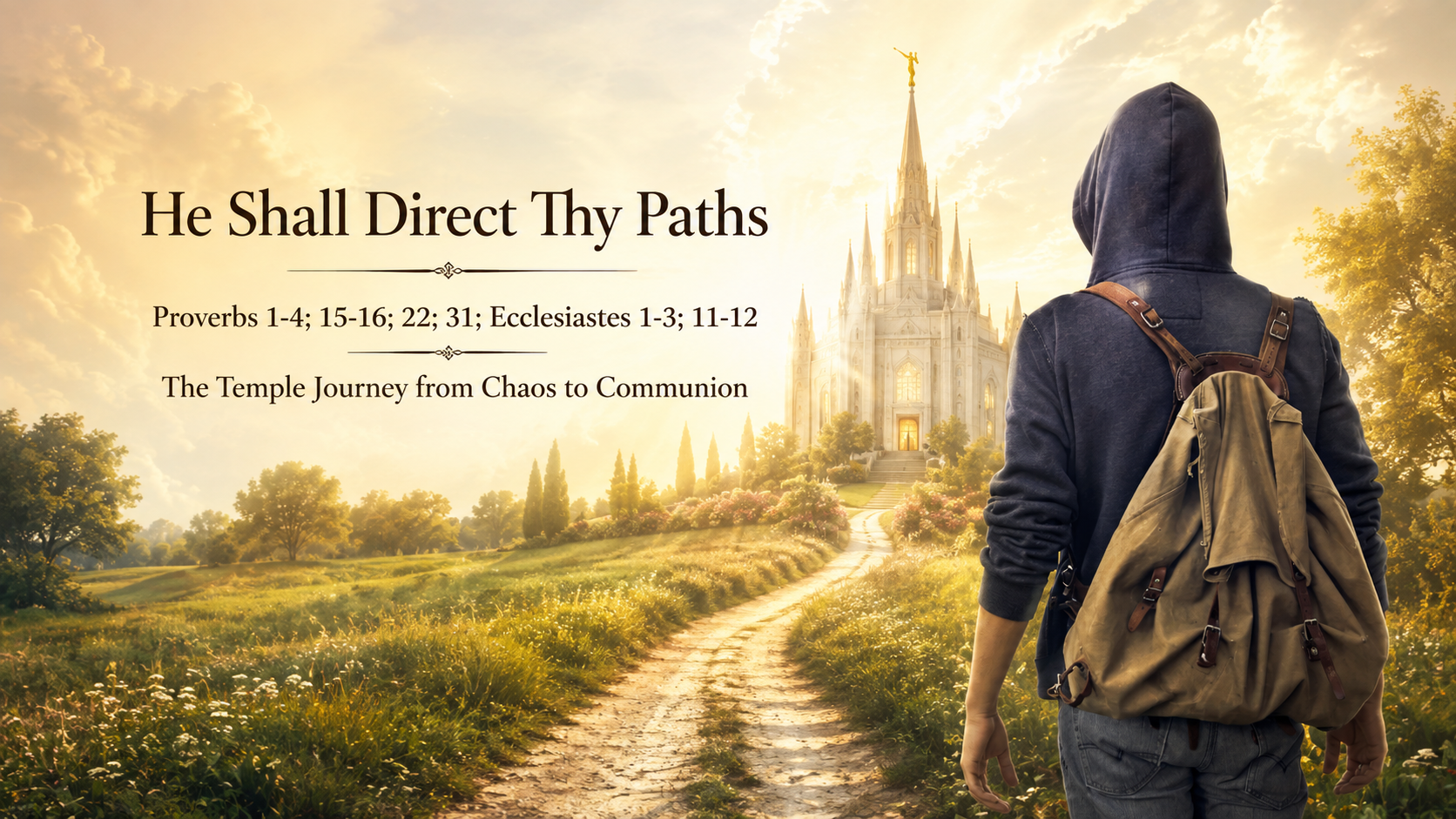
He Shall Direct Thy Paths: Proverbs & Ecclesiastes

He Shall Direct Thy Paths: Proverbs & Ecclesiastes

Proverbs 1-4; 15-16; 22; 31; Ecclesiastes 1-3; 11-12

The Temple Journey from Chaos to Communion

Proverbs teaches us how to walk wisely; Ecclesiastes asks whether wisdom is enough when life remains temporary, unfair, and beyond our control. Together, these books move the covenant disciple from moral formation to eternal perspective, from confidence in human calculation to reverent dependence upon God. Their unity is not a simplistic promise that righteous people will never suffer. It is the deeper testimony that life becomes rightly ordered when the Lord, rather than the isolated self, becomes its center.

This concluding study in the W.I.S.D.O.M. arc follows the appointed Come, Follow Me reading for September 7-13, 2026: Proverbs 1-4; 15-16; 22; 31 and Ecclesiastes 1-3; 11-12. Through Hebrew exegesis, Christ-centered exposition, Latter-day Saint scripture, and respected Jewish and Christian scholarship, we will trace a devotional temple movement from the two paths of wisdom and folly to the final summons to fear God, keep His commandments, and prepare for judgment. The destination is not intellectual mastery but communion: "Trust in the Lord with all thine heart ... and he shall direct thy paths" (Proverbs 3:5-6).

Introduction - When the Road Ahead Disappears

Most of us want God to give us a map. We want the next turn identified, the dangerous roads marked, and the destination guaranteed before we take the first step. Proverbs 3 offers something more demanding and more intimate. It does not promise that we will see the entire road. It promises that when we trust the Lord with the whole heart, refuse to make our own understanding the final authority, and know Him in all our ways, He will make the path straight before us.

That promise matters because discipleship is rarely lived on roads we fully understand. We make decisions with incomplete information. We pray through grief that has not resolved. We obey while consequences remain uncertain. We try to speak gently in a culture trained to reward outrage. We labor faithfully while Ecclesiastes reminds us that achievement, pleasure, wealth, reputation, and even human wisdom cannot defeat mortality. The human problem is not merely that we need better information. The deeper problem is that we are tempted to trust our own perspective as though it were complete.

Proverbs and Ecclesiastes meet us inside that tension. Proverbs says that creation possesses a moral grain: humility, diligence, fidelity, generosity, disciplined speech, and reverence ordinarily lead toward life. Ecclesiastes then refuses to let those observations harden into a mechanical formula. The wise still die. The righteous do not always receive immediate reward. Time overtakes every achievement. Much of life remains hevel - vaporous, fleeting, difficult to grasp. Biblical wisdom therefore matures when it moves beyond technique and becomes covenant trust.

This is why the final installment of our W.I.S.D.O.M. journey must end where the biblical books themselves end: not in admiration of the wise person, but in reverence before God. We have learned to Walk, Invite, Seek, Discern, Observe, and Meet. Each movement has carried us through the recurring wisdom pattern of descent and ascent: from Edenic estrangement into mortal confusion, from lament into remembrance, from self-reliance into surrender, and from the limits of human sight into the presence of the God who sees the whole way.

The 2026 Come, Follow Me manual wisely places Proverbs and Ecclesiastes in conversation. Proverbs teach that life is ordered by divine wisdom; Ecclesiastes asks what faithful life looks like when that order cannot be easily seen. Their combined witness is neither naive optimism nor cynical despair. It is covenant realism: life is temporary and often perplexing, yet it is lived before God, received as His gift, and made eternally significant through trust, obedience, repentance, and Jesus Christ.

Anchor Scripture - Proverbs 3:5-6

Trust in the Lord with all thine heart; and lean not unto thine own understanding.
In all thy ways acknowledge him, and he shall direct thy paths.

The movement of these verses is deliberate. Trust replaces self-sufficiency. The whole heart replaces divided allegiance. Knowing God in every way replaces the habit of confining Him to explicitly religious moments. The promise is not that God will endorse every route we prefer; it is that He will straighten the road of a life yielded to Him.

Sunday, August 23, 2026

"I Will Declare What He Hath Done for My Soul" | COME FOLLOW ME - OLD TESTAMENT 2026 | Psalms 49-86

"I Will Declare What He Hath Done for My Soul" | COME FOLLOW ME - OLD TESTAMENT 2026 | Psalms 49-86

The Temple Pattern of Descent, Ascent, and Exaltation in Israel's Hymnal of Redemption

"Come and hear, all ye that fear God, and I will declare what he hath done for my soul." - Psalm 66:16 KJV


This study reads the selected Psalms 49-86 as a canonical and theological journey through mortality, sin, lament, repentance, remembrance, redemption, and public witness. These poems do not form a single authored liturgy; they cross the boundary between Books II and III of the Psalter and include wisdom instruction, penitential prayer, individual and communal lament, historical recital, royal hope, and testimony. Read together, however, they trace a temple-shaped movement from estrangement toward the presence of God. Psalm 49 exposes the inability of wealth or human power to ransom life from death; Psalm 51 turns confession into a prayer for divine re-creation; Psalms 63, 69, and 77 give faithful language to abandonment and distress; Psalms 66, 71, and 78 transform remembered deliverance into covenant testimony; and Psalms 72, 85, and 86 direct personal restoration toward righteous kingship and Zion. The Book of Mormon intensifies this pattern in Alma 36, Alma 26, Alma 34, and Alma 42, where anguish gives way to joy through Jesus Christ and redeemed experience becomes missionary proclamation. The central claim is that biblical ascent does not deny descent. The worshipper rises by bringing mortality, guilt, fear, and unanswered questions into covenant relationship with the God who alone can redeem, cleanse, heal, and receive the soul. Psalm 66:16 therefore becomes more than a memorable line: it is the vocation of a redeemed people.

Scripture and method note. Biblical quotations follow the King James Version unless otherwise noted. This article distinguishes the psalms' ancient literary setting, their Christian canonical fulfillment in Jesus Christ, and their Latter-day Saint resonance. "Exaltation" is used first for being lifted into divine presence, covenant joy, and praise; restored doctrine gives that movement its fuller horizon in eternal life with God.

The Psalms as the Soul's Ascent Back to Eden

The soul does not merely want relief from pain. At its deepest level, it longs for the presence of God - for the wholeness, communion, and holy order represented by Eden. That longing is one reason the Psalms remain indispensable. They do not speak only from the summit of faith. They also pray from the pit, the wilderness, the sickbed, the battlefield, the guilty conscience, and the long night when God seems silent. The Psalter gives covenant people permission to bring the whole truth of mortal life into worship.

Calling the Psalms Israel's "temple hymnal" captures something essential, but it also requires care. Many psalms are rooted in sanctuary worship, sacrifice, procession, royal ceremony, pilgrimage, and public praise. Others may have begun in personal or communal crisis before being gathered for liturgical use. Sigmund Mowinckel emphasized the Psalms' setting in Israel's worship, while Claus Westermann stressed the dynamic relationship between lament and praise. James Luther Mays therefore describes the Psalms as both scripture and liturgy: ancient prayers that became the prayerbook of later communities (Mowinckel; Westermann; Mays).

The temple lens becomes especially fruitful when joined to the pattern of descent, ascent, and exaltation. The biblical sanctuary represents ordered creation and the divine dwelling among humanity; temple worship moves symbolically toward holiness and presence (Levenson 275-98). In the Psalms, that movement is often existential rather than architectural. The worshipper descends into fear, sin, mortality, exile, or confusion; ascends through remembrance, repentance, sacrifice, trust, and covenant appeal; and is lifted into renewed joy, praise, divine fellowship, and testimony. Walter Brueggemann's well-known categories of orientation, disorientation, and new orientation offer a closely related account of the spiritual world of the Psalter (Brueggemann).

This pattern does not mean that every psalm begins in Eden, passes through a fixed ritual sequence, and ends in triumph. Hebrew poetry resists mechanical outlines. Its parallel lines deepen, contrast, intensify, and sometimes destabilize one another. Yet across Psalms 49-86, a recurring theological grammar becomes visible: false securities fail, the soul cries out, God's mighty acts are remembered, mercy opens a path, and the redeemed worshipper declares what God has done. The result is a spiritual autobiography of redemption, not because all the psalms were written by one person, but because generations of worshippers can find their own descent and ascent within Israel's inspired songs.

Sunday, August 16, 2026

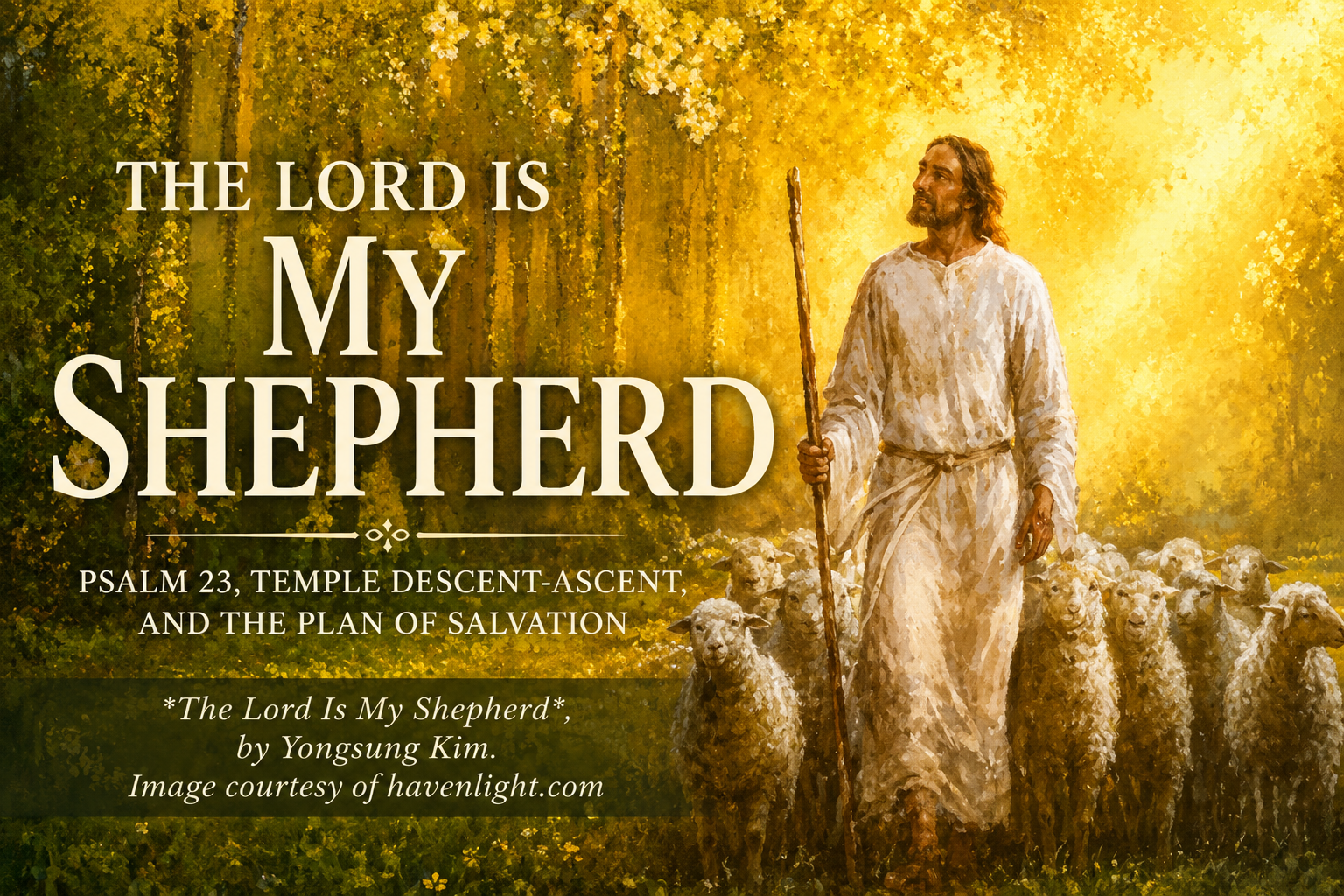
"The Lord Is My Shepherd": Psalm 23, Temple Descent-Ascent, and the Plan of Salvation

"The Lord Is My Shepherd": Psalm 23, Temple Descent-Ascent, and the Plan of Salvation

A Come, Follow Me Study for August 17-23, 2026: Psalms 1-2; 8; 19-33; 40; 46

"For thou art with me." - Psalm 23:4

Most of us first learned Psalm 23 as a psalm of comfort. We hear it at funerals, repeat it in hospital rooms, and reach for it when grief has stripped life down to its most difficult questions. That use is neither accidental nor misplaced. Yet Psalm 23 does more than assure us that God will remain near when we die. It poetically traces an entire journey: the Lord provides, restores, guides, accompanies, protects, welcomes, anoints, and finally brings the worshipper into His house.

That movement makes Psalm 23 especially meaningful for Latter-day Saints. Its imagery can be read as a temple-shaped journey from ordered life into mortal darkness and then upward into covenant fellowship and the presence of God. Read within the immediate sequence of Psalms 22-24, the pattern becomes even more striking: lament and suffering in Psalm 22, the Shepherd's presence in Psalm 23, and ascent to the holy hill with the King of glory in Psalm 24. Nancy deClaissé-Walford's intertextual study similarly argues that these three neighboring psalms form a powerful statement of trust when read together (deClaissé-Walford 139-52).

This interpretation requires one careful qualification. Psalm 23 is not demonstrably a word-for-word transcript of an ancient Israelite temple ceremony, and the full Latter-day Saint plan of salvation should not be projected backward into every Hebrew phrase as though the psalmist were writing a systematic doctrinal manual. Psalm 23 is commonly classified as a psalm of trust or confidence, while a pilgrimage setting that culminates at the temple remains a respected scholarly proposal rather than an uncontested conclusion (Smith 61-66; Tappy 255-80). The temple and plan-of-salvation reading offered here is therefore a disciplined canonical and theological synthesis: it begins with what the Hebrew poem says, follows the intertextual patterns the Psalter supplies, reads the psalm through Jesus Christ, and then asks how Restoration scripture enlarges its hope.

What Come, Follow Me Actually Assigns for August 17-23

The official 2026 reading is often abbreviated as "Psalms 1-46," but the assigned passages are selections rather than every chapter in that range: Psalms 1-2; 8; 19-33; 40; and 46. The manual invites readers to notice the Psalms' vivid images of the Savior, including the green pastures, still waters, rod, staff, and overflowing cup of Psalm 23. It then connects Psalm 24's "hill of the Lord" with the temple and with preparation to enter the presence of God (Come, Follow Me).

The broader three-week schedule is also selective. August 24-30 covers Psalms 49-51; 61-66; 69-72; 77-78; and 85-86, while August 31-September 6 covers Psalms 102-103; 110; 116-119; 127-128; 135-139; and 146-150. Keeping the actual readings clear strengthens the study because it allows Psalm 23 to function as the focal text for this week without forcing an artificial structure onto every psalm from 1 through 46.

Sunday, August 9, 2026

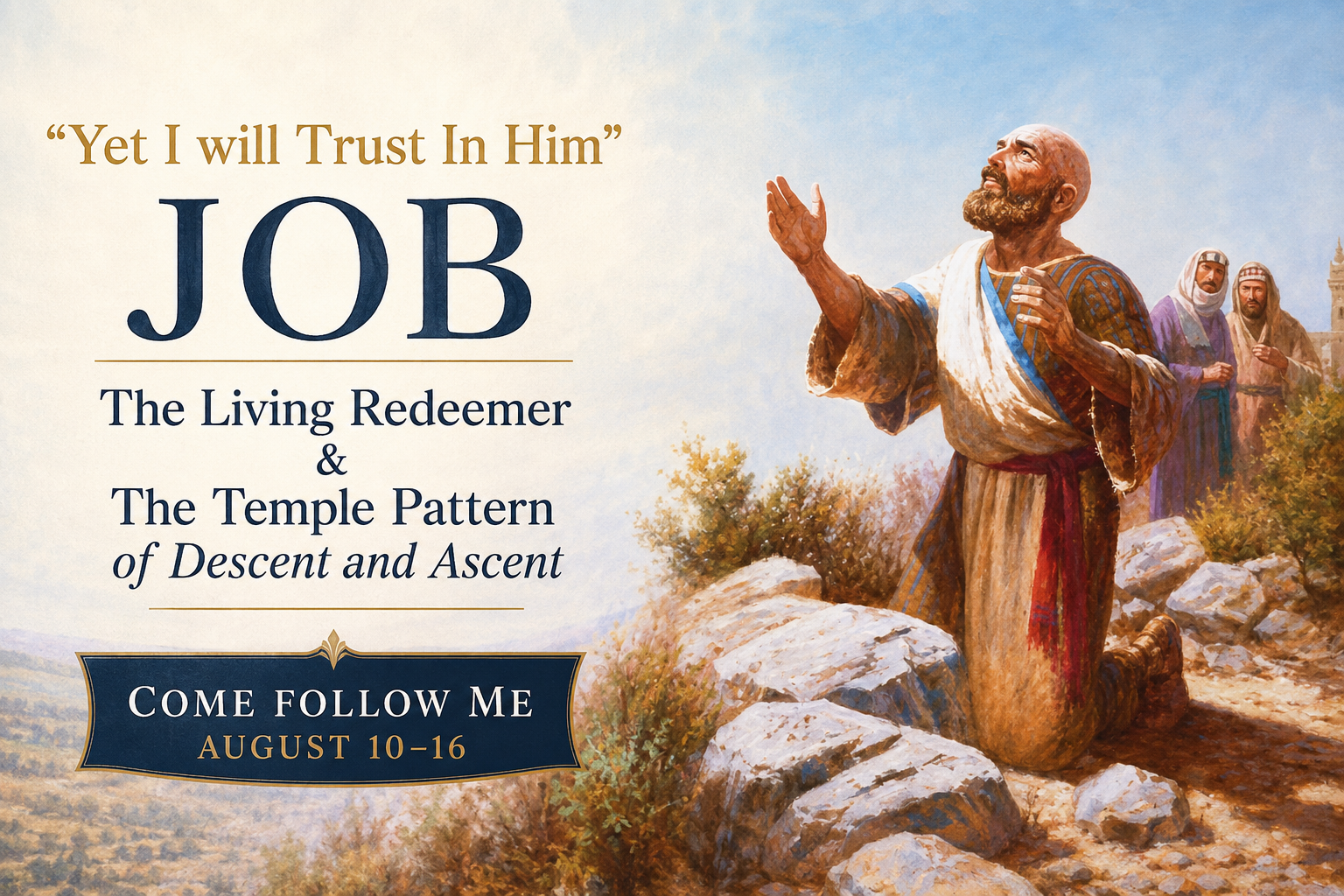
"Yet Will I Trust in Him": Job, the Redeemer, and the Temple Pattern of Descent and Ascent

"Yet Will I Trust in Him": Job, the Redeemer, and the Temple Pattern of Descent and Ascent

How suffering, covenant faithfulness, divine perspective, and restoration reveal the plan of salvation

What do we do when life falls apart—not because we have walked away from God, but while we are doing our best to remain faithful to Him? What do we say when prayer does not immediately change the diagnosis, restore the relationship, return what was lost, or explain why a righteous person has been permitted to suffer? Those questions are not signs of spiritual failure. They are among the deepest questions of mortality, and the book of Job refuses to answer them with a slogan.

Job is not a story about a man who never struggled. He grieved, protested, questioned, and pleaded for God to answer him. He described himself as stripped of glory, surrounded by darkness, abandoned by loved ones, and unable to find the God he still longed to meet. Yet his anguish never became indifference. Job kept turning toward God, even when he could not understand God. His questions and his faith occupied the same ash heap.

That is the spiritual tension at the heart of the 2026 Come, Follow Me lesson on Job. The manual emphasizes that faith in Job is questioned and tested without being completely abandoned. Not every question receives an explanation, but questions can coexist with faith. Job therefore becomes more than a case study in the problem of evil. He becomes a witness of what covenant trust looks like when familiar answers no longer seem adequate.

Read as a whole, Job is a temple-shaped wisdom drama of descent, covenant testing, divine encounter, intercession, and restoration. Its movement carries Job from abundance into ashes, from ashes into argument, from argument toward a living Redeemer, and from limited mortal understanding into the presence of God. The book does not merely ask, “Why do righteous people suffer?” It presses us toward a more searching question: How does a covenant disciple remain faithful until God reveals a larger perspective through the living Redeemer?

How Should We Read the Book of Job?

The first step in responsible expository teaching is to respect the kind of literature we are reading. Job begins with a prose prologue in chapters 1–2, moves into an extended poetic body in chapters 3–41, and returns to prose in the concluding portion of chapter 42. Within the poetic core are Job’s lament, three cycles of debate with Eliphaz, Bildad, and Zophar, Job’s extended defense, the speeches of Elihu, and the Lord’s response from the whirlwind. This carefully arranged structure is one reason Job should not be read as if it were a modern courtroom transcript.

The Religious Studies Center essay “Hast Thou Considered My Servant Job?” acknowledges both the possible historical foundation of Job and the book’s evident literary shaping. Modern scholarship commonly classifies Job as wisdom literature, but that label does not exhaust the book. Will Kynes notes that Job can also be read through the lenses of lament, drama, controversy dialogue, lawsuit, exemplary sufferer narrative, epic, prophecy, and apocalyptic literature. Carol A. Newsom describes the book as a contest of moral imaginations because Job and his interlocutors do not simply exchange information; they present competing visions of God, justice, suffering, and human righteousness.

This literary awareness also helps us understand the heavenly scene in Job 1–2. The Come, Follow Me manual explains that these chapters poetically emphasize Satan’s role as adversary or accuser and should not be treated as a literal transcript of a conversation between God and Satan. The scene reveals the theological issue driving the drama: Is Job’s devotion genuine, or is it merely the price he pays for prosperity and protection? The question is not only whether Job will survive suffering. The question is whether worship can remain worship when the expected rewards disappear.

Catherine Petrany sharpens this literary observation by attending to the Hebrew expression ha-satan, “the adversary” or “the accuser.” The definite article makes the expression function like a title rather than a personal name. Within Job’s ancient heavenly-court scene, this figure roams, investigates, and prosecutes a case; he is not yet portrayed with every feature that later Jewish and Christian texts associate with the Devil. That historical distinction explains the role this character plays in Job without requiring Latter-day Saint readers to discard restored teachings about Satan’s premortal rebellion. The disciplined approach is to let Job’s prologue define the accuser’s narrative function, then let the wider canon supply additional doctrine without forcing all later details back into two poetic chapters.

To call Job a wisdom drama, or even to recognize mythic and liturgical dimensions in it, is not to call it false. In biblical studies, mythic can describe a narrative’s use of cosmic imagery, creation symbolism, heavenly councils, chaos creatures, and archetypal conflict. Liturgical can describe patterns of mourning, petition, divine encounter, sacrifice, and restored communion. Those categories help us see how Job’s personal anguish is placed within a cosmic frame without requiring us to deny that the story may preserve the memory of a real righteous sufferer.

Saturday, August 8, 2026

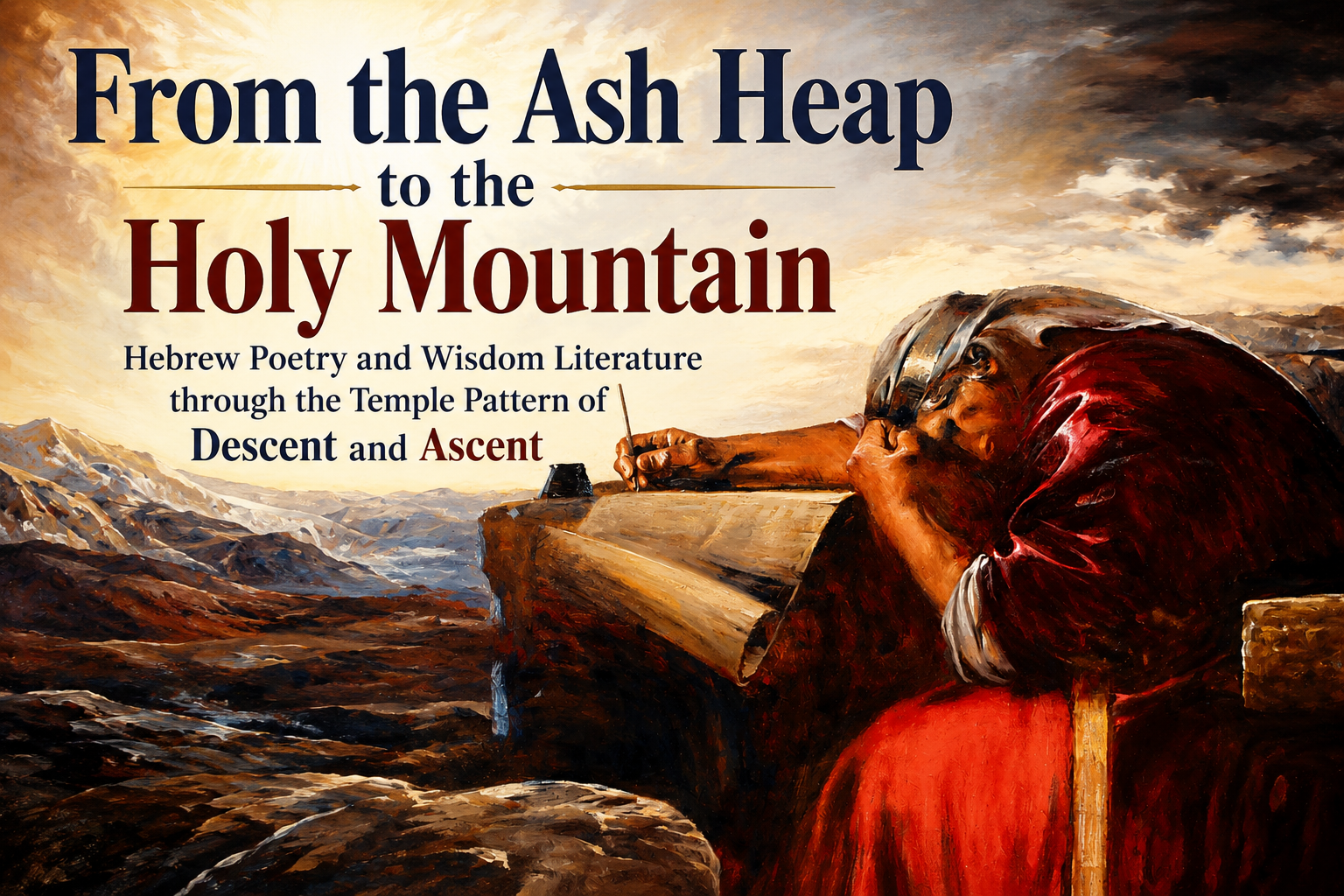
From the Ash Heap to the Holy Mountain: Hebrew Poetry and Wisdom Literature through the Temple Pattern of Descent and Ascent

From the Ash Heap to the Holy Mountain: Hebrew Poetry and Wisdom Literature through the Temple Pattern of Descent and Ascent

A Come, Follow Me introduction to Job, Psalms, Proverbs, and Ecclesiastes

Job, Psalms, Proverbs, and Ecclesiastes do not offer one flat explanation of faithful life. They give us an inspired conversation. Job protests any theology that reduces suffering to a predictable equation. The Psalms teach covenant Israel to pray through joy, guilt, abandonment, fear, gratitude, and praise. Proverbs forms moral perception by training the disciple to fear the Lord and choose wisdom over folly. Ecclesiastes exposes the vapor-like instability of mortal achievement and the limits of human control. Read together, these books move repeatedly from order into disorientation and from disorientation toward a renewed, humbler communion with God.

This study proposes the temple pattern of descent and ascent as a theological and devotional framework for that movement. Descent names mortality, estrangement, lament, disorder, and the collapse of false certainty. Ascent names purification, covenant formation, divine instruction, unveiled perspective, and renewed presence. The framework is grounded most directly in the temple setting of many Psalms—especially Psalm 24—but it should not be mistaken for a claim that Job, Proverbs, and Ecclesiastes were all composed as a single temple ritual. Instead, it is a canonical, Christ-centered reading that brings the wisdom books into conversation with Israel’s worship, the plan of salvation, and the Latter-day Saint journey back into God’s presence. The W.I.S.D.O.M. arc developed below provides the series structure: Walk, Invite, Seek, Discern, Observe, and Meet.

Sunday, August 2, 2026

Esther and the Pattern of Covenant Deliverance

Esther and the Pattern of Covenant Deliverance

Preserving God’s Covenant People Through Hidden Providence

By Jessica Shipp (@ChristPearls), with companion devotional and editorial contributions by Timothy R. Berman

Editor's Note: Jessica Shipp contributed the primary article, biblical character study, and chapter-by-chapter summary. Timothy R. Berman contributed the E.S.T.H.E.R. acrostic, devotional applications, additional reflections, and editorial presentation for Faith & Reason.

The Book of Esther occupies a unique place in Scripture. Unlike every other biblical book, God’s name never appears explicitly in its pages. Yet His presence is everywhere. Rather than revealing Himself through miracles or prophetic declarations, the Lord works quietly through ordinary people, ordinary decisions, and seemingly ordinary events. The story invites us to look beyond coincidence and recognize the unseen hand of providence guiding history according to His covenant purposes.

The historical setting is equally significant. More than a century after the Babylonian exile, many Jews had returned to Jerusalem under Zerubbabel, Ezra, and Nehemiah, but countless others remained scattered throughout the Persian Empire. Living among the nations, they preserved their covenant identity while existing within a foreign culture. At precisely this moment, Haman obtains a royal decree ordering the destruction of every Jew in the empire:

“To destroy, to kill, and to cause to perish, all Jews, both young and old, little children and women, in one day…” (Esther 3:13)

This is far more than a political crisis. The covenant people themselves stand under a sentence of death. Once again, God’s promises appear to hang by a thread. Yet this pattern is familiar throughout Scripture. Pharaoh sought to destroy Israel’s sons. Athaliah attempted to eradicate the royal seed of David. Herod sought the life of the infant Messiah. Time and again, when God’s covenant purposes seem threatened, He raises faithful men and women whose courage preserves His people until His greater purposes unfold. Esther belongs to that pattern.

Sunday, July 26, 2026

“I Am Doing a Great Work”: Stay on the Wall and Finish What God Called You to Do

“I Am Doing a Great Work”: Stay on the Wall and Finish What God Called You to Do

“I Am Doing a Great Work”

Stay on the Wall and Finish What God Called You to Do
Come, Follow Me—July 27–August 2 | Ezra 1; 3–7; Nehemiah 2; 4–6; 8


There are some distractions that do not look dangerous because they look quite reasonable. 

They arrive as invitations, conversations, controversies, urgent notifications, unexpected opportunities, and demands for our immediate attention. They ask us to take a moment and step away from what God may have placed before us - not necessarily forever, just long enough for us to lose our concentration and focus. 

This was the very strategy used against Nehemiah. 

Nehemiah’s enemies did not begin by openly commanding him to abandon the rebuilding of Jerusalem. Instead, they repeatedly invited him to leave the work and meet them in the plain of Ono. Such a proposal sounded quite diplomatic; however, Nehemiah recognized the deception beneath. He was able to discern and understood that not every invitation deserved an answer. Nor every controversy deserved his attention and presence. 

His response has become one of the most significant and clearest declarations of spiritual focus in scripture: “I am doing a great work, so that I cannot come down” (Nehemiah 6:3). Nehemiah was not boasting about his personal importance. What he did is declare the significance of the assignment - or calling - God had entrusted to him. More to the point, Nehemiah took seriously the stewardship of what God called him to accomplish. 

The wall was more than stone and timber. Jerusalem’s restoration represented covenant renewal, spiritual protection, communal identity, temple worship, and the fulfillment of God’s promises. 

This week’s Come Follow Me Study for the Old Testament is about more than rebuilding a temple or repairing a city wall. It is regarding how we are open and willing to recognize the work God has placed before each of us, resisting whatever pulls us away from it, and trusting that the Lord will strengthen our hands as we remain faithful and obedient to His will, purpose, and plans. 

Sunday, July 19, 2026

When You Don’t Know What to Do, Keep Your Eyes on God | 2 Chronicles 14–20; 26; 30

When You Don’t Know What to Do, Keep Your Eyes on God | 2 Chronicles 14–20; 26; 30

Come, Follow Me — July 20–26, 2026: “Our Eyes Are Upon Thee”

What do you do when the opposition is greater than your strength, the pressure is greater than your wisdom, and you honestly do not know what to do next?

This week’s Come, Follow Me study takes us into the lives of kings, prophets, reformers, worshippers, and ordinary families who faced that very question. Their stories reveal that peace does not come from pretending the battle is small. It comes from knowing where to turn when the battle is bigger than you.

Through the accounts of Asa, Micaiah, Jehoshaphat, Uzziah, and Hezekiah, 2 Chronicles invites us to examine where we place our trust, how we respond to correction, and whether our eyes remain fixed upon the Lord when fear, success, pride, or division threaten to pull them away. Each of these figures faced formidable challenges—be it external armies, internal strife, or the temptations of power—and their responses provide valuable lessons for our own lives.

Asa, for instance, shows how reliance on God in times of trouble can lead to unexpected victories, while Micaiah reminds us of the importance of courage in standing for truth, even in the face of overwhelming opposition. Jehoshaphat’s alliance-building and pursuit of divine guidance highlight the significance of seeking God's will in decision-making, especially when circumstances seem dire. Uzziah's rise to power illustrates the fine line between humility in success and the dangers of pride, reminding us that acknowledgment of our dependence on God is crucial. Lastly, Hezekiah's prayer in times of crisis demonstrates that sincere reliance on divine help can yield miraculous outcomes.

This week's study encourages us to reflect deeply on our own lives. When confronted with overwhelming pressure, do we allow our fears to overshadow our faith? Are we quick to seek advice from sources that may not align with our beliefs? Or do we, like these biblical figures, turn our attention steadfastly to God, trusting that He will guide us through our fiercest battles? Through these narratives, we learn that true peace comes from steadfast faith and a commitment to seek God's wisdom relentlessly, no matter how insurmountable the obstacles may appear.

Sunday, July 12, 2026

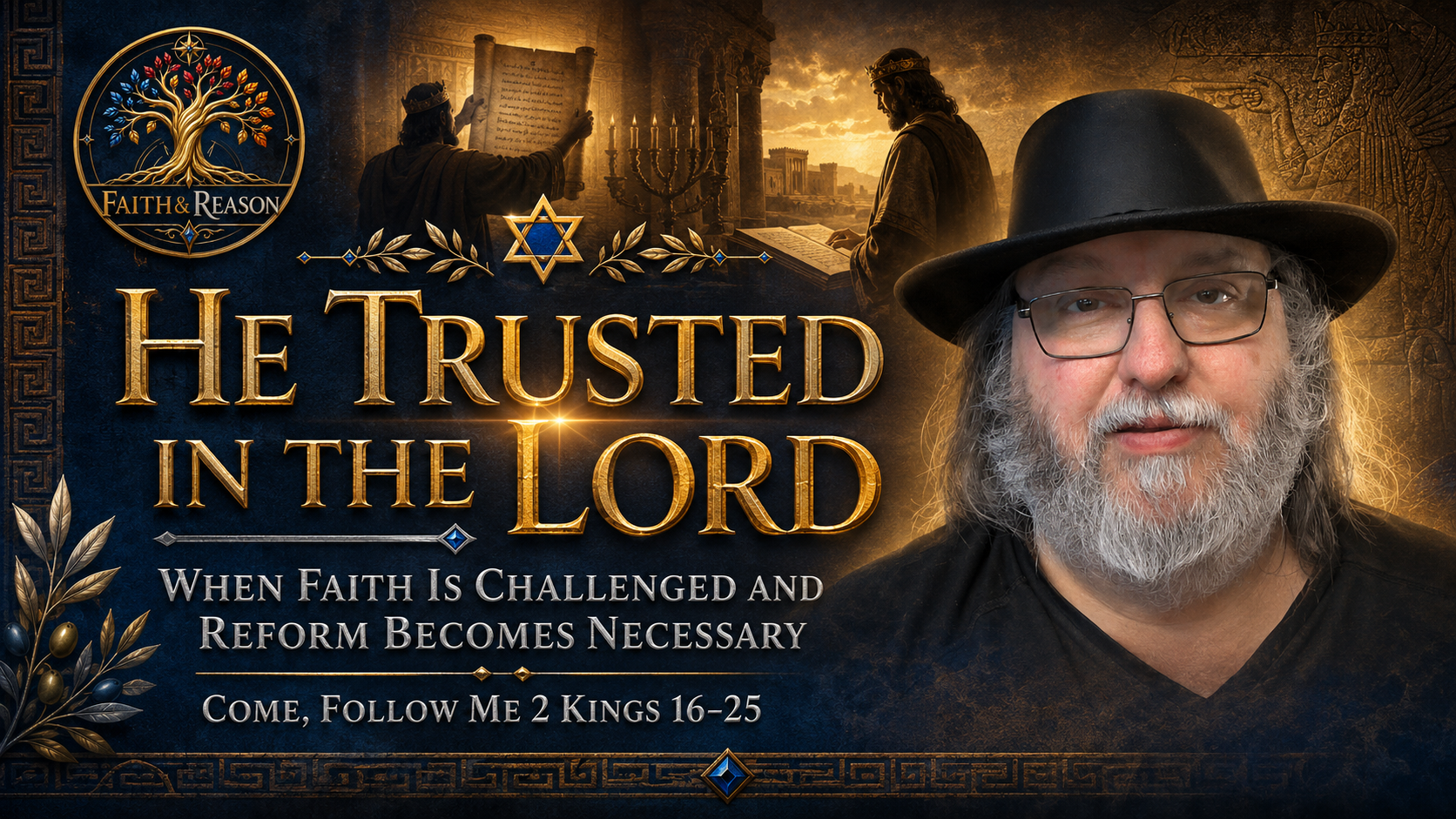
He Trusted in the Lord: When Faith Is Challenged and Reform Becomes Necessary | Come Follow Me 2 Kings 16–25

He Trusted in the Lord: When Faith Is Challenged and Reform Becomes Necessary | Come Follow Me 2 Kings 16–25

Let's face the reality and truth: Our faith is going to be tested time and time again. Much of the time, there are going to be those seasons where our faith is not tested through seasons of silence. Instead, they are going to be tested through seasons where there are clamor and noise.

The Assyrian voice outside the wall is quite loud. The threat is very public. The accusation is calculated. And the enemy does not merely attack Jerusalem's defenses; the enemy attacks Jerusalem's confidence in God. I want to say this again: The enemy does not merely attack Jerusalem's defenses because the enemy attacks Jerusalem's confidence in God. This becomes a powerful tension in 2 Kings 16-25. For good reason, because the issue is not only whether Judah is capable of surviving Assyria or Babylon. The deeper question is whether God's people will trust the Lord when worldly power looks more practical than covenant faithfulness.

This week's Come Follow Me lesson, "He Trusted in the Lord God of Israel," places us in some of the darkest years of Israel and Judah's history. The Northern Kingdom is conquered and scattered by Assyria. Whereas the Southern Kingdom struggles with idolatry, compromise, fear, reform, and eventual destruction. Yet in the middle of spiritual rebellion and decline, two kings stand out: Kink Hezekiah, who trusted the Lord when Jerusalem was threatened, and King Josiah who seemed to turn to scripture and renew covenants when the Book of the Law was rediscovered. The latter resulting in what scholars refer to as the Deuteronomist Reform or the Josiah Reformation. Bridging first temple Judaism with the movement toward what will become the Second Temple era of Jewish history.

The contrast here is quite sobering as Ahaz looked to Assyria for security and compromised the First Temple - or Solomon's Temple. While Hezekiah seemed to turn to look unto the Lord and went to the temple in prayer. Josiah heard the scriptures, humbled himself, and led a reform that reshaped Jewish history and religious worship. Zedekiah rebelled and Babylon rose up - bringing destruction upon Jerusalem. It's destruction of the city and temple a fulfillment of prophecy the Jew's of First Temple Jerusalem refused to accept.

These chapters teach that trust is not something built upon sentimental optimism. Trust is built on covenantal loyalty while under pressure and enduring the refiner's fire.

Sunday, July 5, 2026

There Is a Prophet in Israel: When You Feel Surrounded, God Is Still Working | Come Follow Me 2 Kings 2–7

There Is a Prophet in Israel: When You Feel Surrounded, God Is Still Working | Come Follow Me 2 Kings 2–7

There were moments in my own life when the challenges seemed larger than the promise. The overall pressure felt immediate. Fear seemed quite rational. The surrounding issues seemed visible, measurable, and impossible to ignore. This is where Elisha's servant saw when he woke and found the city surrounded by horses and chariots. The servant's question was not dramatic, it is quite human: "Alas, my master! How shall we do?"

Elisha did not deny the reality of the danger. He did not pretend the army was not there. He simply saw more than the servant saw. His answer is one of the great faith-building declarations of scripture: "Fear not: for they that be with us are more than they that be with them." Elisha, then, prayed that the Lord will open the young man's eyes, and suddenly the mountain was filled with heavenly help. The issue had not changed, the servant's vision had.

This is the very heart of this week's Come Follow Me lesson in 2 Kings 2-7. The title of the lesson is, "There is a Prophet in Israel," and it walks us through the ministry of Elisha, the successor of Elijah. These chapters are filled with miracles: water healed, oil multiplied, a child raised, poisoned food purified, bread multiplied, Naaman cleansed, an ax head recovered, armies restrained, and prophetic words fulfilled. Yet the deeper message is not merely how miracles happened, nor how long ago they happened, because the deeper message is that the Lord still works through covenant faith, prophetic authority, humble obedience, and spiritual eyes that learn to see beyond fear and doubt.

The official Come Follow Me material notes that although Elisha's record does not preserve much of his direct teaching, his miracles testify of Christ's life-giving, nourishing, and healing power. These miracles point us to the Savior who raises, feeds, cleanses, restores, and opens up eyes. They invite us to ask the same prayer Elisha offered: Lord, open our eyes, that we may see.

Sunday, June 28, 2026

Rehoboam's Pride, Elijah's Fire & the Voice You're Missing | 1 Kings 12-13; 17–22 CFM

Rehoboam's Pride, Elijah's Fire & the Voice You're Missing | 1 Kings 12-13; 17–22 CFM

Choose This Day: Finding Christ in the Divided Kingdoms of Our Lives

Quite frankly, I am grateful for the many people who have come into my life and spoken to me directly, compassionately, and with genuine understanding. They showed patience and grace without sitting in judgment over me. They met me in difficult and messy moments, listened to what I was carrying, and helped me confront unhealthy attitudes and behaviors without condemning me.

Yet, if I am completely honest, I have also carried resentment, bitterness, self-hatred, and anger toward people whom I believed had betrayed, ignored, or abandoned me.

Every one of us is shaped—lifted, wounded, strengthened, or misled—by the voices we choose to follow.

Families may rise or fall because of those voices. Communities may flourish or fracture because of them. Our faith may deepen or drift depending on whose counsel we trust and whose influence we permit to guide our decisions.

Much of the pain we carry may be traced to someone who used influence selfishly—or to someone who possessed the ability to help but refused to use it.

The opposite is also true.

Some of the deepest healing we experience comes through Christlike leaders, mentors, friends, and disciples who choose to show up, serve, and sacrifice. They meet us in places where others might pass by. They take time to understand, comfort, encourage, and help us move forward without excusing destructive behavior or enabling us to remain stuck.

That tension between selfish influence and Christlike service stands at the heart of this week’s Come, Follow Me study for June 29–July 5: “If the Lord Be God, Follow Him,” covering 1 Kings 12–13 and 17–22.

Sunday, June 14, 2026

The Battle Is the Lord’s: Facing Your Goliath with Faith in Jesus Christ

The Battle Is the Lord’s: Facing Your Goliath with Faith in Jesus Christ

Come Follow Me | June 15-21 | “The battle is the Lord’s.” —1 Samuel 17:47

There are seasons in life when the challenge standing before us seems larger than our faith, stronger than our resolve, and better equipped than anything we possess. We may know the language of faith, remember the promises of scripture, and sincerely believe that God is with us, yet the giant still appears to dominate the valley. It calls attention to our weakness, rehearses our failures, magnifies our fears, and confidently predicts our defeat.

For one person, that giant may be addiction or the relentless temptation to return to an old way of living. For another, it may be grief, rejection, loneliness, financial uncertainty, family conflict, shame, resentment, or the lingering consequences of decisions that cannot be undone. Some giants appear suddenly, while others have occupied the valley for years, issuing the same challenge every morning and evening until fear begins to feel like the natural condition of life.

The Come, Follow Me lesson for June 15–21, covering 1 Samuel 17–18; 24–26 and 2 Samuel 5–7, invites us to look again at David’s story and hear his declaration that “the battle is the Lord’s.” That declaration does not mean our participation is unnecessary, nor does it promise that discipleship will protect us from every difficulty. David still walked into the valley, selected the stones, prepared his sling, and confronted the enemy. What he refused to do was accept the assumption that the outcome depended entirely upon his own size, strength, resources, or experience.

David understood that he was participating in a battle whose final authority belonged to God.

That same truth can transform the way we approach our spiritual battles today. We do not have to pretend that our giants are small. We do not have to deny the pain, complexity, or danger of what stands before us. Faith does not require us to minimize reality; it teaches us to see reality within the greater reality of God’s power, covenant faithfulness, and redemptive purposes.

Tuesday, April 28, 2026

Our Heavenly Family: What the Gospel Teaches About Premortal Life and the Plan of Progression

Our Heavenly Family: What the Gospel Teaches About Premortal Life and the Plan of Progression

What if your identity didn’t start at birth—but before time as you know it?

Culture and society constantly attempt to define you by your past, your struggles, or your achievements, the restored gospel of Jesus Christ offers a radically different foundation: you are not an accident—you are a child of God.

This truth sits at the very heart of Latter-day Saint belief and shapes everything from purpose to destiny. If you’ve ever wondered, Who am I? Why am I here? Where am I going? —this doctrine answers all three with clarity, hope, and eternal perspective. Understanding this inherent identity offers comfort amidst life's challenges and reassures you that your existence is meaningful and intentional.

The idea that your identity predates your mortal experience invites a profound reflection on the nature of your soul. It posits that you were known to God before the foundation of the world, reinforcing a sense of belonging that transcends earthly definitions. This foundational belief encourages individuals to look beyond transient labels and societal expectations, fostering a deeper connection with the divine.

In this post, we’ll walk through the doctrine of our Heavenly Family as taught in Chapter 2 of the Gospel Principles manual—unpacking it through scripture, thoughtful explanation, and real-life application. We will explore how viewing yourself as a beloved child of Heavenly Parents impacts your day-to-day life, the decisions you make, and the way you interact with others. By examining scripture, we’ll delve into key passages that illuminate your divine lineage and help you internalize the powerful message that you are part of a larger, eternal family.

Join us as we navigate these teachings together, uncovering the significance of your eternal identity and how it serves as a guiding light through trials and triumphs alike. Through this exploration, may you gain a renewed perspective on your divine worth and a deeper understanding of your eternal purpose.

Friday, April 3, 2026

The Ten Plagues of Egypt: A Typology of Mortality, Sin, Death, and Resurrection

The Ten Plagues of Egypt: A Typology of Mortality, Sin, Death, and Resurrection

When most people think of the Ten Plagues, they imagine frogs, flies, and fire raining down. However, the plagues were never random acts of divine wrath. Instead, they served as a spiritual roadmap — revealing what happens when humanity turns away from God, and how God still works to redeem His people. Each plague acts as a mirror. It reflects something about us, the world we inhabit, and the God who refuses to leave us trapped in bondage. When you connect the plagues with Genesis, the Gospels, Revelation, and even the Book of Mormon, a clear pattern appears — a cycle of descent, judgment, mercy, and ascent.

The plagues are not merely ancient events. They symbolize the human condition — mortality, sin, corruption, spiritual darkness, and ultimately death. They also represent deliverance — the Lamb, the Light, the Firstborn Son, the Passover, the Exodus, and the path toward resurrection. This is the reason the plagues resonate throughout scripture: in John’s Apocalypse, the Nephites’ cycles of destruction, the fall of Jerusalem, and the ultimate gathering of Israel. The plagues are one of many scriptural apocalypse.

I want to invite you as we take a moment to examine each plague in depth — the gods they challenged, the creation they overturned, and the Christ they foreshadowed. Hopefully you might see how each plague breaks down false systems, uncovers spiritual sickness, and unveils aspects of the gospel.

And I want us to take a broader view. By doing so, I want to show how the entire structure of the ten plagues forms the core of biblical prophecy, temple theology, covenant ascent, and God’s ultimate redemption of His people. This story is not just about Egypt. It is the story of every person that has ever needed deliverance.

As we begin, remember this: the plagues are not the conclusion. They are the gateway. They are the descent that precedes the ascent. They are the shadow that reveals the Lamb.”

Let us enter the pattern — from bondage to freedom, from darkness to light, from death to resurrection.

Monday, September 2, 2024

Divine Guidance and Modern Prophets: Helaman 7-11 Contextual Insights

Prophets Reveal God's Will:
Exegetical Insights on Helaman 7-10

In the pages of Helaman 7-10, we discover the profound power of prophecy and its critical role in guiding God's people. Prophets have long been the vital connection between the divine and humanity. Through their divine calling, prophets reveal God’s unwavering will, offering insight and direction in times of moral turbulence. These chapters in Helaman don't just recount historical events; they call us to reflection. What does it mean to truly heed the counsel of prophets today? As we explore the revelations within Helaman 7, we see that the lessons of the past remain incredibly relevant. They urge us to listen and act with faith, aligning our lives with divine wisdom. Join us as we unravel the timeless messages shared by prophets and understand their indispensable role in our spiritual journey.

The Nature of Prophets in Ancient and Modern Times

Throughout history, prophets have played a crucial role in guiding God's people. Whether in ancient times or today, prophets provide divine direction and powerful messages that align with God's will. But how are these prophets chosen, and what makes their role so impactful even in modern times?

God's Call for Prophets

God's method of calling prophets is both mysterious and profound. He selects individuals who have the strength, faith, and dedication to convey His messages.

  • A Divine Selection: God doesn't choose prophets at random. They are often prepared long before they are called, infused with wisdom and understanding. Just like Isaiah responded, "Here am I; send me," true prophets hear God's voice and accept the call willingly.
  • Messages for the People: Prophets are chosen not to predict a distant future, but to communicate God's instructions for the present. It's like receiving a letter written just for us, guiding us through life's challenges.

God's call is a profound reminder that He is present and actively seeking to guide His people through the voices of His chosen prophets.

Modern Prophets and the Restoration

In modern times, prophets continue to play a vital role. One of the most notable prophets of recent history is Joseph Smith, who was fundamental in the Restoration of the Gospel.

  • Joseph Smith's Role: He was called by God to restore truths that had been lost over time. Through revelations and teachings, Joseph Smith brought clarity and understanding to God's plan for humanity. His work was not just about restoring old truths but renewing them for the people of his time.
  • The Call to Repentance: Just like ancient prophets, modern prophets like Joseph Smith urge us to repent and turn back to God. It’s a call to examine our lives and align them with divine teachings.

Joseph Smith exemplified the timeless role of prophets—to remind us of God's love and call us to live in harmony with His will. In both ancient and modern times, prophets stand as bridges between the divine and mortal worlds, guiding us back to our Creator.

Contextual Insights on Helaman 7-10

In the turbulent passages of Helaman 7-11, we encounter a transformative period where the prophets emerged as vital voices in guiding and warning the Nephite society. Their messages weren't mere words but powerful calls to return to goodness and align with divine will. This section explores the pivotal roles these prophets played, focusing on the actions and messages of Nephi, one of the key prophetic figures in this narrative.

The Prophetic Role of Nephi

Nephi's role as a prophet was both challenging and enlightening. At a time when the Nephite society was swayed by corruption and deceit, Nephi stood as a beacon of truth. His prophetic warnings were not mere predictions but rather heartfelt pleas filled with hope and a desire to inspire change.

  • Warning the People: Nephi boldly warned the people of their spiritual decline. He saw through the facade of their outward appearances and directly addressed the internal decay, urging them to repent. Like a doctor diagnosing an illness, he laid bare their spiritual sickness, emphasizing the urgent need for a cure.
  • Miraculous Insights: Nephi's ability to foresee events, such as the murder of the chief judge, showcased his divine connection. These insights weren't just for spectacle but highlighted the significance of being attuned to spiritual truths. It was as if he had a window into the invisible, allowing him to guide others away from unforeseen pitfalls.
  • Persistent Advocacy: Despite the overwhelming odds and the reluctance of the people to heed his warnings, Nephi persisted. His resilience was akin to a lighthouse steadfastly guiding ships in a storm, never wavering even when the path seemed darkest.

Nephi’s mission during this time serves as a poignant reminder of the responsibilities shouldered by prophets. They weren't mere figures from a distant past; their messages resonate even today, urging us to reflect on our own spiritual journeys. In a society that often mirrors the challenges faced by the Nephites, Nephi's unwavering dedication and insight inspire us to listen more intently to the voices that seek to guide us toward a greater purpose.

Prophets as Witnesses of Jesus Christ

When we consider the role of prophets, one core responsibility stands out: bearing witness to Jesus Christ. This concept is woven into the tapestry of scriptural accounts, providing a beacon of faith for followers. In the Book of Mormon, Helaman offers powerful examples of how prophets consistently testified of Christ's divinity and mission.

The Prophetic Testimony in Helaman

Helaman is replete with accounts of prophets who fervently proclaimed the coming of Jesus Christ. Their testimonies were not mere predictions; they were heartfelt declarations aimed at preparing the people for a pivotal event. Here, we find Nephi, son of Helaman, whose voice echoed the urgency of repentance and faith in Christ.

These prophets spoke with both passion and conviction. Nephi, for example, mourned the wickedness of his people while also bearing a fervent testimony of the Savior's future atonement and resurrection. His words were intended not only to warn but to invite.

By consistently affirming the divinity of Christ, these prophets fulfilled their role as witnesses, bridging the gap between the heavens and the earth. They stood as spiritual sentinels, ensuring that the message of Christ’s salvation would be understood and cherished. Through simple yet powerful truths, prophets like Nephi connected the divine with the daily, making their testimonies timeless.

In examining Helaman 7, we see Nephi calling the people to repentance, underlining the urgency of preparing their hearts for the coming Messiah. His unwavering dedication and testimony serve as a stark reminder of the essential role prophets play in guiding us towards understanding and faith in Christ.

Teaching God's Laws Through Prophets

Prophets have a unique and divine role in guiding us to understand and follow God's commandments. They serve not just as messengers but as living examples of faith and righteousness. By listening to their teachings, we gain insights into how to incorporate spiritual principles into our daily lives. This section uncovers how prophets serve as a beacon of guidance in living out these laws every single day.

Living God's Laws Daily

In our everyday hustle and bustle, it's easy to feel disconnected from spiritual practices. But the teachings of prophets serve as a compass, pointing us straightforwardly towards living a life aligned with God's ways. Have you ever wondered how prophets manage to align their lives so perfectly with divine laws? They don’t just talk the talk; they walk the walk.

  1. Daily Guidance: Prophets often provide applicable examples on how to integrate spiritual laws into our daily routines. By sharing their own experiences, they illustrate how God's laws can influence key decisions at work, family life, and community involvement.
  2. Practical Application: Not only do they teach, but prophets also challenge us to reflect on how well we are living according to God's commandments. Is your life a reflection of your spiritual values? These questions prompt us to think more deeply about our faith's role in everyday decisions.
  3. Community Support: They emphasize the importance of community as a reflection of God's love and teaching. We are encouraged to connect with others, discuss challenges, and support each other in adhering to spiritual principles.
  4. Adaptation and Growth: By stressing continuous learning and adaptation, prophets encourage us to grow in our faith. They remind us that perfection isn’t immediate, but a lifelong journey, urging us to be patient with ourselves and others.

The responsibility of prophets goes beyond mere proclamation; they exemplify a life rooted in divine principles. Their teachings provide us with the tools we need to navigate the complexities of modern life while staying true to our spiritual values. Are we ready to follow their lead and live our lives in a way that reflects God's love and laws daily?

The Call to Repentance

Prophets have always played a vital role in guiding people back to spiritual truth. Their call to repentance echoes through time, resonating with those willing to listen. It's a call not just for change but for a return to the essence of one's faith and fidelity to God.

Prophets and Spiritual Rebellion

In times of spiritual rebellion, prophets emerge as voices of clarity and conviction. It's as if they are standing on a mountain, calling out to those lost in the valleys. But why are prophets so crucial in these times?

  1. Truth Bearers: Prophets deliver messages that many may not want to hear. It's their duty to challenge the status quo and bring divine truth to light. In Helaman 7, Nephi stands as a powerful example, urging people to reflect on their actions and return to righteousness.
  2. Guides Through Apostasy: When spiritual confusion blankets a community, prophets become the guiding stars. They remind us of our spiritual duties and warn against paths leading away from divine teachings. This is not just a gentle nudge but sometimes a loud call, as Nephi exemplified when he stood on the tower, crying repentance to his people.
  3. Catalysts for Change: The message of repentance isn't merely about the past; it's about changing the future. Prophets inspire change by inviting us to examine ourselves and seek a higher path. Often, the invitation is urgent, driven by love and the desire to reconnect the people with God.

When prophets call us to repentance, they're asking us a fundamental question: Are we ready to listen and return to divine principles? Their messages, though sometimes challenging, are steeped in care and a deep desire for our spiritual well-being. Like a lighthouse guiding ships through fog, prophets seek to illuminate our way back. Are we ready to heed the call?

Exegetical Commentary on Matthew 10:41-42

Matthew 10:41-42 captures an engaging insight into the relationship between prophets and those who receive them. This scripture highlights the profound importance of welcoming those who bear the message of God. But what does it really mean to receive a prophet's reward? Let's explore the meaning behind this passage and its reflections on our lives.

Understanding the Role of Prophets

Prophets are more than just messengers; they are the conduits through which God's word reaches the people. Matthew 10:41 emphasizes that receiving a prophet in the name of a prophet is not just a passive act—it's an active engagement with the divine message they carry. When we embrace a prophet, we are participating in a divine connection that enriches our spiritual journey.

  • Conduit of God's Message: Prophets serve as a bridge between God and humanity.
  • Active Engagement with Faith: Accepting a prophet's message is a conscious choice that impacts our beliefs.

The Concept of Receiving a Reward

What does it mean to receive a prophet's reward? This is a metaphor for the spiritual and possibly tangible benefits that come from accepting and supporting those who bring God's word. It's like planting seeds of faith that blossom into blessings.

  • Spiritual Enrichment: Welcoming prophets nourishes our soul and strengthens our faith.
  • Tangible Blessings: Supporting God's messengers can also lead to tangible benefits in our lives.

Implications for the Believer

Receiving a prophet goes beyond mere acceptance; it's about integrating their wisdom into our daily lives. It challenges us to reflect on how we support and uphold those who share divine insights.

  • Reflect on Acceptance: Are we truly open to receiving God's message through His prophets?
  • Encourage and Support: We can uplift prophets by offering kindness, understanding, and encouragement.

Prophets play a pivotal role in our spiritual growth, acting as navigators guiding us through life's journey. Embracing them can lead to a divine reward, enriching our lives far beyond what we might initially perceive. As we walk this path, may we find inspiration in their words and actions, nurturing a deeper connection with the divine.

Parallels Between Helaman and the Olivet Discourse

Helaman 7 and the Olivet Discourse in Matthew 24-25 provide profound insights into the teachings and warnings offered by prophets. Both serve as spiritual guideposts, urging adherents to heed prophetic calls. By examining these texts together, we uncover essential lessons for today.

Warnings of Destruction

In both Helaman and the Olivet Discourse, one of the most striking themes is the prophetic warning of impending destruction. Nephi passionately urged his people to repent, often standing on his garden tower to speak directly to them about the dangers of their wickedness. Similarly, Jesus taught his disciples on the Mount of Olives, warning of wars, famines, and earthquakes as signs of the end times.

Why do these warnings matter today? Imagine a lighthouse signaling to ships about dangerous rocks. Similarly, prophets act as beacons, pointing out spiritual hazards ahead. For modern audiences, these ancient warnings remain relevant, highlighting the consequences of straying from divine teachings. Prophetic messages are not just rooted in history; they resonate with contemporary audiences, compelling us to reflect on our paths.

Consider these factors that make these warnings crucial:

  • Timelessness: Though spoken centuries ago, these warnings transcend time.
  • Guidance: They offer insights to navigate both personal and communal challenges.
  • Accountability: Stressing individual responsibility in adhering to moral principles.

Modern Implications for Latter-day Saints

In our fast-paced world, the teachings of modern-day prophets continue to echo Nephi’s and Jesus' messages. Today, prophets bear the same mantle, calling us to repentance and renewal. How does this translate for Latter-day Saints?

  1. Guidance and Comfort: Modern prophets, like their ancient counterparts, provide guidance through life's storms, just as a shepherd leads their flock to safety.
  2. Continuous Revelation: The belief in ongoing revelation is core. Just as Nephi received divine insights, so too do today's prophets, offering direction tailored for our times.
  3. Call to Action: Prophets urge not just passive listening but active change. Like a coach inspiring a team, they encourage us to uphold virtue and faith.

In sum, both Helaman and the Olivet Discourse showcase the timeless nature of prophetic counsel. They invite us to listen, learn, and act, ensuring our lives align with divine purposes. By examining these two, we see that prophets’ voices, old and new, are threads in the tapestry of spiritual guidance, urging us to stay the course.

Conclusion

Helaman 7-10 reminds us of the profound influence prophets have on our spiritual journey and communication with the divine. These devoted messengers consistently reveal God's will, guiding us through challenges and moral dilemmas. Prophets have always been vital, ensuring that divine intentions are clearly communicated and understood by all.

Engaging with the teachings of prophets can spark a personal transformation. By inviting their wisdom into our lives, we align ourselves more closely with God's intentions. This is not just an ancient practice but a present invitation.

Let us continue to heed the guidance of prophets. As we embrace their insights, we move towards a clearer path of righteousness and fulfillment. Share your thoughts and questions with us. What role do prophets play in your own spiritual journey?

Leave a Tip if you enjoyed this content

Your support not only allows us to continue providing valuable content, but it also enables us to reach a wider audience. By contributing financially, you are helping us expand our reach to individuals who may be seeking guidance and inspiration on their spiritual journey. Together, we can make a difference in the lives of others, encouraging them to live a life of faith, purpose, and meaning.

$5.00

Click here to purchase.

Sunday, September 1, 2024

Helaman 7-12: Remembering the Lord's Vital Message

Exegetical Insights on Helaman 7-12:
Remember the Lord

In Helaman 7-12, we find a compelling call to "Remember the Lord," delivered by the prophet Nephi at a time of great moral decline. This biblical narrative captures the struggle of a society teetering on the brink of self-destruction, reminding us how easily we can forget the divine amidst chaos. Nephi's mission was clear—to awaken his people to their spiritual responsibilities and reignite their faith.

The themes in these chapters focus on remembering the Lord and the vital role of prophets. Nephi's poignant admonitions not only highlight the urgency of repentance but also underscore the power that comes when we turn to divine guidance. His heartfelt pleas resonate with our modern struggles, reminding us that turning back to spiritual roots can lead to renewal and strength. As we explore these scriptures, we'll uncover the timeless truths they hold and the hope they inspire for anyone seeking guidance in trying times.

The Significance of Remembering God

Remembering God is fundamental to our faith, as it reinforces our connection to divine guidance and sustains our spiritual growth. Helaman 7:20 warns that forgetting God leads us down a perilous path away from His wisdom and grace. In a world bustling with distractions, actively keeping Him in our thoughts can anchor our lives and guide our decisions.

Nephi's Urgent Plea

Nephi's heartfelt plea to the Nephites in Helaman 7 underscores the urgency of remembering the Lord. As Nephi stood on his garden tower lamenting the moral decay of his people, he repeatedly urged them to consider their ways and the divine power they were neglecting. His calls weren't mere reminders; they were desperate appeals to a society teetering on spiritual collapse. Nephi's words carried the weight of someone who understood that remembering God wasn't just a personal practice but a communal necessity.

For the Nephites, ignoring Nephi's call was not just a spiritual oversight; it was a deliberate choice to dismiss the divine ancestry and promises that defined their identity. Nephi highlighted how their prosperity was tied to their faithfulness, showing the Nephites that their destiny was intertwined with their remembrance of the Lord. His plea is a reminder to us all that spiritual neglect has real and profound consequences.

The Dangers of Forgetfulness

The dangers of forgetting God are starkly portrayed in the narrative of Helaman. When the Nephites turned from God, they became vulnerable to both internal strife and external threats. This forgetfulness was more than just ignorance; it was a separation from the source of moral and spiritual direction. It led them into a false security that rapidly unraveled into chaos.

Consider this: when we forget the pivotal role that God's teachings play in our lives, it's akin to a ship losing its compass amidst a storm. We risk being swept away by life's tempests without the core guidance that faith provides. The Nephites' experience teaches us that spiritual forgetfulness doesn't just lead to personal consequences but can ripple through families and communities, affecting everyone around us.

In essence, remembering the Lord is not just about reverence and worship but a vital practice that fortifies our lives, aligning us with divine will and ensuring we remain steadfast even amidst the growing challenges of our time.

Exegetical Commentary on Helaman 7:17–22

As we dig into Helaman 7:17-22, we find ourselves captured by Nephi's passionate plea. Nephi's words carry urgency, like a lighthouse signaling troubled ships at sea. His message isn't just ancient scripture; it's a mirror reflecting today's challenges and choices. How often do we get caught up in the hustle, forgetting what truly matters? Nephi's powerful call to repentance invites us to pause and reflect.

Nephi's Cry to Repent

Nephi's plea is clear and heartfelt. "O repent ye, repent ye!" These words aren't just meant for those people back then; they speak to us too. How often do we drift away from what we know is right? Nephi knew that turning away from God meant emptiness. His cry serves as a reminder that there's always a path back, a chance to correct our course.

  • Urgency in His Words: Nephi's use of repetition emphasizes how crucial it is to change. Just like a parent repeating a warning to a child, Nephi wants us to grasp the seriousness.
  • Relevance Today: In today's fast-paced society, we might overlook what we really need. Nephi's message is a wake-up call to realign our priorities with spiritual values.

Turning Back to the Lord

Nephi speaks of turning to the Lord, almost like turning a steering wheel to avoid a collision. Isn't it easy to get distracted by things that don't last? Nephi's message tells us that turning back is not just possible but vital for our spiritual well-being.

  1. Redirection: We are invited to redirect our focus from fleeting pleasures to lasting joys.
  2. Embracing Faith: Taking small steps in faith can lead us back to a path of righteousness.

Consequences of Forgetting

When Nephi asks why the people "will die," he's not just talking about physical death. What happens when we forget our spiritual roots? Do we lose our way?

  • Spiritual Decline: Ignoring Nephi's warnings could lead us to spiritual stagnation.
  • Missing the Mark: By forgetting the Lord, we miss out on the inner peace that faith brings.

A Message for Our Hearts

Nephi's words, while ancient, echo in the chambers of our hearts even now. His call isn't just a warning; it's an invitation to a better, more meaningful way of living. Nephi's insights encourage us to evaluate where we stand and to make those crucial changes before it's too late.

Navigating through Helaman 7:17-22 isn't just about understanding history; it's about seeing our paths clearer today. As we apply Nephi's teachings, we can find strength and direction in our lives. So let's ask ourselves—are we ready to turn back and embrace what truly matters?

Exegetical Commentary on Helaman 7:29 and 9:21–36

In the Book of Helaman, we encounter powerful lessons that juxtapose the awe-inspiring nature of miracles with the profound essence of genuine faith. Through the events of Helaman 7:29 and 9:21–36, we learn that witnessing wonders isn't always enough to inspire lasting conviction.

Miracles vs. True Conversion

As we dive into Helaman 7:29 and 9:21–36, it's clear that miracles alone don't guarantee true conversion. Nephi, a prophet, performs great miracles, yet many who witness these acts don't fully embrace the faith he embodies. How can someone witness a miracle and still lack conviction? It's like watching a magic show and only being thrilled in the moment, rather than letting the deeper message sink into one's soul.

Here are some key points that highlight the distinction between miracles and true conversion:

  • Witnessing vs. Believing: Seeing a miracle can indeed spark wonder and curiosity. While many were astonished at Nephi's mighty deeds, not all chose to follow his teachings sincerely. It shows us that while miracles can be catalysts, they alone don't build lasting faith.
  • Momentary Thrill vs. Lasting Faith: Like the excitement of fireworks, miracles might captivate instantly but can fizzle out quickly if not accompanied by personal choice and firm belief.
  • Genuine Transformation: True conversion involves a change of heart and mind. It's not just about seeing evidence of divine power; it's about integrating the principles of faith into everyday life.
  • Miracles as a Means, Not an End: Nephi's miracles served to draw attention to his message but were never meant to be the sole reason for belief. They highlight the Lord's power and encourage deeper exploration of spiritual truths.

Reflecting on our own lives, how do we respond to the miracles we witness, big or small? Are we those who look for signs, or do we seek out the meaning behind them and allow that understanding to transform us from within?

As we ponder these questions, let's challenge ourselves to move beyond seeking signs and strive towards a genuine, deeply-rooted faith that stands firm, with or without the spectacle of miracles.

Exegetical Commentary on Helaman 8:13–23

In Helaman 8:13–23, we find Nephi boldly standing as a prophet among his people, attempting to guide them back to righteousness. In this section, Nephi faces accusations from corrupt judges while trying to remind his people of the power and truth of prophecy. Here, we see the vital role of prophecy and how Nephi embodies the prophet's duty to speak the word of God, even in challenging circumstances. Let's break down the key aspects that make this passage significant.

Nephi's Prophetic Authority

Nephi's role as a prophet during this time is nothing short of critical. He stands firm amidst opposition, much like a lighthouse in a storm, providing guidance when all seems lost. But why is Nephi's authority so important? It's because prophecy is like a roadmap, guiding us back when we've strayed.

  • The Power of Prophecy: Nephi invokes the memories of past prophets like Moses and Elijah, pointing out that they, too, were often doubted or ignored. Yet, their prophecies brought about great change. Nephi's unwavering faith in the face of skepticism illustrates the enduring power of prophecy.
  • A Reminder and a Warning: Nephi doesn't mince words. He warns his people of the consequences of ignoring prophetic counsel, reminding them of past destructions. It's as if he's holding a mirror to society, urging them to recognize their faults and make amends.

The Struggle Against Corruption

Nephi's struggle isn't just a spiritual battle; it's a fight against societal decay. The corrupt judges symbolize greed and selfishness, values that often cloud judgment and lead people away from truth.

  • Standing for Truth: Nephi chooses to speak the truth, even when it's unpopular. This reflects the timeless battle between righteousness and corruption. By refusing to back down, Nephi exemplifies the bravery needed to support ethical values in our own lives.
  • A Call to Repentance: Through his words, Nephi implores his followers to remember their divine heritage and turn back to God. It's more than a call to action; it's a plea to rekindle faith and restore integrity.

Trusting Prophetic Knowledge

Nephi's confidence in his prophetic knowledge is contagious. Why should we trust in prophecy? Simply put, it connects us to a higher purpose, offering hope and direction.

  • Faith Over Fear: Nephi's example teaches us to have faith in the unseen and uncertain. His steadfast belief in God's plan encourages us to trust the prophetic counsel in our own lives, aligning our paths with divine wisdom.
  • Prophecy as a Guide: Like the North Star, prophecy serves as a constant guide. Nephi's words remind the people that listening to and acting upon prophetic insight leads to prosperity and peace.

In understanding Helaman 8:13–23, we see a vivid portrayal of a prophet tirelessly working to uphold truth, despite the shadows of doubt and corruption. Nephi's example is a clarion call for us to cherish and heed the voices of today's modern prophets, ensuring that we remain grounded in truth and righteousness.

Exegetical Commentary on Helaman 10:1–12

In Helaman 10:1–12, we witness a profound moment in the life of Nephi, a prophet from the Book of Mormon. This passage is a testament to the power of faith and humility, showing us how divine trust and empowerment can be achieved through obedience to God's will. Nephi's journey is an illustration of unwavering dedication and spiritual focus, traits that allowed him to receive remarkable blessings from the Lord. Let's explore how this exemplary prophet’s commitment to God was rewarded in extraordinary ways.

Seeking God's Will

Nephi's humble pursuit of God's will set the stage for receiving divine power and trust. His life was characterized by his willingness to put God's desires above his own, a principle that resonates deeply with anyone seeking spiritual growth. How did Nephi manage to gain such remarkable blessings? By being utterly devoted to listening, understanding, and following the guidance of the Spirit.

Key Lessons from Nephi's Humility and Obedience:

  • A Heart Aligned with God: Nephi's desire wasn't just to follow God when convenient. His heart was entirely open to God's instructions, making him a vessel for divine work.
  • Unwavering Faith: Faith isn't just a momentary feeling; it's a persistent state of trust and commitment. Nephi's continued faithfulness paved the way for being entrusted with the power to seal truths on earth and in heaven.
  • Empowerment through Obedience: Nephi's story shows us that true power comes through obedience. His ability to perform extraordinary tasks wasn’t based on his own desires but on aligning with God's will.
  • Example of Divine Trust: How often do we seek to align our aspirations with a higher purpose? Nephi’s life serves as a powerful reminder that when we do, incredible doors of opportunity can open.

In this sacred narrative, Nephi exemplifies the way to divine empowerment—through humility, obedience, and unyielding faith. His relationship with the Lord is a beacon for us all, showing how spiritual dedication can lead to profound blessings. It invites us to reflect: Are we ready to align our hearts with divine will, just as Nephi did?

The Role of Prophets in Our Lives

Prophets have long played a vital role in guiding individuals and communities toward spiritual truth and moral righteousness. As intermediaries between the divine and the earthly, prophets offer crucial insights that shape our understanding and daily practices. But what makes prophets so essential in our lives? How do we understand their calling and duties? By examining Nephi's ministry in the Book of Helaman, we can better appreciate what defines a prophet and their indispensable function in spiritual communities.

Understanding Prophets Through Nephi's Ministry

When we think of prophets, Nephi from the Book of Helaman stands out as an exemplary figure. Nephi's life and work offer us a vivid picture of what it means to be a prophet: a voice for justice, a guide to the truth, and a bearer of divine messages.

  • A Voice for Justice: Nephi didn't shy away from speaking out against wrongdoings in his society. He called out corruption and urged people to repent and turn back to God. This courage to stand up and speak the truth forms a crucial part of a prophet's character.
  • A Guide to the Truth: Nephi constantly sought wisdom from God and shared it to lead others toward righteousness. His teachings were clear and straightforward, making divine principles accessible to all who would listen.
  • A Bearer of Divine Messages: Nephi received revelations from God and acted as a conduit, imparting these messages to the people. In doing so, he connected his community to divine intentions and plans, helping them align their lives accordingly.

By embodying these qualities, Nephi offers a framework through which we can understand the role of prophets today. They don't just predict the future; they are present to guide, to call out injustices, and to keep us anchored in truth.

In our own lives, how often do we look to modern-day prophets for guidance? Do we see their messages as a divine compass or mere historical anecdotes? Recognizing the role of prophets can transform how we engage with our faith and navigate our spiritual journeys.

Prophets, like Nephi, are not relics of the past but are very much part of our present spiritual lives. They remind us to remember the Lord, offering wisdom to guide our path. Can we afford to ignore such guidance?

The Boldness of Prophetic Speech

In the midst of turmoil and wickedness, the voice of a true prophet often rings with unparalleled boldness. Nephi, in Helaman 7:11–29, exemplifies this courage. His unflinching words serve as both a call to repentance and a beacon of truth, echoing throughout history.

Why Boldness Was Key

Nephi's situation wasn't just challenging; it was a battlefield of morality and truth. He stood before a society slipping into corruption, where leaders and citizens alike turned blind eyes to dishonesty and sin.

  • A Deteriorating Society: The people had become indifferent, and complacency was rampant. Nephi knew silence wasn’t an option. Just like a lighthouse in a storm, his words were meant to guide those who'd lost their way.
  • A Stirring Wake-up Call: Imagine a society drowning, its populace clinging to whatever falsehoods they could grasp. Nephi’s bold voice was the jolt they needed—a trumpet blast reminding them of their divine duties.

Nephi's Messages: Direct and Unapologetic

His words were not just direct; they were necessary punches of truth.

  • Calling Out Corruption: Nephi spoke against the fraudulent judges, identifying them as the root of societal decay. He knew that addressing these issues was crucial for any chance of redemption.
  • Challenging Indifference: Nephi didn't mince words. He openly chastised the people's apathy, urging them to turn back to their foundational beliefs and worship the Lord with sincerity.

Lessons in Courage

Nephi’s courage wasn't merely for rebuking; it was a testament to prophetic duty. Today, his example serves as an inspiration, reminding us to have courage in our convictions.

  • Speaking Truth to Power: We might not face the exact scenarios Nephi did, but life often demands that we face challenges with unwavering integrity. Are we ready to take a stand, regardless of opposition?
  • Embrace the Responsibility: As believers, silence in the face of wrongdoing can be a grave sin. Nephi teaches us that sometimes, to save a friend sinking in deceit, we must throw them a lifeline woven with bold truths.

In our journey through life's difficulties, Nephi’s resolute voice encourages us to act without fear and speak with conviction. Why wait to make a positive impact?

Exegetical Commentary on Helaman 12

In Helaman 12, we encounter Mormon's candid commentary on the nature of humanity, the pride cycle, and the essential need to remember the Lord. Mormon passionately warns us about spiritual complacency and urges us towards genuine repentance and humility before God. His insights provide a roadmap for us to recognize our dependence on divine guidance and the amazing power of God. With these concepts in mind, let's explore strategies to better remember Christ in our everyday lives.

Strategies to Remember the Lord

Many of us find daily life filled with distractions. Work, school, social media, and the constant hum of notifications can pull our minds away from what truly matters. Yet, even in our fast-paced lives, remembering the Lord is possible. Here's how:

  • Daily Scripture Reading: Engaging with scriptures each day is like recharging our spiritual batteries. Even a few verses can shift our thoughts from the mundane to the eternal.
  • Prayerful Reflection: Making time to communicate with God is crucial. Whether through formal prayers or a simple whispered thought, speaking with Him keeps our focus aligned with His teachings.
  • Service to Others: Giving our time and talents to those in need helps us emulate Christ's love. Acts of kindness, big or small, connect us with the Savior and remind us of His example.
  • Mindful Meditation: Take a few minutes each day to meditate on spiritual themes. This practice can calm our minds and help us center our thoughts on Christ's teachings.
  • Keeping a Gratitude Journal: Writing down daily blessings can help us see God’s hand in our lives. When we actively acknowledge His influence, we naturally remember Him more often.

Why not integrate these strategies into your life? It's about making small, intentional decisions to combat the distraction and forgetfulness that modern life brings. By taking these steps, we not only remember Christ more consistently but also invite more peace and direction from Him into our lives. We hope you try these and find yourself drawn closer to the things that matter most.

Conclusion

The teachings of Helaman 7-12 resonate with a timeless call to remember the Lord. These chapters are rich with narratives that highlight the critical importance of turning our hearts and actions toward divine principles. We recognize the constant reminders to prioritize faith and righteousness over worldly distractions, offering us a path toward spiritual fulfillment.

Engaging with these scriptures challenges us to actively remember the Lord in our daily lives, ensuring that our decisions align with His teachings. This commitment promises to lead us to a more purposeful journey, marked by peace and divine guidance.

As we reflect on Helaman's lessons, we invite readers to explore how these principles can transform their lives. How can you incorporate the practice of remembering the Lord more fully in your daily routine? Your spiritual growth can inspire others, creating ripples of positive change in your community.

Thank you for joining us as we explore this important chapter. Share your insights with others and help strengthen your community by encouraging a thoughtful dialogue on faith and remembrance.

Leave a Tip if you enjoyed this content

Your support not only allows us to continue providing valuable content, but it also enables us to reach a wider audience. By contributing financially, you are helping us expand our reach to individuals who may be seeking guidance and inspiration on their spiritual journey. Together, we can make a difference in the lives of others, encouraging them to live a life of faith, purpose, and meaning.

$5.00

Click here to purchase.

Saturday, August 31, 2024

Helaman 6:17 and Matthew 19:16-30: Confronting the Destructive Power of Greed

Unmasking Greed:
The Hidden Dangers in Helaman 6

In Helaman 6, we find ourselves amidst a gripping narrative that unravels the interplay of power, wealth, pride, greed, and secret combinations. This historical account rings alarm bells about the corrupting influence of greed and secret societies that conspire to overthrow righteousness. The scripture illustrates how the pursuit of wealth can lead individuals and societies to moral decay, driving them toward shadowy alliances and secret acts against their better nature.

We're not just reflecting on ancient events here; these themes are timeless and resonate strongly in today's world. Greed blinds us, distorts our values, and fuels the formation of clandestine groups that thrive on deception and power. Helaman 6's message is compelling in its relevance, offering insights into the perils of prioritizing material wealth over integrity and the price of yielding to prideful ambitions.

As we explore these themes, let's consider how they mirror contemporary challenges and why vigilance remains crucial in safeguarding against these age-old pitfalls. Are we, like the Nephites, at risk of letting greed and secret machinations erode our principles? Through careful analysis, we'll uncover the wisdom in this scripture and its implications for our lives today.

Exegetical Context of Helaman 6

In the Book of Mormon, Helaman 6 stands out as a chapter rich with themes and narratives that mirror the human experience. It places emphasis on power, wealth, pride, greed, and secret combinations. As we explore the exegetical context of this chapter, it's essential to understand its role within the broader narrative of the Book of Mormon and the historical backdrop it presents.

Understanding Helaman's Place in the Book of Mormon

The Book of Helaman, a pivotal section in the Book of Mormon, tells the story of the Nephites and Lamanites. Positioned between Alma and 3 Nephi, Helaman serves as a bridge during a time of societal change. It's much like the connective tissue in a tapestry, holding together narratives of faith and folly, unity and division.

The Nephites and Lamanites often find themselves oscillating between righteousness and wickedness. In Helaman 6, we observe a rare moment of peace and prosperity. But this peace is fleeting, much like a calm before the storm. The chapter acts as a narrative arc that demonstrates how greed and pride can usher in corruption, even amidst prosperity.

Historical Significance and Themes

Helaman 6 is historically significant because it highlights the dangers of secret combinations. These were conspiratorial groups working in the shadows, much like modern-day mafia or cartels. Their influence grows as they exploit human weaknesses such as greed and pride.

This chapter serves as a cautionary tale, underscoring the idea that unchecked greed can lead to societal collapse. It poses a compelling question: if we let greed guide our actions, what becomes of our moral fabric?

Relevance to Modern Readers

As we explore Helaman 6, it’s striking how its themes resonate today. Greed, power struggles, and secret combinations are issues that societies still grapple with. In a way, this chapter is a mirror reflecting our world’s challenges.

When we look around, it's easy to spot parallels. Corporations with unchecked power, governments riddled with corruption, or individuals putting wealth above all else—these are the modern-day secret combinations. Helaman 6 invites us to reflect on these issues and consider what steps we can take to prevent them from consuming our values.

Engaging with the Text

A thoughtful engagement with Helaman 6 requires us to ask ourselves:

  • How can we guard against greed in our personal lives?
  • What lessons can we draw from the Nephites and Lamanites in avoiding pride and secret combinations?

These questions not only help us internalize the teachings of this chapter but also encourage us to apply them meaningfully in our own lives.

In summary, the exegetical context of Helaman 6 provides a rich exploration of human tendencies toward greed and the dangers of secret combinations. As students of the text, we walk away with a deeper understanding of its historical weight and its persistent relevance today.

Understanding Greed in Helaman 6:17

In Helaman 6:17, we witness a vivid portrayal of how greed can grip the hearts of individuals, a powerful emotion that transcends time and scripture. The passage tells us about the Nephites whose hearts were set upon wealth, leading to societal decay. This scripture invites introspection and challenges us to reflect on how the pursuit of riches can overshadow spiritual values. Greed is not merely a historical struggle but a living, relevant reminder of what occurs when material desires eclipse ethical principles.

Connections to Matthew 19:16-30

A compelling parallel to Helaman 6:17 can be found in Matthew 19:16-30, where a rich young man's encounter with Jesus uncovers truths about wealth and spiritual accountability. The young man, earnest yet entangled in his possessions, illustrates the eternal struggle between earthly riches and spiritual fulfillment. When Jesus tells him to sell his possessions and give to the poor to truly follow Him, the young man turns away, unable to part with his wealth.

Here, we find similarities with the Nephites, who too were "blessed with riches" yet allowed their hearts to become hardened. Both narratives show us that when wealth takes precedence, it can cloud judgment and prioritize earthly treasures over eternal rewards. Isn't it remarkable how these stories, separated by hundreds of years and contexts, resonate so profoundly with one another?

The broader themes of greed in these scriptures highlight the consequences when we allow wealth to dictate our actions and decisions. In both cases, the fixation on material wealth leads to a departure from spiritual paths. Through these texts, we are invited to examine our own lives and ask ourselves: Are we prioritizing transient riches over lasting spiritual growth?

This examination into the nature of greed in Helaman 6:17, mirrored in Matthew's account, serves as a stark reminder of the destructive potential of unchecked desires. Let's be candid — how often do we find ourselves measuring success by what we have rather than who we are? By drawing on these scriptural examples, we can strive to balance our material pursuits with our spiritual responsibilities, ensuring that our paths remain aligned with more enduring values.

Secret Combinations: Characteristics and Objectives

In Helaman 6, we discover the dark and hidden world of secret combinations, groups that thrive on power, wealth, and unchecked greed. These clandestine organizations operate shrouded in secrecy, manipulating situations to their advantage. But what truly are the defining traits of these secret combinations, and what fuels their relentless pursuit of dominance and control? Let's explore.

The Role of Secrecy and Covenant Making

Secret combinations are anchored by secrecy, much like a shadow that hides their true intentions in the darkness. In Helaman 6:22, we see how these groups use secret signs and covenants to protect and grow their nefarious networks. They forge these covenants not out of loyalty, but out of fear and control. Like an unending chain, each link is bound in silence, only driven by greed and the promise of more power.

  • Secrecy: Their operations are masked with hidden oaths and whispers, ensuring only the inner circle knows the full truth.
  • Covenant Making: These are not just mere promises, but solemn vows that bind individuals to their cause, reinforcing their ability to commit acts without remorse.

This secrecy is what makes them so elusive and effective, spinning a web that is hard to detect until it's too late.

Violence and Deception as Tools for Control

In the world of secret combinations, violence and deception are weapons just as real as swords and shields. Helaman 6:17, 23 reveals how deeply these tools are embedded in their operations. They employ murder without hesitation, using brutality as a means to silence opposition and instill fear.

  • Murder and Violence: These acts are used strategically, not randomly, targeting those who stand in their way or who threaten their ambitions.
  • Deception: Lies and deceit are woven into their strategies, masking their intentions and misleading others to support their cause. It's like a poisonous gas, unseen but deadly.

Their brutality is not just senseless; it's calculated, perpetuating a cycle of fear and submission among those they seek to control.

Conclusion

As we reflect on these dark truths, it begs the question: How can we recognize and dismantle these secret combinations before their greed-fueled ambitions lead to greater suffering? Understanding their characteristics and objectives is the first step toward shining a light on their darkness.

The Theological Implications of Secret Combinations

In the Book of Helaman, secret combinations are portrayed as insidious alliances forged in darkness, driven by unchecked ambition and greed. These covert agreements operate not just in secrecy but also in opposition to divine purposes, leading individuals away from spiritual light. As we reflect on these notions, we must consider the broader theological narrative that unveils the spiritual ramifications of such conspiracies.

Satan as the Grand Conspirator

In Helaman 6:26-30, Satan emerges as the grand conspirator, orchestrating these secret combinations. His influence pervades every level of these alliances, depicting him as a master manipulator. Just as a puppeteer controls marionettes, Satan directs these dark conspiracies, ensuring they serve his purposes of chaos and destruction.

The text reveals Satan's cunning strategies:

  • Corruption of Values: By promoting greed and power, he distorts moral values, leading individuals to prioritize personal gain over communal well-being.
  • Erosion of Trust: These combinations thrive on betrayal, eroding the social fabric and breaking down trust among people.
  • Spiritual Blindness: Participants are led into spiritual darkness, unable to perceive truth and righteousness.

Have you ever considered how these tactics manifest today? Whether it's in corporate greed or political deception, these spirit-stifling strategies remind us of Satan’s ongoing influence.

In our spiritual journey, how do we guard against these sinister forces? One might suggest that recognizing Satan’s role and refocusing on divine principles could serve as a robust defense. Reflect on the compelling fact that these combinations are not just historical relics, but contemporary challenges still rooted in the pursuit of power through stealth and deceit.

Recognizing Satan's role as the grand conspirator equips us with the wisdom to counteract these forces. Let's prioritize light over darkness and truth over deception, ensuring we resist becoming part of such soul-damaging schemes.

Modern Parallels: Toxic Politics and Secret Combinations

In today's world, politics often mirrors troubling patterns described in scripture. The rise of "secret combinations," or clandestine groups that plot and execute schemes for power and control, warns us about the dangers we face. As we examine our political climate, we find striking resemblances to these ancient warnings. The themes of power, greed, and hidden dealings resonate in current affairs, making it essential for us to understand their impact on today's society.

The Rise of Liberalism and Progressivism

The dynamics of liberal and progressive movements have reshaped the political landscape, often reflecting the prophetic insights found in scripture. Particularly, references in Isaiah 50:20-30, which talk about moral confusion and the reversal of ethical norms, seem eerily relevant today.

Consider how politics often turns into a game of power grabs and partisanship. Politicians sometimes twist the truth just to align with their agendas. This may seem like a metaphorical dance where truth is the one sitting out. Why do leaders stray from honesty? The struggle for control can lead to an environment where greed and ambition overshadow genuine public service.

As we look around, we notice:

  • Moral Inversion: Issues previously seen as clear-cut now appear blurred and twisted. Like Isaiah's warning, wrong is sometimes called right, and vice versa.
  • Echo Chambers: Social media platforms have transformed into echo chambers, where only familiar voices get amplified. This can foster a toxic cycle of misinformation and suspicion.
  • Hidden Alliances: Behind-the-scenes deals and secret alliances seem to thrive, making it harder for transparency to prevail.

These challenging trends can remind us of the importance of staying vigilant and ensuring that ethics guide our decisions. Instead of falling prey to greed and clandestine dealings, let us work towards a politics rooted in openness and mutual respect.

Engaging with these parallels encourages us to reflect on our role in promoting positive change. Are we fostering a culture that values transparency? Or are we unknowingly supporting secrecy? These questions are vital as we navigate the complex web of modern politics, striving for a future where integrity leads the way.

Spiritual Guidance from President Henry B. Eyring

In a world where greed and secret combinations threaten our spiritual well-being, President Henry B. Eyring's teachings offer profound insights. His messages, shared during the General Conference, emphasize the importance of prayer and spiritual vigilance to counter these negative forces. By drawing upon his counsel, we can find ways to strengthen our resolve and maintain our integrity.

Prayer as a Shield

President Eyring highlights prayer as a powerful shield against the temptations of greed. In moments of spiritual struggle, prayer serves as our line of defense. Imagine prayer as the anchor that holds us steady amidst turbulent waves. Without it, we can easily drift into the stormy seas of material desire and selfish ambition. By praying with sincerity, we open our hearts to divine guidance and the strength needed to resist greed.

The Role of the Holy Ghost

Eyring teaches that the Holy Ghost acts as our constant companion, guiding us through life's challenges. When greed tempts us, the Holy Ghost can provide a gentle nudge back onto the righteous path. Consider the Holy Ghost as a spiritual compass that points us back to our true north when we stray. By staying receptive to this guidance, we fortify ourselves against the lure of wealth that leads to corruption.

Building Faith through Service

President Eyring underscores the importance of service as a means to combat greed. When we serve others, we break free from the chains of selfishness. Service allows us to see beyond our desires, fostering a sense of community and selflessness. It's like planting seeds of goodness in a garden overtaken by weeds of greed. Over time, these seeds grow, overshadowing our desires and nurturing a spirit of charity.

Seeking Truth and Avoiding Deception

In confronting secret combinations, Eyring prompts us to seek truth diligently. Lies and deceptions are the tools of greed, leading us away from spiritual enlightenment. By seeking truth, we dismantle the webs of deception spun by greed. Picture truth as a blazing torch in a dark tunnel; it reveals hidden traps and illuminates the path to safety.

Application in Daily Life

How can we apply these teachings in everyday life? Here are practical ways:

  • Daily Prayer: Set aside a quiet time each day for sincere prayer, asking for strength to resist greed.
  • Seek Guidance: Be attentive to the promptings of the Holy Ghost in decision-making.
  • Actively Serve: Find opportunities to serve others without expectation of reward.
  • Stay Informed: Regularly read scriptures and other uplifting materials to arm yourself with truth.

By internalizing President Eyring's spiritual guidance, we can find the strength to overcome greed and live with greater purpose and clarity.

Conclusion: The Call to Righteousness

As we reflect on the lessons found in Helaman 6, a tapestry of themes such as power, wealth, pride, greed, and secret combinations emerges. The narrative reveals how these vices have the potential to lead us away from the true path. But what carries stronger through these threads is the call to righteousness.

In a world filled with distractions and temptations, how do we keep our moral compass pointing to true north? Let's explore this in some practical ways.

Embracing Humility

Humility is more than just bowing our heads. It's about recognizing our limitations and understanding the boundless wisdom that lies beyond our grasp. It's an acknowledgment that helps us avoid the trap of pride:

  • Listen to Others: Sometimes, the loudest voice we hear is our own. By opening ourselves to the wisdom of others, we foster connection and growth.
  • Acknowledge Mistakes: Understanding and admitting our faults is not a weakness; it’s a strength. It allows us to learn and improve.
  • Serve Selflessly: Putting others' needs before our own cultivates a spirit of humility and reminds us of the importance of compassion.

Living with Integrity

Integrity is like a sturdy anchor in the stormy seas of life. It keeps us grounded, ensuring that our actions align with our words:

  • Be Honest: Truthfulness should form the foundation of our relationships, both personal and professional.
  • Stand Firm: Even when faced with challenges, sticking to our principles helps build character.
  • Lead by Example: Our actions speak volumes. By demonstrating integrity, we encourage others to follow suit.

Rejecting Greed

Greed can blind us, leading us to lose sight of what truly matters. Here's how we can keep this temptation at bay:

  • Prioritize Needs over Wants: Focus on the essentials and learn to be content with what we have.
  • Share Generously: Recognize the joy in giving and the positive impact it can have on others.
  • Focus on Experiences: Material possessions fade, but experiences and memories last a lifetime. Invest in what enriches your soul rather than your bank account.

Building Strong Relationships

A supportive circle helps keep us on the righteous path. Here's how we can nurture our connections:

  • Communicate Openly: Honest and open communication solidifies trust and understanding.
  • Offer Encouragement: Be the cheerleader in someone else's life, and in turn, you'll find encouragement yourself.
  • Spend Quality Time: Real connections grow from shared moments, laughter, and even tears.

In weaving these principles into the tapestry of our lives, we strengthen our resolve against the lures of power and greed. By answering the call to righteousness, we not only enrich our own lives but illuminate the path for others, creating a legacy of virtue and integrity.

Leave a Tip if you enjoyed this content

Your support not only allows us to continue providing valuable content, but it also enables us to reach a wider audience. By contributing financially, you are helping us expand our reach to individuals who may be seeking guidance and inspiration on their spiritual journey. Together, we can make a difference in the lives of others, encouraging them to live a life of faith, purpose, and meaning.

$5.00

Click here to purchase.