Showing posts with label LDS Apologetics. Show all posts

Monday, September 14, 2026

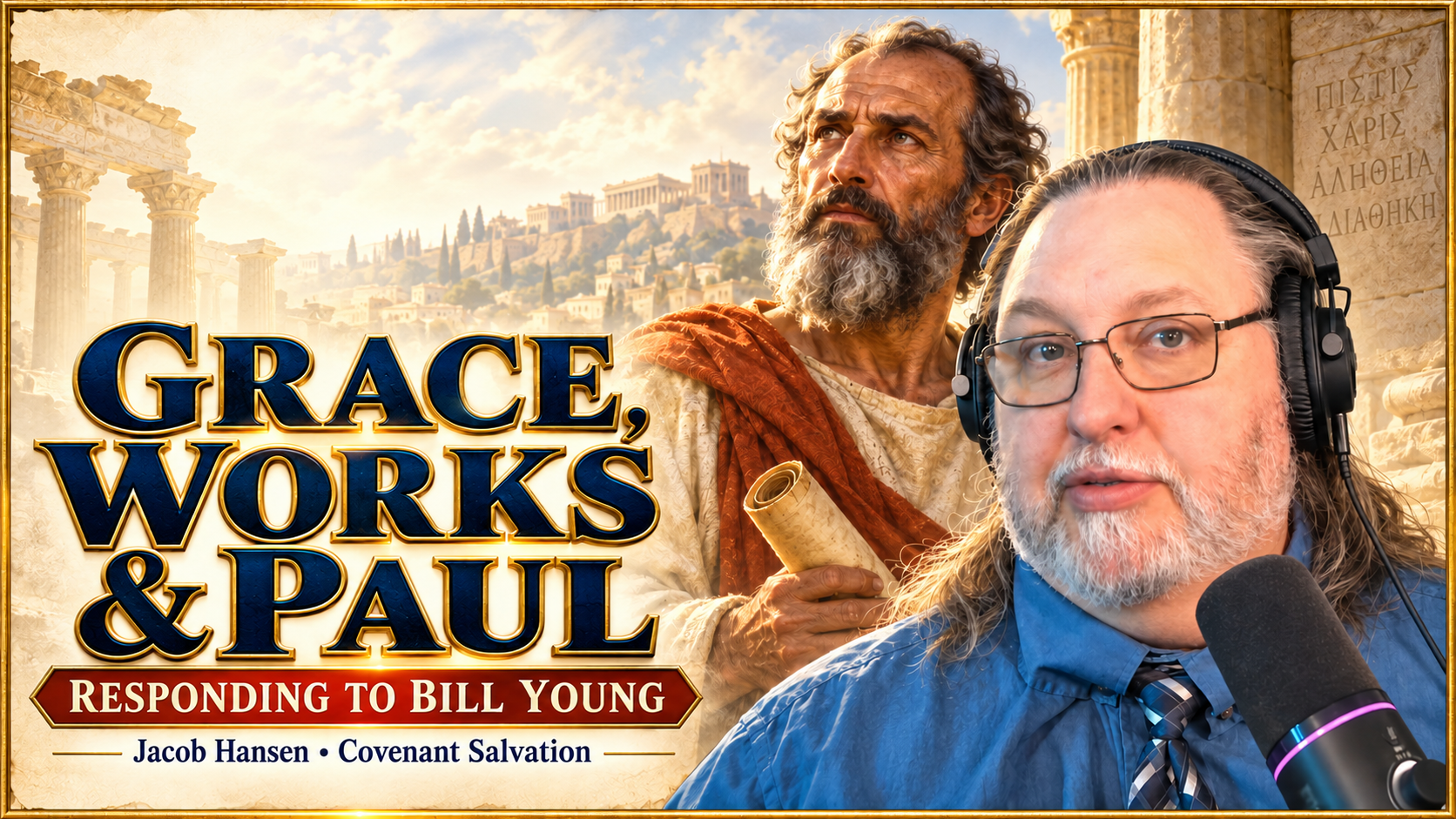
Bill Young's Response to Jacob Hansen: Does Covenant Obedience Deny Grace?

Bill Young's Response to Jacob Hansen: Does Covenant Obedience Deny Grace?

Does obedience turn the gift of salvation into a wage? That is the question beneath Bill Young’s response to Jacob Hansen—and it deserves a better answer than either “Mormonism is counterfeit” or “modern scholarship proves us right.” A Christian can affirm that Christ alone makes salvation possible while still believing that repentance, faithfulness, and a transformed life matter. The dispute begins when we ask how they matter: as payment, as conditions of receiving a gift, as evidence of living faith, or as the life that grace itself creates.

In Episode 104, Young argues that Hansen’s covenant model gives familiar LDS requirements a more attractive vocabulary without changing their function. That objection has force against any explanation that merely renames achievement as relationship. But Young’s broader conclusion—that necessary covenant obedience must therefore amount to earning salvation—requires an additional argument. Neither the presence of conditions nor the fact that human beings actually act establishes that their actions purchase God’s forgiveness.

This response approaches the debate from a Latter-day Saint perspective while taking Protestant objections seriously. It examines the supplied transcript and comment-section record alongside Pauline scholarship, Jewish historical scholarship, LDS sources, and evangelical biblical commentaries. Some of the evidence supports Young’s criticisms of oversimplified apologetics; other evidence directly challenges his portrayal of LDS grace and the scholarly alternatives he dismisses. The purpose is to identify which claims survive careful examination and to hold our treatment of other people to the Christian standard we invoke.

In this response

  • Young’s strongest objection
  • Paul, Judaism, and covenant
  • Grace, necessary works, and merit
  • “After all we can do”
  • What LDS leaders have taught
  • Comments and logical fallacies
  • The Christian standard
  • Frequently asked questions
  • Sources and further reading

What this response examines

The principal source is Young’s “Response to Jacob Hansen’s Covenant Model of Salvation”, identified as Episode 104 in the supplied materials. Quotations below follow the supplied transcript, with punctuation lightly normalized where needed; timestamps identify the relevant passages. The opening Hansen clip is presented within Young’s episode, so this article evaluates the argument as represented there rather than claiming to review every statement Hansen has made elsewhere.

Comment quotations come from the supplied document titled EP 104: Response to Jacob Hansen’s Covenantal Salvation Comment section. Usernames and document paragraph numbers identify excerpts where individual comment permalinks were not supplied. These are selected examples, not a statistical description of the entire audience. The record also contains substantive biblical arguments and objections to mockery. A commenter’s statement is attributed to that account; it is not automatically treated as Young’s own position.

Tuesday, July 21, 2026

Satan's Counter-Mission: The Ancient Playbook Behind Modern Social Media Gainsayers

Satan's Counter-Mission: The Ancient Playbook Behind Modern Social Media Gainsayers

How First-Century Religious Polemics Reappear in the Digital Age

Did you know that long before YouTube exposés, TikTok reaction videos, livestream debates, and thumbnails announcing that someone's faith tradition had been "destroyed" or they "got cooked," religious opponents were already employing a variety of tactics? These tactics included not only labels and ridicule but also the strategic use of selective evidence, harsh accusations of deception, and appeals to the prevailing orthodoxy of the time.

Throughout history, individuals and groups have engaged in polemical discourse, employing familiar patterns that transcend modern technology and social media platforms. While social media may amplify these exchanges and offer new avenues for expression, the fundamental dynamics of polemics—debate and dispute—are anything but new. They are deeply rooted in the fabric of human communication and interaction.

Understanding these historical parallels can offer valuable insights. However, it is crucial to recognize that for Latter-day Saints, acknowledging these patterns should not devolve into a license to demonize every critic. Instead, it calls upon us to foster a more nuanced approach to dialogue and engagement. This means we must strive for discernment without slipping into paranoia. We can hold firm convictions without succumbing to contempt for others.

In our conversations and debates, we want to aim to express truth in a manner that reflects the charity of Jesus Christ. This challenges us to engage thoughtfully and respectfully, even when faced with opposition. We are invited to navigate the complexities of faith, belief, and skepticism with a spirit of love and understanding, creating space for constructive dialogue rather than animosity. Ultimately, our response to criticism can be a powerful testament to the principles we uphold, embodying a spirit that upholds truth while also extending grace to those with whom we may disagree.

Sunday, July 19, 2026

When You Don’t Know What to Do, Keep Your Eyes on God | 2 Chronicles 14–20; 26; 30

When You Don’t Know What to Do, Keep Your Eyes on God | 2 Chronicles 14–20; 26; 30

Come, Follow Me — July 20–26, 2026: “Our Eyes Are Upon Thee”

What do you do when the opposition is greater than your strength, the pressure is greater than your wisdom, and you honestly do not know what to do next?

This week’s Come, Follow Me study takes us into the lives of kings, prophets, reformers, worshippers, and ordinary families who faced that very question. Their stories reveal that peace does not come from pretending the battle is small. It comes from knowing where to turn when the battle is bigger than you.

Through the accounts of Asa, Micaiah, Jehoshaphat, Uzziah, and Hezekiah, 2 Chronicles invites us to examine where we place our trust, how we respond to correction, and whether our eyes remain fixed upon the Lord when fear, success, pride, or division threaten to pull them away. Each of these figures faced formidable challenges—be it external armies, internal strife, or the temptations of power—and their responses provide valuable lessons for our own lives.

Asa, for instance, shows how reliance on God in times of trouble can lead to unexpected victories, while Micaiah reminds us of the importance of courage in standing for truth, even in the face of overwhelming opposition. Jehoshaphat’s alliance-building and pursuit of divine guidance highlight the significance of seeking God's will in decision-making, especially when circumstances seem dire. Uzziah's rise to power illustrates the fine line between humility in success and the dangers of pride, reminding us that acknowledgment of our dependence on God is crucial. Lastly, Hezekiah's prayer in times of crisis demonstrates that sincere reliance on divine help can yield miraculous outcomes.

This week's study encourages us to reflect deeply on our own lives. When confronted with overwhelming pressure, do we allow our fears to overshadow our faith? Are we quick to seek advice from sources that may not align with our beliefs? Or do we, like these biblical figures, turn our attention steadfastly to God, trusting that He will guide us through our fiercest battles? Through these narratives, we learn that true peace comes from steadfast faith and a commitment to seek God's wisdom relentlessly, no matter how insurmountable the obstacles may appear.

Tuesday, July 14, 2026

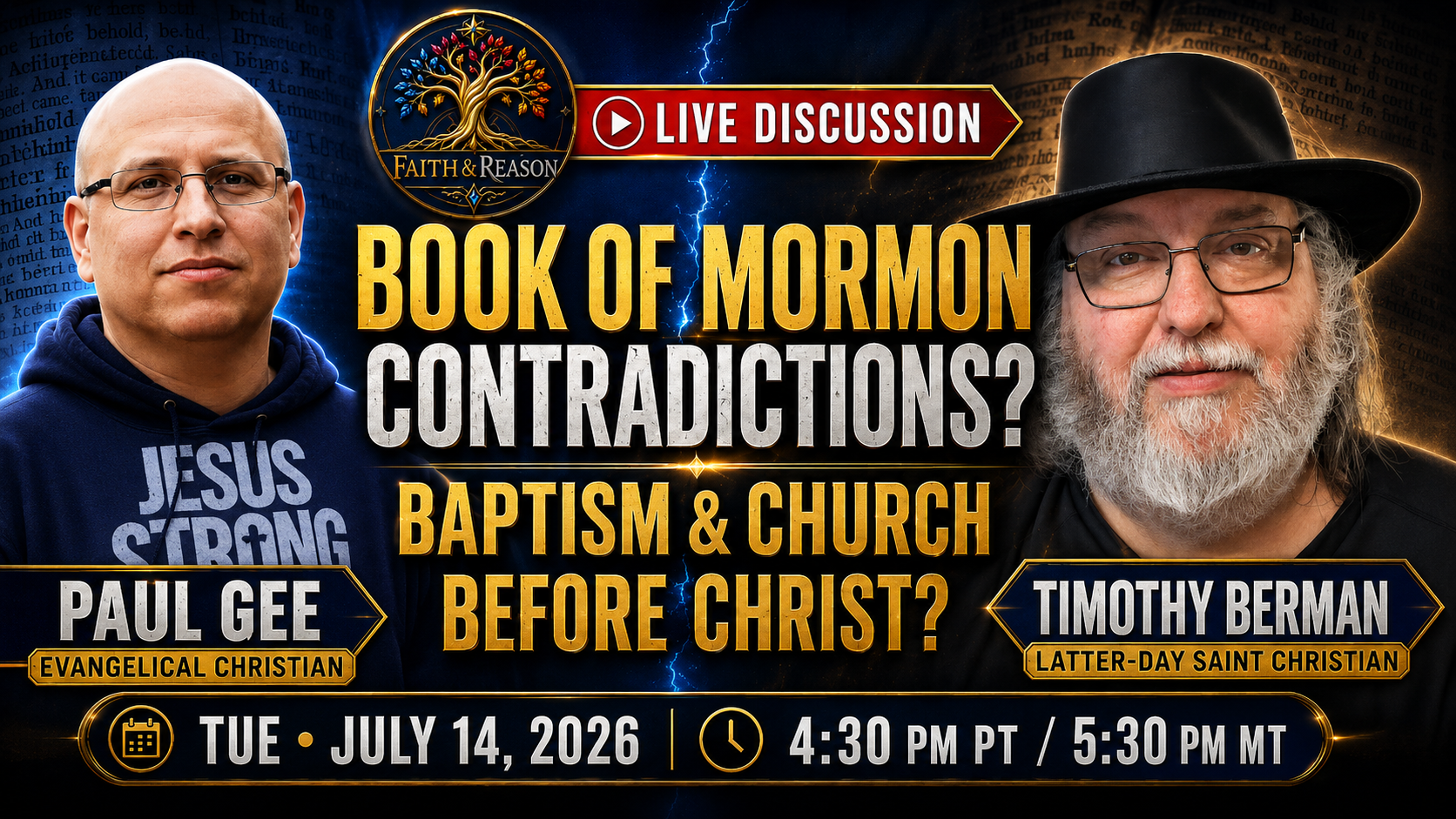
Book of Mormon Contradictions? Paul Gee and Timothy Berman Discuss Mosiah 18

Book of Mormon Contradictions? Paul Gee and Timothy Berman Discuss Mosiah 18

Tonight, Faith & Reason hosts a focused livestream discussion between Paul Gee and Timothy R. Berman examining one of the central arguments raised against the Book of Mormon: the claim that Mosiah 18 contains biblical and historical contradictions.

The discussion will stream live directly on this page.

Watch the Livestream

Date: July 14, 2026
Time: 4:30 PM Pacific / 5:30 PM Mountain
Participants: Paul Gee and Timothy R. Berman
Topic: Baptism and the Church in Mosiah 18

The livestream video is embedded below. The broadcast will begin automatically when the event goes live.

Sunday, June 21, 2026

What the Divinity of Jesus Christ Means to You

What the Divinity of Jesus Christ Means to You

Why Jesus Alone Could Accomplish the Infinite and Eternal Atonement

What manner of man commands the wind and sea—and they obey Him? He who speaks to the chaotic elements and they submit to His will, revealing His divine authority over nature itself. His voice echoes through the storm, bringing peace where there was turmoil, demonstrating an unparalleled mastery that transcends human understanding.

What manner of man possesses the power to lay down His life and take it up again? He who, with the authority inherent to His being, presents the ultimate sacrifice, fully aware of the weight of such a decision. In laying down His life, He unveils the profound mystery of love and redemption. The same strength that allows Him to give Himself away also empowers Him to conquer death, rising triumphantly to provide hope and eternal life to humanity.

What manner of man suffers more than mortal humanity can endure, yet remains until the work of redemption is complete? He bears the weight of all humanity’s sins, feeling the depths of anguish and despair, yet persevering through the agony to fulfill His purpose. His empathy is boundless, experiencing sorrow in ways that only a divine nature could comprehend. In His endurance, He illustrates the profound depth of grace, revealing that true strength is often displayed in vulnerability and unwavering commitment to a higher calling, despite the unbearable cost.

This man is a testament to the coexistence of power and humility, a divine figure whose actions reshape the narrative of humanity's relationship with the Creator. His life and legacy stand as an eternal beacon of hope, a call to embrace the extraordinary potential within each of us to rise above our circumstances and to foster love, compassion, and redemption in a world so often in need of these gifts.

These questions stand at the center of Doctrine Lesson 6, “What the Divinity of Jesus Christ Means to You,” from the 1974–75 Melchizedek Priesthood study guide When Thou Art Converted, Strengthen Thy Brethren. The lesson’s purpose was not merely to establish that Jesus was extraordinary. It invited priesthood holders to understand why Jesus Christ alone possessed power to accomplish the infinite and eternal Atonement—and why every one of us remains completely dependent upon Him.

Nearly five decades later, that central purpose remains unchanged. Some of the language used in the original lesson, however, has generated theological questions and apologetic controversy. In particular, statements by James E. Talmage and Bruce R. McConkie about Christ’s literal divine sonship have been interpreted by critics as teaching that God the Father physically descended and engaged in sexual intercourse with Mary.

A responsible modern treatment must do more than dismiss that criticism. It must distinguish among what scripture reveals, what individual Church leaders have proposed or speculated, and what the Church currently teaches as established doctrine.

It is best we do not allow controversy over the manner of Christ’s conception to distract us from the greater truth: Jesus Christ did for us what we could never do for ourselves.

Friday, June 12, 2026

Social Media Gainsayers: The Anti-Mormon Playbook Has Not Changed—Only the Platforms Have

Social Media Gainsayers: The Anti-Mormon Playbook Has Not Changed—Only the Platforms Have

How Ex-Mormon Influencers, Evangelical Critics, and Online Ministries Repackage the Same Arguments for YouTube, TikTok, Facebook, Podcasts, and Livestreams

In 1989, anti-Latter-day Saint ministries, often referred to as Counter-cult or Anti-Mormon groups, relied heavily on printed tracts, cassette tapes, books, traveling seminars, church presentations, and controversial films—most notably, The Godmakers. Pastors would announce special meetings from their pulpits, offering "classes" on how to witness to Mormons. If you strolled into any brick-and-mortar Christian bookstore, you'd find a substantial collection of books specifically discussing the Church of Jesus Christ of Latter-day Saints. Among the more notable titles were Kingdom of the Cults by the late Walter Martin, Letters to a Mormon Elder by James White of Alpha and Omega Ministries, Mormonism 101 by Bill McKeever and Eric Johnson, and Mormons Answered Verse by Verse by David A. Reed and John R. Farkas. In addition to these apologist works, you'd also discover a range of small group and individual study guides about the LDS faith.

As if that weren't enough, it wasn't uncommon for members of the faith to be invited over to a family friend's or relative's home for dinner, only to be introduced to a friendly couple. The gentleman would often start the conversation with, "I used to be a Mormon, but I’ve found Jesus." This felt like a kind of religious intervention aimed at coaxing you to leave the church. I experienced this firsthand in my early twenties when my mother-in-law invited my then-wife and me over for dinner. That evening plunged me into the world of Anti-Mormonism and apologetics. I had already purchased They Lie in Wait to Deceive by the Browns (I had all four volumes at that time), The Truth About the Godmakers by Gilbert Scharff, and The Gainsayers: A Converted Anti-Mormon Responds to the Critics of the LDS Church by Derrick T. Evenson—this last book serving as the foundation for my Social Media Gainsayers series.

This atmosphere left minimal opportunity for individuals to hear a meaningful response from Latter-day Saints. The urgency of the message was unmistakable: “They are stealing your people. They must be stopped,” as Ed Decker wrote in his letter to pastors, promoting his book and film, The Godmakers. Fast forward more than three decades, and we see that the media landscape has undergone a dramatic transformation. Pamphlets have turned into Facebook posts, and cassette tapes have been replaced by podcasts. Traveling seminars have morphed into YouTube livestreams and channels, while the controversial film The Godmakers has resurfaced on social media platforms, mainly appearing as "The Mormon Banned Cartoon." Church basement presentations have transitioned into TikTok debates and live discussions. The once-printed quotations, often stripped of context, have been condensed into fifteen-second video clips and responses. What used to be the anti-Mormon bookstore shelf has now become algorithmically generated playlists.

The technology has changed, distribution has accelerated, and the audience is now global. Yet, the underlying playbook remains startlingly familiar. Today’s social media gainsayers might identify themselves as Ex-Mormons, evangelical Christian pastors, Christian apologists, cult experts, deconstruction coaches, religious commentators, or former "insiders." Though they use differing methods, it’s crucial to note that not every critic of the Church of Jesus Christ of Latter-day Saints is manipulative, dishonest, or deceptive.

Legitimate criticisms deserve legitimate responses. Difficult historical questions should never be ignored, and former members have every right to share their personal experiences. Likewise, Christians have every right to express their disagreements with Latter-day Saint theology. The challenge arises when personal experiences are framed as universal facts, theological disagreements are marketed as scandals, and mockery and insults take the place of honest discussions. Unfortunately, algorithms often amplify the most hostile narratives.

That’s when criticism turns into gainsaying. As Latter-day Saints, we bear the responsibility to stand firm in our faith and testimony, for it is through “sound doctrine that we both exhort and convince the gainsayers” (Titus 1:9, KJV).

Saturday, May 30, 2026

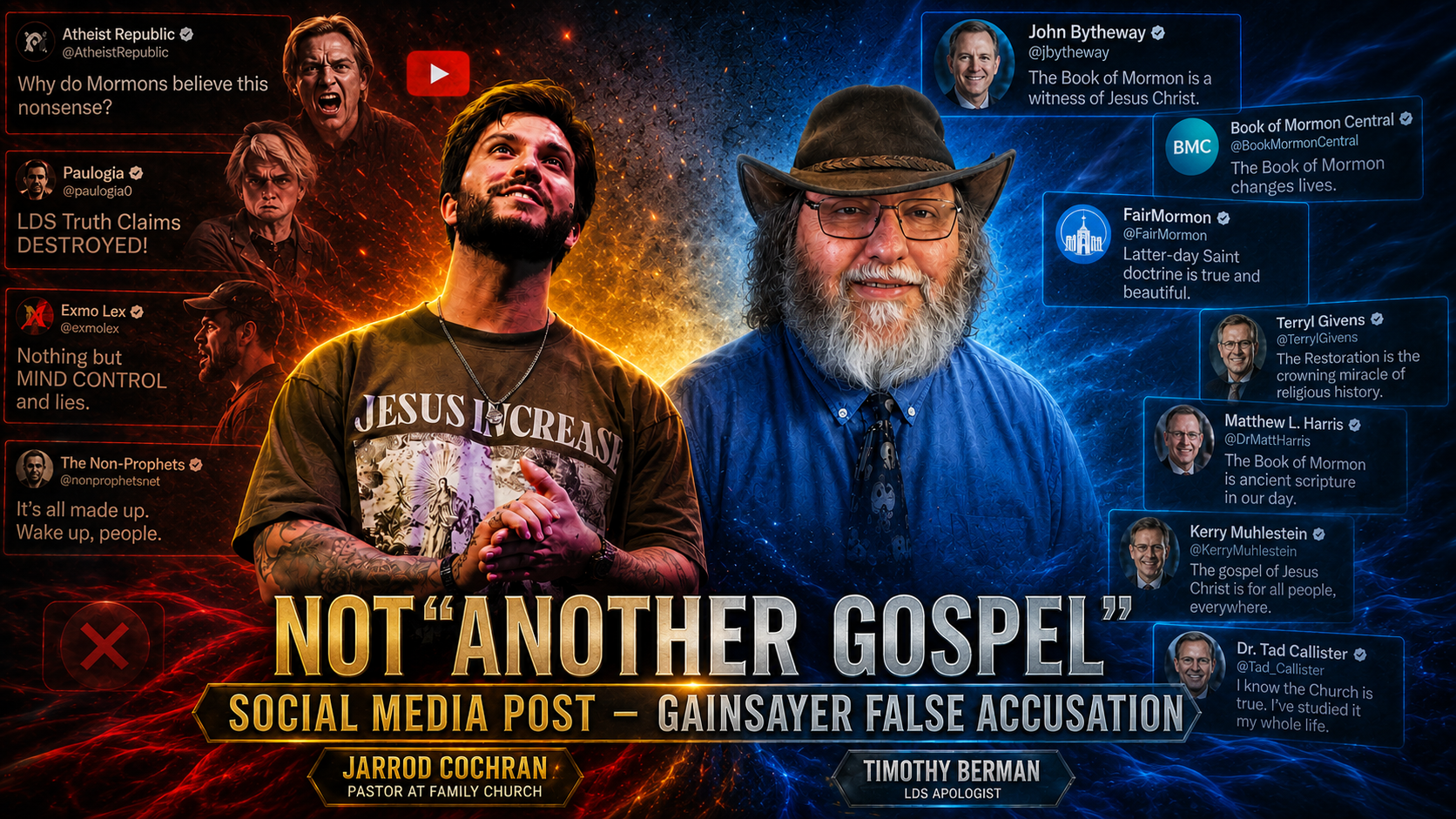
Not “Another Gospel”: A False Accusation Against Christ

Not “Another Gospel”: A False Accusation Against Christ

It really never fails that someone who has issues, without tissues, against the Church of Jesus Christ of Latter-day Saints recycle the same accusation and anti-LDS tropes. And typically, the go to Evangelical eisegesis "gotcha" verse is Galatians 1:8. A weaponized verse used to bludgeon Joseph Smith into the status of being accursed, preaching a different gospel and the case is closed. It sounds bold and confident. However, it is mere haughty arrogance posturing from a place of one being completely illiterate of properly interpreting the scriptures. Evidence of another gainsayer who is ever learning and never understanding:

You must understand this, that in the last days distressing times will come. For people will be lovers of themselves, lovers of money, boasters, arrogant, abusive, disobedient to their parents, ungrateful, unholy, unfeeling, implacable, slanderers, profligates, brutes, haters of good, treacherous, reckless, swollen with conceit, lovers of pleasure rather than lovers of God, holding to the outward form of godliness but denying its power. Avoid them! For among them are those who make their way into households and captivate immature women, overwhelmed by their sins and swayed by all kinds of desires, who are always studying yet never able to recognize truth. As Jannes and Jambres opposed Moses, so these people, of corrupt mind and counterfeit faith, also oppose the truth. But they will not make much progress because, as in the case of those two men, their folly will become plain to everyone. ... Indeed, all who want to live a godly life in Christ Jesus will be persecuted. But wicked people and impostors will go from bad to worse, deceiving others and being deceived. But as for you, continue in what you have learned and firmly believed, knowing from whom you learned it and how from childhood you have known sacred writings that are able to instruct you for salvation through faith in Christ Jesus. All scripture is inspired by God and is useful for teaching, for reproof, for correction, and for training in righteousness, so that the person of God may be proficient, equipped for every good work. (2 Timothy 3:1- 9, 12-17).

Yet, such arguments consistently collapse the moment we examine the text, the history, and the logic.

The claim is simple: Because Paul warned about another gospel and because Joseph Smith reported an angelic visitation, therefore the Restoration must be a demonic deception. An arrogant and boastful claim. One that appears to sound quite powerful - until you take the time to read Paul, understand his context, and compare it to what Latter-day Saints actually teach. Yet, these internet gainsayers are mere lazy learners who do not want to test their claims against truth. They want to sound loud and proud screaming into the Social Media landscape to deceive people. And they don't want their claims challenged.

Therefore, I am not here to dodge the passage. In fact, the only person that appears to dodge a real discussion is the gainsayer refusing to have a livestream discussion on whether or not the Book of Mormon is demonic. As such is the individual's claim. Neither am I here to soften Paul. I am here to take the claim seriously, steelman it, and then show how it fails on every textual, historical, and theological level.

Today, let's examine Jarrod Cochran's claims regarding Joseph Smith, the Book of Mormon, and an unfolding dialogue regarding whether or not this gentleman is speaking truth - or perpetuating ongoing lies and deceptions.

Friday, May 29, 2026

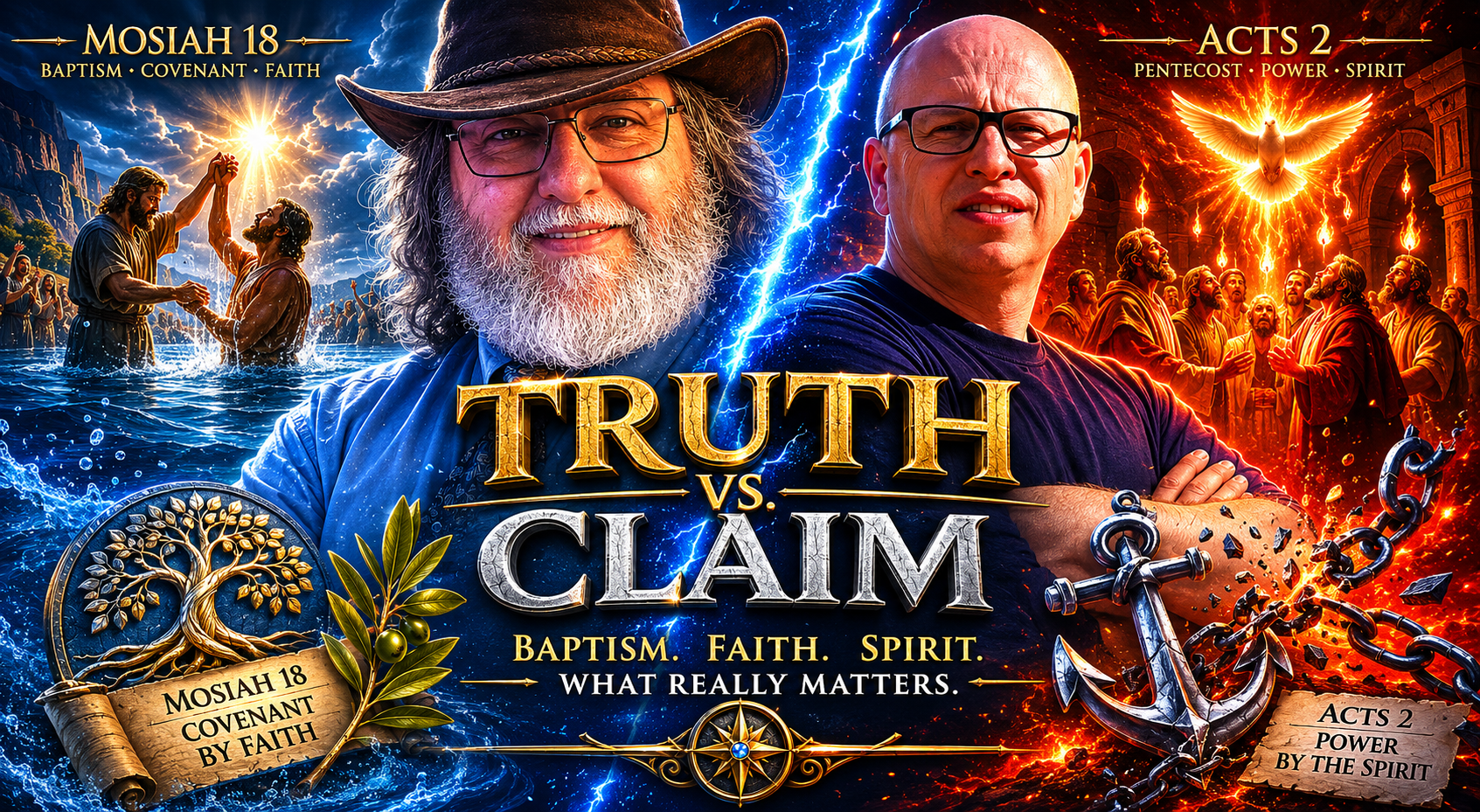
Book of Mormon Contradictions? A Latter-day Saint Responds to Paul Gee on "Baptism" and "Church" in Mosiah 18

Book of Mormon Contradictions? A Latter-day Saint Responds to Paul Gee on "Baptism" and "Church" in Mosiah 18

We are going to look at a very specific claim: that the Book of Mormon story of baptism in Mosiah is just Joseph Smith copying Acts 2 - and that baptism for the remission of sins could not have existed before Jesus Christ, therefore the Book of Mormon contradicts the Bible. If this is true, Latter-day Saint scripture definitely collapses. If it is not, then this criticism is built on a very sandy foundation. Let's actually examine to see if such a claim has any credibility and validity to truth or if it is a false claim.

Now, I am not asking you to take my own word for it. I am asking that we open up the scriptures, open up our hearts and minds because we are going to walk through Paul Gee's argument, steelman it, and then test it against scripture, history, and essential logic. By doing this, we can critically assess the merits of his claims and their implications for the understanding of both the Book of Mormon and biblical texts.

This is not an attack on Paul. In fact, he reached out and asked me to read it as it will supposedly prove that the Book of Mormon is false. And I will quote him fairly, present his argument in its strongest form, and will show how I believe it fails - scripturally, historically, and logically. By carefully dissecting the specifics of his argument, we can delve deeper into the theological and historical context of baptism and its significance within both texts.

Understanding that baptism as a practice existed in various forms before Christ and that the concept of a remission of sins is not exclusively tied to any one scripture, we must analyze whether the Old Testament precedents and the teachings of Christ later broaden our comprehension of baptism. This exploration will hopefully shed new light on claims made against the Book of Mormon, fostering a more nuanced and comprehensive understanding of the narrative within its pages.

As we navigate through this intricate discussion, I invite all readers to remain open-minded and reflect critically on the scriptures, drawing personal insights even as we engage with challenging interpretations. A sincere examination can lead us to a deeper faith and understanding of these profound spiritual texts.

Thursday, May 28, 2026

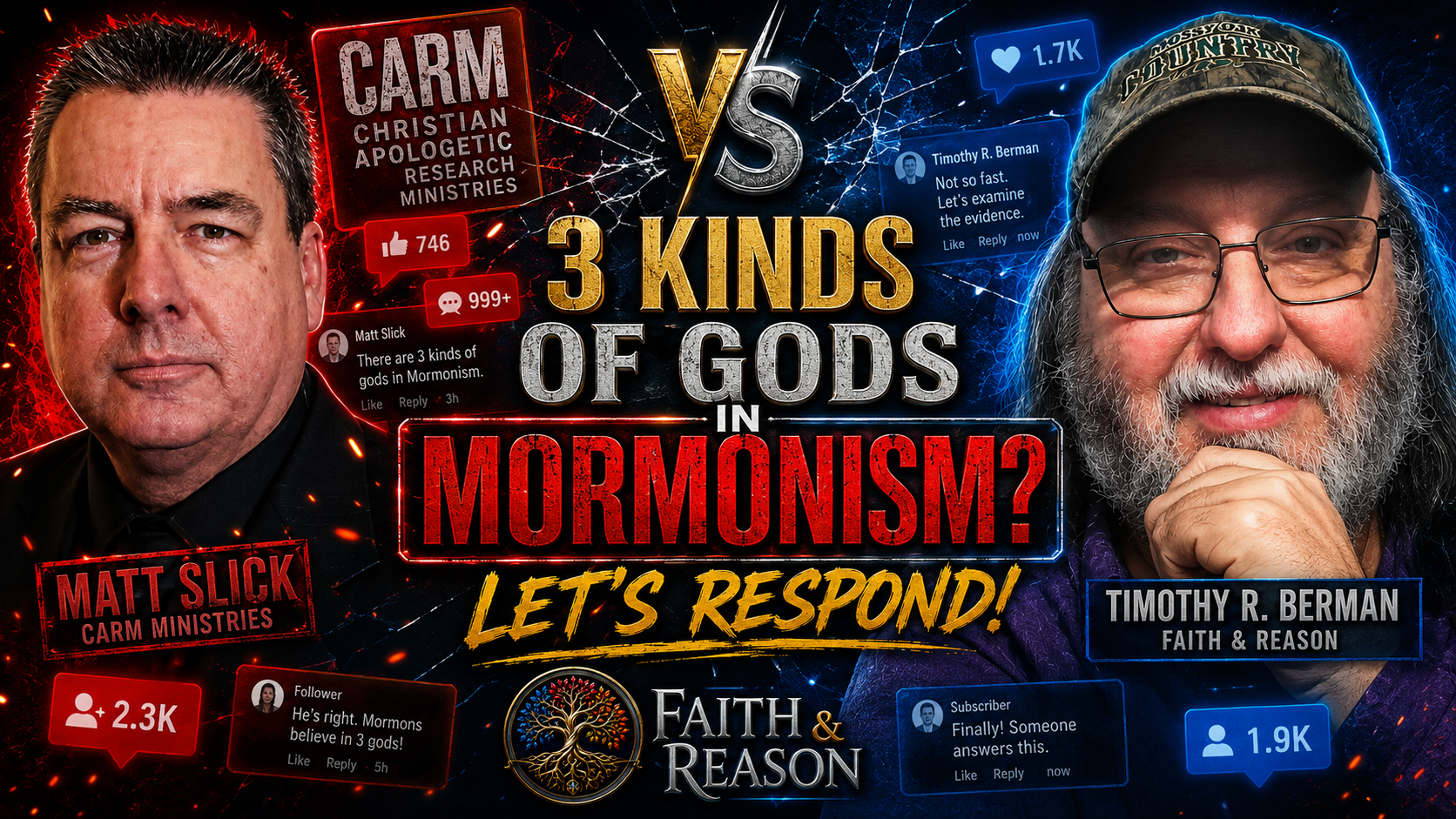
Does the LDS Faith Have 3 Kinds of God?

Does the LDS Faith Have 3 Kinds of God?

Are there three Gods within the LDS Faith, or is Matt Slick of the Christian Apologetics Research Ministry making three specific category errors? He appears to contend that Latter-day Saint theology contains three types of gods. Yet, his conclusion seems to depend entirely on misunderstandings, inaccuracies in reading LDS sources, and the imposition of post-Nicene metaphysics onto texts that do not utilize them.

When we scrutinize Slick's assertions, it becomes apparent that they stem from misrepresentations of key doctrinal points. The Latter-day Saint understanding of God emphasizes a singular divine nature, with a clear distinction between God the Father, Jesus Christ, and the Holy Ghost, who are unified in purpose but distinct in being. This understanding challenges Slick’s insistence on a concept of multiple gods existing in separate categories, which does not align with LDS beliefs as how we interpret our scriptures and teachings.

By examining the categories he uses and applying a proper lens through which to analyze LDS doctrine, one may ultimately see that Slick's arguments significantly falter. His framework seems to force the doctrine into a misunderstanding of the term 'God,' failing to account for the context and nuances within Latter-day Saint theology.

His claims not only misrepresent what Latter-day Saints uphold but also create contradictions within his argumentation regarding what he purports they teach. This is not merely a disagreement over religious interpretation; it represents a profound mischaracterization that undermines genuine discourse.

Today, I wish to respond to this critique with clarity, doctrinal precision, and integrity, standing firm in the belief that the truth of Latter-day Saint doctrine deserves to be presented honestly. It is vital that we engage with those who misunderstand or misrepresent our beliefs with a spirit of boldness and respect—exhorting and convincing the gainsayer (Titus 1:9) through proper correction and thoughtful rebuke (2 Timothy 3:16). By addressing these misunderstandings directly, we can foster a more accurate understanding of Latter-day Saint teachings and encourage meaningful dialogue that respects differences while seeking common ground.

Monday, May 18, 2026

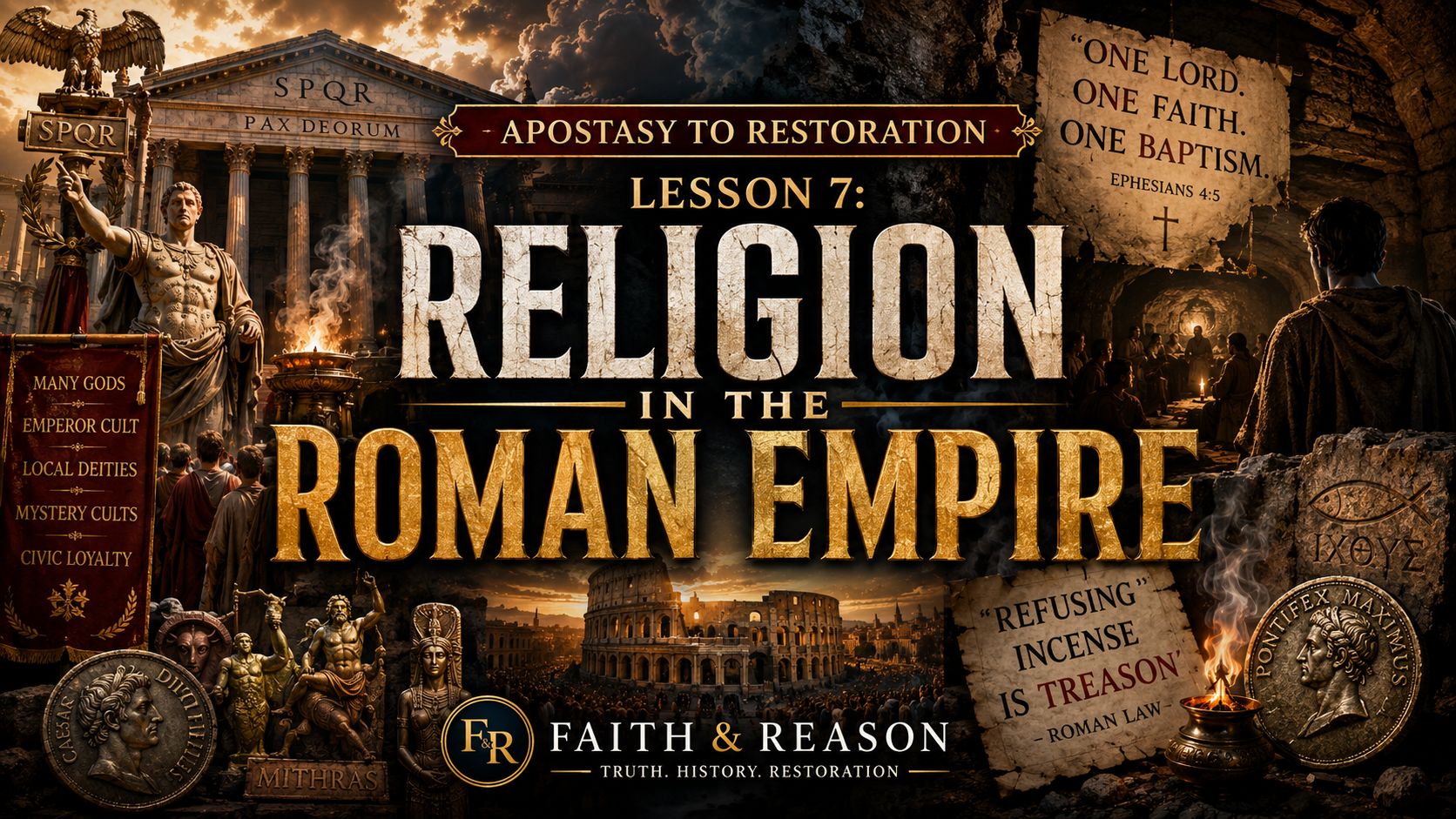
Apostasy to Restoration: Lesson 7: Religion in the Roman Empire

Apostasy to Restoration: Lesson 7: Religion in the Roman Empire

When T. Edgar Lyon first penned Lesson 7 of Apostasy to Restoration in 1960, he invited Latter-day Saints to step into a world where religion was not just a private conviction but a fundamental component of the machinery of empire. This bold assertion set the stage for a deeper exploration of the intricate interplay between faith, culture, and politics. Sixty years later, the landscape of scholarship has transformed dramatically, yet Lyon’s central insight remains strikingly relevant: to truly understand the need for a Restoration, we must first immerse ourselves in the complex milieu that shaped the early Christian Church.

This updated lesson builds upon Lyon’s foundational work, integrating modern archaeological discoveries, peer-reviewed historical research, and contemporary Latter-day Saint scholarship to form a more nuanced understanding of the context in which early Christianity emerged. What emerges from this scholarly synthesis is a clearer, richer, and more compelling picture of the Roman religious world—a world that was teeming with a pantheon of gods, replete with elaborate rituals, and governed by a political theology that made the act of Christian discipleship both radical and perilous.

In a society where loyalty to the state was intricately tied to acts of sacrifice and devotion, where citizens adeptly navigated multiple cults without a hint of contradiction, and where the pursuit of salvation was often sought through clandestine mystery rites and the favor of emperors, the Christian proclamation of “one Lord, one faith, one baptism” represented a profound challenge to the status quo—it was nothing less than a revolutionary stance. This declaration was, in essence, a radical reformation of the religious landscape, directly opposing the established norms that dictated the relationship between the individual, the divine, and the state.

Understanding that world is essential for grasping why the early Church fractured amidst various pressures and why a Restoration was not merely desirable but indeed inevitable. The tensions between emerging Christian beliefs and the entrenched systems of power were not just obstacles to be overcome; they underscored the urgent need for a return to core principles that could unify and reinvigorate the faith community. Lyon’s insights encourage us to reflect on our own circumstances in today’s religious environment, prompting critical questions about the nature of faith, the role of community, and the ongoing quest for spiritual authenticity in an increasingly complex world. As we navigate the remnants of an ancient tapestry interwoven with faith and politics, we find ourselves inspired to reconsider the implications of our shared history and the enduring quest for a true Restoration.

Saturday, May 16, 2026

The Divine Architecture of Gender: An LDS Analysis of the "Godhead Creation Dilemma" and Biblical Exegesis

The Divine Architecture of Gender: An LDS Analysis of the "Godhead Creation Dilemma" and Biblical Exegesis

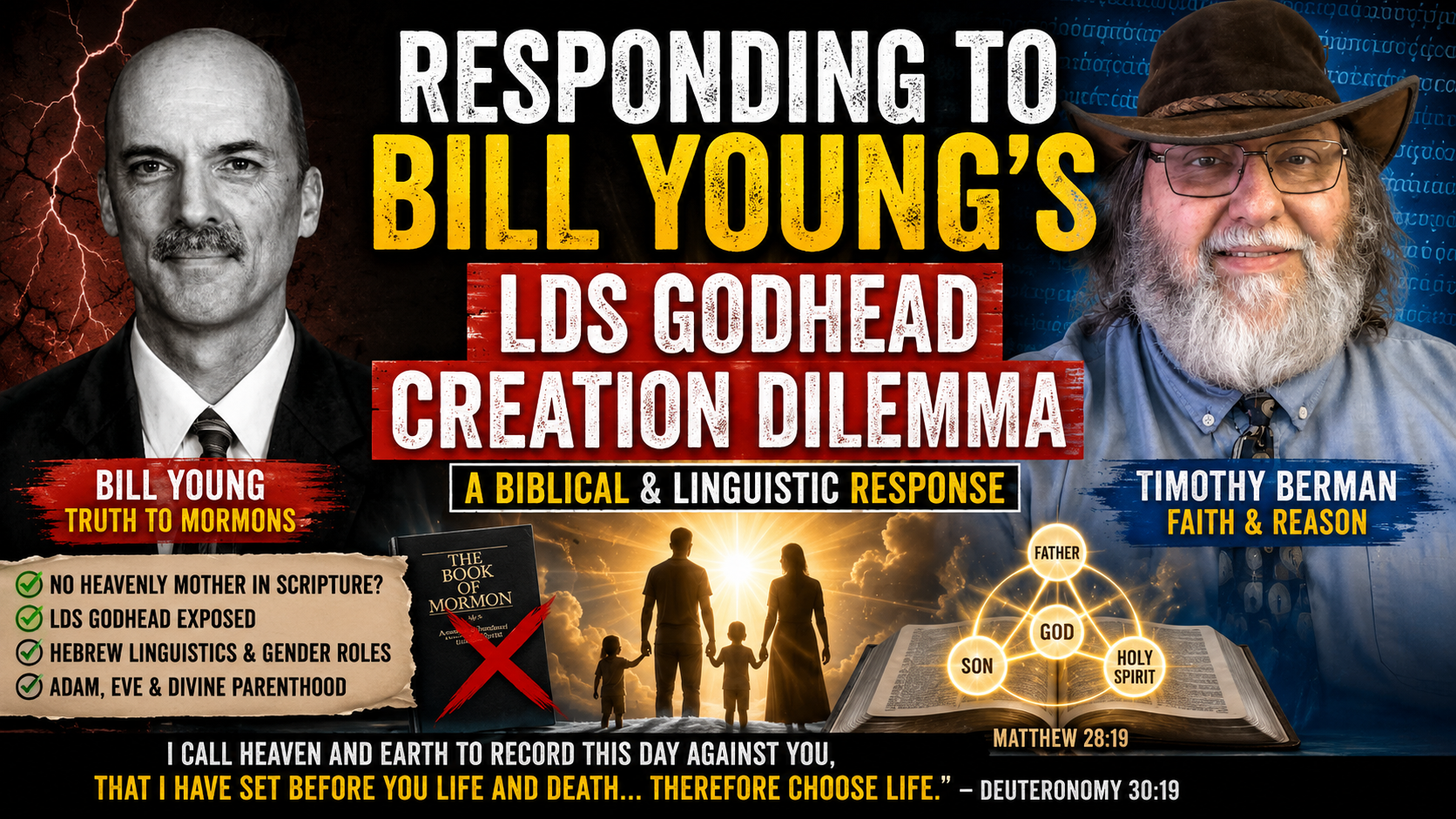
In his podcast (Episode 87), “The LDS Godhead Creation Dilemma,” critic Bill Young attempts to force a theological checkmate onto Latter-day Saints. He argues that because a Heavenly Mother is not explicitly canonized in LDS standard works, the entire Latter-day Saint cosmology and understanding of the Godhead collapses. His argument is rhetorically forceful, emotionally charged, and heavily dependent on satire and selective framing.

However, the central irony of his critique is profound: Bill repeatedly attacks Latter-day Saints for deriving doctrine through theological inference while simultaneously defending the mainstream doctrine of the Trinity. This defense is particularly troubling given that the Trinity is a doctrine that likewise emerges through synthesis, philosophical formulation, and post-biblical doctrinal development rather than from a singular, explicit biblical statement. This selective application of inference highlights a critical inconsistency in his argument and reveals a double standard that is structurally unsustainable.

To unpack why this critique fails historically, linguistically, and methodologically, we must move past an intuitive, "feels-right" approach to scripture and dive into the rigorous reality of biblical exegesis. Historical context plays a crucial role in understanding both Latter-day Saint doctrines and mainstream Christian beliefs. The development of the Trinity, for instance, did not occur in a vacuum; it was the result of centuries of theological discourse and debate among early church leaders.

In contrast, the concept of a Heavenly Mother may not be as explicitly outlined in LDS scripture, but the principle of a divine feminine presence is woven throughout the fabric of Latter-day Saint theology. By ignoring this contextual nuance and dismissing the significant theological development within Latter-day Saint thought, Bill’s critique falls flat.

Furthermore, linguistically, the words we choose to frame our understanding of God significantly influence how doctrines are perceived and articulated. In Latter-day Saint belief, the concept of a Mother in Heaven is not merely an optional addendum but a vital part of understanding the divine family structure. By failing to engage with this linguistic complexity, Bill oversimplifies a rich and profound belief system.

Methodologically, the task of drawing theological conclusions must be approached with care. Relying solely on explicit biblical texts can lead to an incomplete understanding of the intricate and often subtle ways that spiritual truths manifest. Both the Latter-day Saint perspective and the traditional Christian views on the Godhead are informed by interpretation, historical development, and communal understanding.

In concluding this analysis, it is essential to recognize that engaging with theological beliefs requires depth, patience, and a willingness to explore the intricacies that shape those beliefs. By fostering a spirit of inquiry and open dialogue, rather than reductive criticisms, we can appreciate the multifaceted nature of faith that transcends oversimplified arguments.

Friday, May 1, 2026

A Latter-day Saint Rebuttal to ChristAzure1624's AI Generated "Johannine Epistle to the Mormons"

A Latter-day Saint Rebuttal to ChristAzure1624's AI Generated "Johannine Epistle to the Mormons"

My previous video critique of an “AI Pauline Style Letter to the Mormons” was to examine how a YouTube Commentator by the name of ChristAzure1624 decided to weaponize New Testament style against Latter-day Saint (LDS) beliefs. He then decided that it was okay to post a comment of a “Johannine” styled pastoral epistle to the members of the LDS Faith. Yet, all he did was provide an example where he does exactly the same thing — and it fails for the same reasons.

I am going to provide a structured analysis drawing from a peer-reviewed New Testament scholarship on Johannine rhetoric (e.g., Raymond E. Brown, Rudolf Schnackenburg, and others) and a clear-eyed look at the anti-LDS tropes it recycles. Not only will I address the rhetorical techniques employed in this letter, but I will also delve deeper into how these methods align or misalign with authentic Johannine texts.

First, I will quote each major section of the letter and indicate how it attempts (and ultimately fails) to imitate the Johannine style. For instance, the use of specific phrases and a focus on community-related themes are common in genuine Johannine literature, intended to provide warmth and fellowship. However, ChristAzure1624’s approach tends to strip away the compassionate undertones, reducing the message to mere rhetoric rather than heartfelt communication.

Next, I will steelman the underlying evangelical critique that he is trying to convey. This involves presenting the best version of his arguments to honestly assess their merits. Even while critiquing LDS beliefs, it is important to recognize the passion behind such religious discourse, and this critique will consider the historical and cultural context of these discussions.

Lastly, I will rebut the arguments with logical inconsistencies, fallacies, and scholarly context. This will include highlighting instances where his claims reflect a misunderstanding of key theological points in LDS doctrine, as well as instances where he unwittingly mirrors strawman criticisms often leveled against religious movements. By the end of this analysis, readers should have a clearer understanding of both the rhetorical shortcomings of ChristAzure1624's missive and the deeper significance of genuine Johannine communication.

Tuesday, March 17, 2026

When a Lie Is Repeated Enough: Exposing Modern Misreadings of LDS Grace and Covenant Theology

When a Lie Is Repeated Enough: Exposing Modern Misreadings of LDS Grace and Covenant Theology

When Misreadings Become “Truth”

What if the most dangerous lie about Latter-day Saint belief isn’t what critics say — but how often they repeat it?

Because when a misreading of scripture is repeated often enough, it stops sounding like an opinion… and starts sounding like truth. This phenomenon reveals the power of repetition in shaping perceptions and beliefs. Misinterpretations or half-truths can gain traction, leading to misconceptions that overshadow the actual teachings and principles of the faith. Critics may not always engage with the actual texts or doctrines but instead rely on sound bites or misrepresentations, creating a narrative that can feel authoritative simply due to its frequency.

Today, we’re not responding with outrage. We’re responding with scripture. It is essential to turn to the foundational texts of our faith to clarify the misunderstandings surrounding our beliefs. By examining the scriptures in their full context, we can counteract the false narratives that may circulate. The goal is not to engage in heated arguments, but rather to educate ourselves and others about the true tenets of our faith, promoting a dialogue rooted in understanding rather than controversy. We seek to illuminate the principles that guide Latter-day Saint belief, fostering a more informed and respectful conversation about what we truly stand for.

The Pattern Behind the Critique

For years, a familiar pattern has circulated through online critiques of the Book of Mormon:

A verse is isolated, often taken out of context to fit a specific critique or interpretation.

A modern theological framework is then imposed onto this ancient covenantal text, creating a disconnect between the original intent of the scripture and the contemporary understanding of concepts like grace, salvation, and the gospel.

Latter-day Saints frequently encounter assertions that they “don’t understand grace,” “don’t understand salvation,” or “don’t understand the gospel.” Such statements are heavy with condemnation and carry a tone of authority that can make them seem credible.

It sounds authoritative. It sounds confident. It sounds convincing — until you actually read the text the way it was written, with its historical and cultural context in mind.

This isn't just a misrepresentation; it's a fundamental misunderstanding of the text itself. What is often dismissed as naive or simplistic faith may, in fact, be rooted in a deeper comprehension of the intricate relationships and themes woven throughout the Book of Mormon.

This isn’t exegesis, which seeks to draw out the meaning from the scripture itself. Instead, it’s eisegesis — meaning interpretations and meanings are inserted into scripture instead of being derived from it. This approach fails to honor the complexity of the original text and the beliefs it articulates, leading to conclusions that may be misleading or inaccurate.

Understanding the Book of Mormon requires more than surface-level readings or preconceived notions; it necessitates an open heart and a willingness to engage with the text on its own terms, allowing its messages to unfold in their intended manner. Only through such an approach can a true appreciation of its teachings and doctrines be attained, along with a richer understanding of the faith it represents.

Tuesday, February 24, 2026

A Logical and Reasonable Refutation of Bill Young's Critique of President Dallin H. Oaks

A Logical and Reasonable Refutation of Bill Young's Critique of President Dallin H. Oaks

Is President Dallin H. Oaks issuing a "cult-like gag order," or is he simply teaching the same pattern of discernment used by the Apostles in the New Testament? In a recent episode of Truth to Mormons, Bill Young attempts to dismantle President Oaks’ BYU Devotional, "Coming Closer to Jesus Christ." Young frames the talk as "damage control" and "thought stopping," suggesting that it serves as a mechanism to silence dissent and enforce conformity among followers. However, when you peel back the rhetoric, you find a series of logical fallacies and a fundamental misunderstanding of Latter-day Saint theology. As a student of both the scriptures and logic, my goal is not to trade insults but to examine the evidence critically and thoughtfully. We will look at Young’s arguments in a detailed manner, "steelman" his positions to ensure they are understood fairly, and then provide a clear, scriptural, and logical rebuttal from the LDS perspective. This process will involve not only a close reading of the original devotional but also an analysis of the core principles of Latter-day Saint belief, including the importance of personal revelation and the role of modern prophets. By engaging in this thoughtful discourse, we can arrive at a more nuanced understanding of the issues at hand, fostering an environment where productive dialogue can thrive over simplistic accusations and misunderstandings.

Summarizing the BYU Devotional: President Dallin H. Oaks

In his first major address as President of the Quorum of the Twelve Apostles (acting as the most senior leader alongside President Nelson), Dallin H. Oaks spoke to the students at BYU, emphasizing the profound relationship between faith and knowledge. His central thesis was that Jesus Christ is the answer to all doubts. He acknowledged that members have concerns regarding history, doctrine, and social issues, which can often lead to confusion and uncertainty in their spiritual journeys. Rather than ignoring or dismissing these concerns, he proposed a "spiritual method" of knowledge—reminding students that while the "scientific method" is useful for man’s discoveries and advancements, the divine truths and the things of God are known only by the Spirit of God. He urged students to focus intently on the "Covenant Path," which serves as a guiding light in their lives, and to actively seek associates who reinforce their faith and commitment to the gospel rather than those who specialize in "speculation and false information." By cultivating a supportive community grounded in truth, Oaks encouraged the students to strengthen their testimonies, embrace their spiritual gifts, and remain steadfast in their faith, knowing that their journey may be fraught with challenges, yet filled with divine guidance and enlightenment.

Objective of This Post

The objective is to demonstrate that Bill Young’s "rebuttal" relies on category errors and circular reasoning. This analysis will focus our attention on the logical fallacies present in Young's arguments while simultaneously establishing that President Oaks’ counsel is biblically sound, consistent with the core teachings and principles found within scripture. This article will show how Young’s "Bible-only" attacks, rather than solidifying his position, actually contradict the very Bible he claims to defend, creating a paradox that undermines his credibility. As we unpack these discrepancies, we aim to illuminate the discrepancies between Young’s interpretations and the foundational messages of the Bible, revealing the inherent weaknesses in his argumentation and highlighting how a proper understanding of scripture can affirm Oaks’ viewpoint rather than discredit it.

Saturday, February 14, 2026

Does the Book of Mormon Teach "Mormonism"? Examining the Claim Before the Debate Begins

Does the Book of Mormon Teach "Mormonism"? Examining the Claim Before the Debate Begins

Does the Book of Mormon contradict Mormon doctrine—or is this another case of critics debating a faith they haven’t actually given over to comprehend and understand?

There is a recent video discussion between Melissa Dougherty and Keith Walker claims that “The Book of Mormon does not teach what Mormons believe.” That’s a bold assertion. It sounds persuasive. It spreads quickly. And it’s wrong in ways that reveal more about evangelical presuppositions than about Latter-day Saint scripture.

Due to the reality of response needed for this interview between Melissa Dougherty and Keith Walker, I will be addressing each segment of the point-by-point rebuttal in separate and subsequent blog posts and video responses. This approach is essential, as it allows for a thorough engagement with their arguments. Each segment will be dissected, providing not only a rebuttal but also an opportunity to delve into the core teachings of the LDS Faith. I will strive to offer a comprehensive expository and exegetical analysis of their claims.

In my exploration, I aim to shed light on the teachings of the Book of Mormon, contextualizing them within the broader spectrum of Latter-day Saint theology. Over the past thirty years, I have come to profoundly understand and appreciate these teachings, and I believe it is crucial to convey them in their intended spirit. Each post will serve to clarify misconceptions, respectfully counter claims made by the critics, and illustrate how these beliefs are rooted in scripture and prophetic teachings.

To the point, this sequence of responses will also highlight the importance of understanding faith from within. Engaging sincerely with a belief system requires an openness to learn and understand its scriptures and doctrines. Therefore, I encourage readers to approach the upcoming discussions with a willingness to explore different perspectives. Through this method, I hope to foster a respectful dialogue that promotes understanding rather than division.

Therefore, each response does three things' critics rarely do:

  1. Steelman their arguments rather than caricature them. Critics often oversimplify or misrepresent beliefs, making it easy to refute a distorted version of Mormon doctrine rather than engaging with genuine Latter-day Saint teachings. By presenting a more nuanced interpretation, this response aims to foster understanding and promote thoughtful dialogue, which can be a rare occurrence in discussions about faith.
  2. Engage the actual text of the Book of Mormon and the Bible. Many critiques are rooted in a lack of familiarity with the foundational texts themselves. This response will delve deeply into specific verses, themes, and doctrines found in both the Book of Mormon and the Bible that align with Latter-day Saint beliefs. By utilizing the actual scriptures, we provide clarity and context, allowing the audience to comprehend the rich theology woven throughout these sacred texts.
  3. Explain LDS doctrine as Latter-day Saints understand it, not as outsiders imagine it. It's critical to delineate between the caricature of belief often presented by critics and the lived faith of Latter-day Saints. This engagement will showcase how adherents interpret their scriptures, the importance of prophetic revelation in their doctrine, and how teachings have evolved over time within their faith community, promoting a more authentic representation of what Mormons believe.

These are not mere hit pieces. They are well-researched and a careful, evidence-based, expository, and exegetical response. By seeking to understand rather than simply demolish, we create a space for constructive conversation, challenging misconceptions, and illuminating the deeper aspects of a faith that, for many, serves as a guiding light in their lives. The goal is not to dismiss critiques outright but to respond with insight and clarity, enriching the understanding of both Latter-day Saints and those who are curious about their beliefs.

The interview highlights a persistent critique of what some are labeling the Impossible Gospel of Mormonism. Critics argue that this gospel presents a troubling standard: forgiveness is only available following the complete abandonment of sin, a standard that seems unattainable for any individual. Such a viewpoint can be disheartening, especially for those striving to align their lives with gospel principles.

Keith Walker, representing Evidence Ministries, brings over 30 years of experience serving and evangelizing among members of the LDS faith and adherents of Jehovah's Witnesses. His approach emphasizes the concept of same vocabulary, different dictionary, which aims to foster respect for individuals while critiquing their doctrinal views. However, this method can sometimes create confusion about the true nature of Latter-day Saint beliefs.

From a mindful Latter-day Saint apologetic perspective, it is essential to engage in these discussions with an evidence-based and rational framework. While critiques may arise, they often stem from misunderstandings or a lack of familiarity with LDS doctrine. Trust can be built through open, respectful dialogue that accurately represents the beliefs and practices of Latter-day Saints. It is important to clarify that the teachings of the Book of Mormon do, in fact, align with the beliefs of its adherents, emphasizing grace, personal responsibility, and the process of repentance in a way that many might find both rational and life-affirming.

My goal is one of purpose and intention where I want to address these theological discussions. One that requires both an understanding of differing viewpoints and a commitment to presenting LDS doctrine in its true light. Through thoughtful engagement, we can demystify misconceptions and foster understanding amongst all parties involved.

Monday, July 7, 2025

Setting the Record Straight: A Thoughtful LDS Rebuttal to Chatfield's Claims on Mary's Virginity and Jesus' Conception


Response to Glen E. Chatfield

Dear Mr. Chatfield,

Thank you for taking the time to respond to my comment and engage with my blog post. I appreciate your passion for theological discussion and your willingness to share your perspective. However, I believe there are some misunderstandings and misrepresentations of LDS doctrine in your rebuttal that I’d like to address thoughtfully and respectfully. My aim is not to provoke contention but to clarify what Latter-day Saints actually believe, examine the reasoning behind your critique, and foster a meaningful dialogue about God’s nature as revealed in scripture.


Clarifying LDS Doctrine on God and the Virgin Birth

Your comment asserts that LDS doctrine teaches that God the Father had physical relations with Mary, His supposed spirit daughter, to conceive Jesus, implying incest and adultery since Mary was espoused to Joseph. 

It is claimed that Latter-day Saints believe Jesus was conceived through sexual intercourse between God the Father and Mary, and that Mary therefore was not a virgin when Jesus was born. It is also claimed that Latter-day Saints reject the "Evangelical belief" that "Christ was born of the virgin Mary, who, when the Holy Ghost came upon her, miraculously conceived the promised messiah."

Often used as evidence are a handful statements from early LDS leaders, such as Brigham Young, that directly or indirectly support this idea. However, such statements do not represent the official doctrine of the Church. The key, official doctrine of the Church is that Jesus is literally the son of God (i.e., this is not a symbolic or figurative expression), and Mary was a virgin before and after Christ's conception.

At the annunciation, Mary questioned the angel about how she could bear a child: "How shall this be, seeing I know not a man?" (Luke 1:34; the expression "know" in the Greek text is a euphemism for sexual relations). Nephi likewise described Mary as a virgin (1 Nephi 11:13-20), as did Alma1 (Alma 7:10).

You further claim that when you challenged LDS leadership on this, citing the Bible’s affirmation of Mary’s virginity, they responded that she was “a virgin to mortal man” but not to an immortal God. I respectfully submit that this portrayal does not align with official LDS teachings, and I’d like to clarify the actual doctrine.

  • God as the Father of Spirits: Yes, Latter-day Saints believe that God the Father is the spiritual Father of all human spirits (Hebrews 12:9). This is a spiritual, not biological, relationship. Mary, like all of us, is a spirit child of God in this sense.
  • The Conception of Jesus: Official LDS doctrine does not teach that God the Father had physical relations with Mary. The Book of Mormon explicitly states that Mary was a virgin when she conceived Jesus by the power of the Holy Ghost:  And behold, he shall be born of Mary, at Jerusalem which is the land of our forefathers, she being a virgin, a precious and chosen vessel, who shall be overshadowed and conceive by the power of the Holy Ghost, and bring forth a son, yea, even the Son of God.” (Alma 7:10). Similarly, 1 Nephi 11:18-20 describes Mary as “a virgin, most beautiful and fair” who bore a son “after the manner of the flesh” through divine means, not physical intercourse with God. The Bible concurs in Luke 1:35: “The Holy Ghost shall come upon thee, and the power of the Highest shall overshadow thee.” LDS teachings affirm the virgin birth as a miraculous event, consistent with scripture.
  • Misrepresentation and Anecdote: Your claim that “LDS teaches that their god had sex with her” appears to stem from a misunderstanding or an informal conversation rather than official doctrine. The explanation you attribute to unnamed “LDS leadership”—that Mary was a virgin to mortal men but not to an immortal God—is not found in the standard works (Bible, Book of Mormon, Doctrine and Covenants, Pearl of Great Price) or authoritative statements from the Church. Without specific details or verification, this anecdote lacks credibility and seems to misrepresent what the Church teaches.

In short, Latter-day Saints uphold the biblical account of the virgin birth. The notion of God physically engaging with Mary is not part of our doctrine and contradicts our scriptures. I invite you to consider these references and engage with what we actually believe, rather than a distorted version of our teachings.

Logical Fallacies in Your Rebuttal 

Your critique employs several logical fallacies that undermine its persuasiveness and fail to engage with the substance of my arguments. Let me outline these respectfully:

  • Straw Man FallacyYou attack a misrepresentation of LDS beliefs—namely, that God had physical relations with Mary—rather than addressing our actual doctrine. By setting up this exaggerated and erroneous claim, you make it easier to dismiss LDS theology without tackling the real issues, such as the nature of God in Hosea 11:9b or the incarnation of Christ. A fair discussion requires engaging with what we truly teach, as outlined above.
  • Ad Hominem Fallacy: Statements like “I don’t post comments with links to false teachings,” “LDS apologetics twist scripture and revise history to support their cultic beliefs,” and “Anyone who can accept that doctrine has been totally duped and LDS apologetics just keeps them brainwashed into their cult” dismiss my arguments by attacking their source rather than their merit. Labeling LDS beliefs as “false,” “cultic,” or “brainwashing” avoids substantive debate and resorts to name-calling. This sidesteps the theological and scriptural points I raised about Christ as God manifested in the flesh.
  • Appeal to Anonymous Authority: Your reference to a conversation with unnamed “LDS leadership” lacks specificity—names, dates, or context—that would lend it credibility. Without verifiable evidence, this claim cannot be evaluated and appears as an attempt to bolster your argument with untestable hearsay.
  • Genetic Fallacy: By suggesting that LDS beliefs are inherently invalid because they come from “Mormonism” (e.g., “Your link showed me nothing I haven’t seen before in my 50 years studying Mormonism after leaving the LDS”), you imply that their origin discredits them, regardless of their content. This overlooks the possibility that scripture and reason might support our perspective, as I’ve sought to demonstrate.

These fallacies weaken your rebuttal by shifting focus from reasoned analysis to misrepresentation and dismissal. I encourage a discussion grounded in scripture and logic, where we can explore our differences constructively.

Hosea 11:9b in Context and the Incarnation of Christ

Your original post cites Hosea 11:9b— “For I am God and not a man, the Holy One in your midst”—to argue that God was never a man, challenging the LDS belief that God the Father was once mortal and is now exalted. My comment asked how you reconcile this with New Testament passages stating that Christ, who is God, became a man (e.g., John 1:14, 1 Timothy 3:16). Let’s examine this exegetically and address the apparent tension.

  • Context of Hosea 11:9b: Hosea 11 portrays God’s love for Israel despite their rebellion, culminating in a promise of mercy: “I will not execute my burning anger… for I am God and not a man” (Hosea 11:9, ESV). Here, God contrasts His divine attributes—steadfast mercy, holiness, and power—with human tendencies toward fickleness and wrath. The phrase “not a man” emphasizes His current divine nature, not a categorical denial that God could ever take on human form or have a mortal experience. It’s about God’s transcendence over human limitations in this moment of compassion.
  • Christ as God Manifested in the Flesh: The New Testament clearly teaches that Jesus Christ is divine and became human:  John 1:14: “And the Word became flesh and dwelt among us, and we have seen his glory, glory as of the only Son from the Father.”  
    • 1 Timothy 3:16: “He was manifested in the flesh, vindicated by the Spirit… taken up in glory.”  
    • Colossians 2:9: “For in him the whole fullness of deity dwells bodily.” In traditional Christianity, the incarnation—God the Son taking on humanity—coexists with His divine nature via the hypostatic union. If Christ is God and became a man, your assertion that “God is not, nor ever was, a man” seems to conflict with this reality unless qualified.
  • Traditional Reconciliation: You might argue, as in your initial reply, that the Trinity resolves this: God the Father remains a spirit, while God the Son became incarnate without altering the divine essence. Hosea 11:9b, then, applies to God’s immutable nature, not precluding the Son’s unique human experience. This hinges on Trinitarian distinctions, which I respect as your framework.
  • LDS ReconciliationFrom an LDS perspective, Hosea 11:9b highlights God’s exalted state, not a denial of past mortality. We believe God the Father may have been mortal in the distant past, progressing to divinity, much as Christ did (see Joseph Smith’s King Follett Discourse). Christ, divine as Jehovah, became mortal to redeem us, then resumed His glorified state (Doctrine and Covenants 93:11-17). Hosea’s declaration reflects God’s current transcendence— “not a man” in frailty—without negating a prior mortal phase. The incarnation of Christ supports this: if God the Son could become man, it’s plausible the Father followed a similar path eons ago.
  • Bridging the GapBoth views affirm Christ’s divinity and humanity but differ on God’s broader nature. Your interpretation sees Hosea as proof of eternal immutability; mine sees it as a statement of present divinity within eternal progression. The New Testament’s witness of Christ as God in the flesh challenges an absolute “never was a man” stance unless contextualized, which both our theologies attempt in distinct ways.

Additional Fallacies and a Call to Dialogue

Beyond the fallacies noted, your rebuttal oversimplifies complex theological issues. For instance, dismissing LDS apologetics as “twisting scripture” assumes malicious intent without evidence, ignoring how all traditions interpret scripture through their lenses. Your focus on a sensationalized claim (God and Mary) diverts attention from my core question about Christ’s incarnation, a tactic resembling a red herring.

I invite you to reconsider my actual arguments:  

  • The contextual meaning of Hosea 11:9b as God’s mercy, not a denial of mortality.  
  • The New Testament’s affirmation that Christ, as God, became man.  
  • The LDS view of eternal progression as consistent with Christ’s example.

Rather than dismissing these as “false teachings,” let’s explore them scripturally. I’m open to a respectful exchange that honors our shared love for God and His word, focusing on reason over rhetoric. What are your thoughts on John 1:14 in light of Hosea 11:9b? How do you see Christ’s humanity fitting with your claim? I look forward to your insights.

Update: Glenn E. Chatfield's Recent Response

Rebuttal to Glenn E. Chatfield’s Comment

What follows is the flow of discussion at Glenn E. Chatfield's The Anti-Mormon blogger post titled: God is NOT, nor ever was, A Man. My response to him (which he does not want to publish to his blogger post - and thus may cause confusion among those who may happen upon his content and seeing the discussion) addresses the typical attitude and behavior most critics of the LDS Faith (specifically, those who are apostates) engage in when their claims and assertions are scrutinized and challenged. They tend to become defensive, condescending, almost ridiculing and mocking. Shutting down any actual discussion. Also, the reader will see the screenshot of the actual discussion at the blog post and notice the missing commentary from this writer (which is included in this blog post). 

Is it considerate to say that you are not interested in the truth and possibility of being wrong? I posted my response to your rebuttal and address it. I am not afraid of the truth. In fact, if it is adequately shown through sound and reasonable understanding and sufficient evidence, I am willing to admit I am wrong. Are you capable of saying the same thing?

It seems there appears to be an attitude and behavior that is more ego driven and prideful that is more arrogant than one of humility and willingness. It seems you come off as lacking any sense of humility.

I've shown respect in responding to you, attempting to correct and point out possible flaws in your arguments, and yet, it is consistently met with words of harshness, arrogance, and condescending attitude.

Additionally, it seems to do your readers a disservice of providing a response to my comment without your readers actually seeing my comments you are responding to. Almost as if you are attempting to gloat pridefully a way of showing how critics engage in typical ranting behaviors when challenged.

You are more than welcomed to come and discuss these issues. I won't delete your comments, nor will I use condescending loaded language and arguments that are riddled with logical fallacies.

Regardless - you do not have any real authority and understanding on the subject matter since you lack proper communication and respectful engagement.

His response to this: 

Glenn E. Chatfield

It is YOU who is not interested in the truth about the LDS. I have not shown you disrespect, gave you no words of harshness or a condescending attitude. I just don't want to waste time with someone who denies the LDS is nothing but a cult built on a false prophet and doctrines built on lies. Your rebuttal was just claiming logic fallacies but if what I stated was true then there is no fallacy.

I never post comments which included false teaching or links to false teachings.

Again, I have studied the LDS for 50+ years and have seen all the LDS apologetics arguments. I KNOW I am not wrong about LDS teachings. Refusing to debate you is not about ego or pride, it's about not wasting time with someone who just wants to defend the LDS cult.

Mr. Chatfield,  

Your recent comment— 

“Mr. Berman, I am not going to have a dialogue with you because you are not interested in the truth of Mormonism. I have plenty of proof about the LDS god having sex with Mary. Just look on my index on the right side and see the link to articles on the topic. Take your LDS defense elsewhere—I’ve heard it all”

—reflects a stance that, while rooted in conviction, raises concerns about logical consistency, openness to discussion, and the strength of your authority on this topic. I offer the following response with respect and a desire for constructive dialogue, addressing three key aspects of your comment.

1. Logical Fallacy: Appeal to Authority

Your assertion that “I have plenty of proof” followed by a directive to “look on my index… to articles on the topic” suggests an appeal to authority—a logical fallacy where the validity of a claim is assumed based solely on the authority of external sources, without engaging directly with the evidence or counterarguments. While these articles may contain compelling points, deferring to them without discussion does not inherently validate your position. Truth in religious matters, such as the claim about the LDS god and Mary, often hinges on interpretation and context, both of which can vary across sources. By refusing to elaborate or address potential challenges, you leave your argument vulnerable to the critique that it relies on unexamined authority rather than reasoned analysis. A stronger approach would involve presenting your evidence directly and engaging with opposing views to demonstrate its robustness.

2. Observable Attitude and Behavior: Dismissiveness and Prejudgment

Your statement, “I am not going to have a dialogue with you because you are not interested in the truth of Mormonism,” coupled with “Take your LDS defense elsewhere—I’ve heard it all,” reveals a dismissive and confrontational attitude. This response prejudges my intentions, assuming a lack of interest in truth without evidence, and shuts down discussion before it can begin. The phrase “I’ve heard it all” further implies that any defense or alternative perspective is unworthy of consideration simply because it is familiar to you. Such behavior suggests a reluctance to have your views scrutinized, which comes across as arbitrarily dismissive. Openness to dialogue—even with those who disagree—signals confidence in one’s position, whereas this approach risks appearing defensive and closed-off, limiting the potential for mutual understanding.

3. Impact on Credibility and Authority: Diminished by Arbitrary Dismissiveness

The combination of refusing dialogue and relying on external sources without engagement continues to erode your credibility and authority on this subject. Credibility rests not just on what you know, but on your willingness to defend it through reasoned exchange. By dismissing discussion with an air of finality, you appear evasive, which may lead others to question the strength or depth of your understanding. Authority is bolstered by demonstrating a capacity to address challenges head-on, yet your arbitrary dismissiveness— “Take your LDS defense elsewhere”—suggests a lack of confidence in confronting counterarguments directly. This approach alienates those who might otherwise engage with your perspective, reducing its persuasive impact and casting doubt on your ability to represent the topic with nuance or fairness.

4. An Invitation to Constructive Engagement

I respectfully encourage you to reconsider this stance. Dialogue does not demand agreement, but it does offer an opportunity to refine and strengthen your position through scrutiny. If you believe strongly in your proof regarding the LDS god and Mary, presenting it openly and addressing counterpoints would only enhance your credibility. Arbitrary dismissiveness serves neither your argument nor the pursuit of truth; it deepens divisions rather than bridges them. I invite you to share your perspective directly—perhaps by summarizing the key evidence from your articles—and engage with any questions or challenges that arise. Such an approach would reflect both intellectual rigor and a genuine commitment to understanding, qualities that elevate authority far more than a reliance on external references alone.

In closing, while I respect your conviction, I urge you to reflect on how this dismissive tone and avoidance of discussion may weaken your influence. Truth, to resonate, must stand up to inquiry, not sidestep it. I remain open to a thoughtful exchange, should you choose to pursue one.

Sunday, February 16, 2025

Deep Dive Regarding Criticism and Anti-LDS Rhetoric and How to Respond


Mindful Latter-day Saint Apologetics: Defending Faith with Clarity & Confidence

Welcome to a thought-provoking exploration of Latter-day Saint Apologetics, where faith meets reason. This AI-generated podcast is based on four published articles offering faithful, well-reasoned, and effective responses to ongoing criticism of Latter-day Saint beliefs, teachings, history, and doctrine.

📖 In this episode, we cover:
✔️ How to thoughtfully navigate and respond to anti-Mormon rhetoric
✔️ Identifying and addressing toxic apologetics and faith-damaging discourse
✔️ Defending Latter-day Saint Christian beliefs with intellectual rigor and spiritual strength
✔️ The impact of social media on faith and how to remain resilient

🎧Access the Audio and Resource Overview through Google Notebook LM AI


📜 Read the Articles Here:
🔹Blogger Article Source: Protecting Faith Dialogue from Toxic Apologetics and Narcissistic Traits

🔹WordPress Article Source: Toxic Christian Apologists - Characteristics and Impact on Faith 

🔹WordPress Article Source: Weaponizing Social Media: How Toxic Apologetics Threaten Faith and Testimony of Latter-day Saints

🔹WordPress Article Source: Handling Anti-Mormon Rhetoric: Resilient Strategies of Latter-day Saint Christians

💙 Support This Work & Make a Difference!
If this podcast and YouTube channel bring value to you, please consider donating to sustain and expand this vital effort. Your urgent financial support ensures we continue producing faith-building content. Every contribution—big or small—is deeply appreciated.

🔗 Donate today through this PayPal link and be a vital part of this mission

📌 Subscribe, Like, & Share to help spread truth and defend faith with strength and understanding!
#LDSApologetics #MormonFaith #LatterDaySaints #DefendingTheFaith #ChristianApologetics #FaithfulAnswers #ToxicApologetics #ResilientFaith #GospelTruth

Thursday, January 30, 2025

Weaponizing Social Media: How Toxic Apologetics Threaten Faith and Testimony of Latter-day Saints


Join our Mindful Latter-day Saint Christian Living & Apologetics community today for $10.00 per month or $120 per year. Arm yourself with knowledge, build your testimony, and engage with faith-focused insights that uplift and inspire. Subscribe now for full access!

Photo by Sander Sammy on Unsplash


Navigating Faith in the Digital Age: Defending Truth Against Online Attacks

In an era where social media amplifies criticism and contention, members of The Church of Jesus Christ of Latter-day Saints face an increasing wave of digital opposition. From historical distortions to modern ideological pressures, faith is often put on trial in the court of public opinion. Critics—both external and internal—use social media to challenge, mock, and undermine core beliefs, creating confusion and division among faithful members. This exclusive deep dive into the phenomenon of Latter-day Saint-baiting sheds light on the history, tactics, and evolving digital landscape of these attacks—and, most importantly, how members can fortify their faith in the face of opposition.

Understanding the History of Religious Criticism

Religious opposition is not new, but the rise of Mormon-baiting—a targeted strategy to provoke and discredit faithful members—has evolved significantly. From 19th-century anti-Mormon literature to 20th-century evangelical counter-cult movements, critics have long sought to redefine the Church’s message through misinformation. Now, in the 21st century, viral posts, algorithm-driven engagement, and ex-Mormon influencers continue this trend, adapting old criticisms for a digital audience.

Modern-Day Faith Challenges: The Social Media Battleground

Today’s critics weaponize online platforms, often distorting Church teachings, spreading half-truths, and using emotional manipulation to foster doubt. This investigation examines:

  • The rise of ex-Mormon influencers who frame their departures as moral awakenings, encouraging others to follow.
  • Evangelical apologists who use selective doctrine to paint Latter-day Saints as non-Christian.
  • Internal critics who challenge Church leadership and doctrine, pushing for alignment with societal trends.

Through these tactics, critics aim to erode faith by presenting their narratives as the “real truth.” Their influence extends beyond theology, affecting discussions on gender, race, politics, and historical controversies.

How to Strengthen Your Testimony Amidst Criticism

In a world where faith is publicly scrutinized, it’s critical to strengthen testimony, recognize manipulative tactics, and engage with wisdom and love. This exclusive content provides practical strategies for navigating online debates, maintaining spiritual resilience, and ensuring that personal faith remains unshaken. Topics include:

  • Discerning misinformation and emotional manipulation in social media debates.
  • Responding with clarity, confidence, and Christlike love when facing antagonism.
  • Building resilience through scripture study, prayer, and prophetic guidance.
  • Leveraging social media positively to amplify faith-based messages.

Exclusive Access: Equip Yourself with Truth

This deep-dive article is part of a premium collection designed to empower Latter-day Saints to navigate modern faith challenges with confidence. As a subscriber, you gain access to exclusive faith-based content, in-depth apologetics, and strategies for strengthening personal discipleship in an increasingly polarized world.

Monday, January 27, 2025

Debunking Misconceptions: A Rebuttal to Glenn E. Chatfield's 'God Had a Father God?


There is an endless stream of criticism against the beliefs, traditions, and views of the Latter-day Saint Christian Faith. These criticisms consistently surface and always lack a fair or informed understanding of what the Restored Gospel actually teaches. Glenn E. Chatfield's recent post, titled "God Had a Father God?" is one such example. And it is not the first time this topic has been brought to my attention - I've already addressed a similar criticism presented by Life After Ministry - where there is a clear misconception. Chatfield merely offered his thoughts and linked to Life After Ministry blog post. 

Chatfield also claims that he refutes the LDS on his blog using nothing more than LDS teachings and scriptures. This is not what is in dispute. What is questionable is how he is using LDS Teachings and Scriptures in a way that presents the teachings and doctrines of the Latter-day Saint faith in a false manner. This is accomplished by cherry-picking quotes and scriptures, building strawman arguments, deflection, and even engaging in ad hominem against past and present leaders. Not only that, but critics also tend to project and insult any who may be a Latter-day Saint and attempt to engage in discussion with them. Take for example Chatfield's recent comment to an anonymous commentator: 


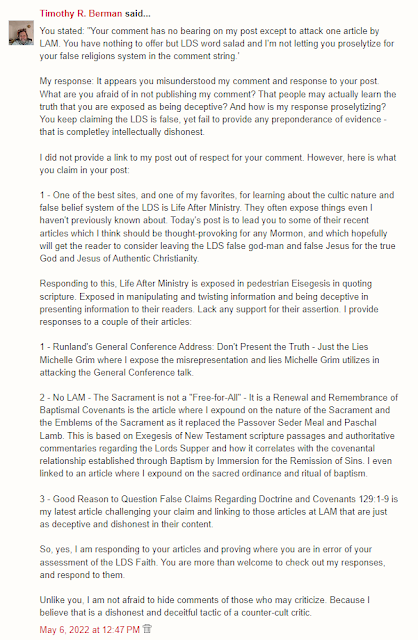
One of Chatfield's posts, dated May 5, 2022, titled Good Stuff to Peruse, I engaged in a discussion with him regarding this issue. Here is his response: 


What was he responding too? Here is my comment. 


The point of this is that the individual guilty of any ad hominem is Glen E. Chatfield. Here are some of the personal insults he has used to attack anyone willing to step up to correct any misinformation and refute any erroneous information that is deceptive and manipulative. 

  • He is a cult member defending false teachings: It is inflammatory and outright slanderous 
  • LDS is a demonic and false system: Arbitrarily dismissing any Latter-day Saint and calling them demonic and false. 
  • LDS Apologists merely cause confusion: Again, further dismissal of any rational discussion. 
  • Joseph Smith a lying and false Prophet: insulting and attacking Joseph Smith without evidence and rational thought. 

The observable attitude and behavior of critics like Chatfield also show that they are entrenched in such toxic apologetics where they do not hold themselves to the same expected standards of respect that is imposed on others. Meaning, they flippantly call people out for perceived personal insults when they are themselves the one doing the insulting and personal attacks. This is called projection. Critics attempt to push their own insecure and inadequacies upon others and then blame them for the exact behavior they are observed in doing. 

The particular criticism that centers around the Latter-day Saint belief of God's nature and the idea God may have had a Father is misconstrued. First, it is oversimplified and framed in a way that does sound quite absurd. On this point - Chatfield is correct. Only correct in the sense that he is manipulating and regurgitating previous information in a way that does sound absurd. Second, it speaks to the nature of how critics, and those who are apostates, are merely lazy learners because often times they do not put forth any effort, energy, and time to honestly engage with the theological nuances of the LDS Faith. Critics often have a rally cry of superiority. "I was a member, I know what I am talking about" or a list of callings and positions of some low hanging fruit of authority. It does not amount to a hill of beans - what matters is whether they are willing to consider the possibility that they may very well be wrong. Sadly, Chatfield, like most critics in my experience of various discussions over the decades of apologetics, is staunch in that they are 100% Correct and use LDS Teachings and scriptures to prove how wrong the LDS Faith is. It is strutting around like a peacock and pontificating intelligence when in reality they are peddling wares of lies and deceptions. Causing confusion and faith crisis and essentially lying in wait to deceive (Ephesians 4:14-15). 
Therefore, my aim is to respond to Glenn E. Chatfield (as I know he won't allow me to publish a comment on his post because has articulated how he does not want his audience to be "confused" or "deceived"). It also will shed light on what has already been established addressed regarding the claim is deemed quite absurd. 

Rebuttal to Glenn E. Chatfield's Post: God Had a Father God?"

Chatfield's post, that is under scrutiny and examination here, reflects several common misconceptions about LDS teaching, doctrine, and faith. Granted, it is important to take the time to have a cohesive and rational discussion where there are theological differences. However, it is Chatfield's observable attitude and behavior regarding the tone, arguments, and presentation that call into question his credibility and undermine his assertions. He relies heavily on logical fallacies (as well as Life After Ministries). And when he engages in any discussion, it is observed to come from a condescending attitude that lacks empathy, compassion, and genuine engagement. Quite uninviting. He does little to foster any meaningful conversation. Nor does he accurate represent what Latter-day Saints actually believe in - no matter how often he may claim that he is merely quoting LDS teaching, leaders, and scriptures. 

Chatfield's presenting argument relies on the following fallacies: 

1. Straw Man Fallacy: By grossly misrepresenting LDS teaching and beliefs about God's nature, through oversimplification and caricaturing the LDS beliefs, Chatfield reduces the idea of God having a Father to a mere crude notion of an endless chain of God's (infinite regression idea and teaching interpreted by numerous counter-cult ministries and apostates over the years). 

2. False Equivalence: Chatfield claims that the LDS God is "nothing like the God of the Bible". By this reasoning, he is implying that because our understanding differs from creedal Christian belief - it is deemed unbiblical and indefensible. This argument fails in acknowledging how LDS theology is deeply rooted in scripture. This includes teachings about divine parentage (e.g., Hebrews 12:9, which refers to God as the Fathers of spirits). Furthermore, Latter-day saints affirm the divine and omnipotent and eternal nature of God. Aligning closely to the Biblical foundation - even if additional revealed truths expand upon these ideas. 

3. Appeal to Ridicule: Employing trigger phrases, like "this is one of those absurd doctrines" are not theological or rational arguments. They are rhetorical mechanisms designed to arbitrarily dismiss LDS beliefs outright. Such hostile and passive aggressive language comes across as arrogant, condescending, and prideful. As such, it discourages any productive and rational discussions. It also reveals a lack of respect for differing perspectives. 

4. Circular Reasoning: Chatfield, assuming that the creedal Christian perspective and worldview of God is the only valid interpretation, uses it as the standard by which LDS doctrine and teaching is measured. Doing so, he disregards the plausibility that LDS Teachings offer greater insights due to restored truths that were once lost or obscured. 

Addressing the Tone of Condescension and Arrogance

Chatfield’s tone is unnecessarily condescending, as evidenced by statements like “And LDS claims they are Christian?!?!” Such rhetorical flourishes reveal an underlying assumption that his interpretation of Christianity is definitive, leaving no room for differing perspectives. This attitude not only alienates Latter-day Saints but also undermines his credibility as someone seeking genuine theological engagement.

Respectful dialogue should aim to understand the beliefs of others rather than mock them. Latter-day Saints unequivocally affirm Jesus Christ as the Son of God, the Savior of the world, and the central figure in God’s eternal plan. Questioning our Christian identity without careful consideration of our faith’s Christ-centered foundation comes across as dismissive rather than constructive.

The LDS Perspective on the Godhead: Monarchial Monotheism

When properly examined, Latter-day Saint theology reflects a monarchial monotheistic view of the Godhead, distinct yet compatible with biblical principles. This perspective acknowledges one God—God the Father—who reigns supreme, with His Son, Jesus Christ, and the Holy Ghost united in purpose and divinity.

The doctrine of divine parentage and eternal progression, as cited by Orson Pratt in The Seer (p. 132), does not detract from the supremacy of God the Father but rather emphasizes His role as the ultimate source of life and creation. The idea that we are “begotten by our Father in Heaven” and that He, in turn, was begotten by a Father aligns with the biblical notion of God as the “Father of spirits” (Hebrews 12:9) and the principle that “as man is, God once was; as God is, man may become” (Lorenzo Snow). This understanding highlights the eternal nature of God’s work and glory: to bring to pass the immortality and eternal life of His children (Moses 1:39).

Far from being a “chain of gods” that diminishes God’s majesty, this doctrine expands our understanding of His eternal nature and His love for us as His children. It underscores the biblical truth that we are created in His image (Genesis 1:27) and invites us to strive for spiritual growth and eventual exaltation through the grace of Jesus Christ.

Conclusion

Glenn E. Chatfield’s critique reflects a misunderstanding of Latter-day Saint theology and relies on logical fallacies, misrepresentation, and dismissive rhetoric. In contrast, LDS doctrine offers a profound and biblically grounded understanding of God’s nature, the Godhead, and our divine potential as His children.

Rather than dismissing LDS beliefs as “absurd,” I invite critics like Chatfield to engage in sincere study and dialogue. By doing so, we can move beyond condescension and ridicule and work toward mutual understanding, even in the face of theological differences.