
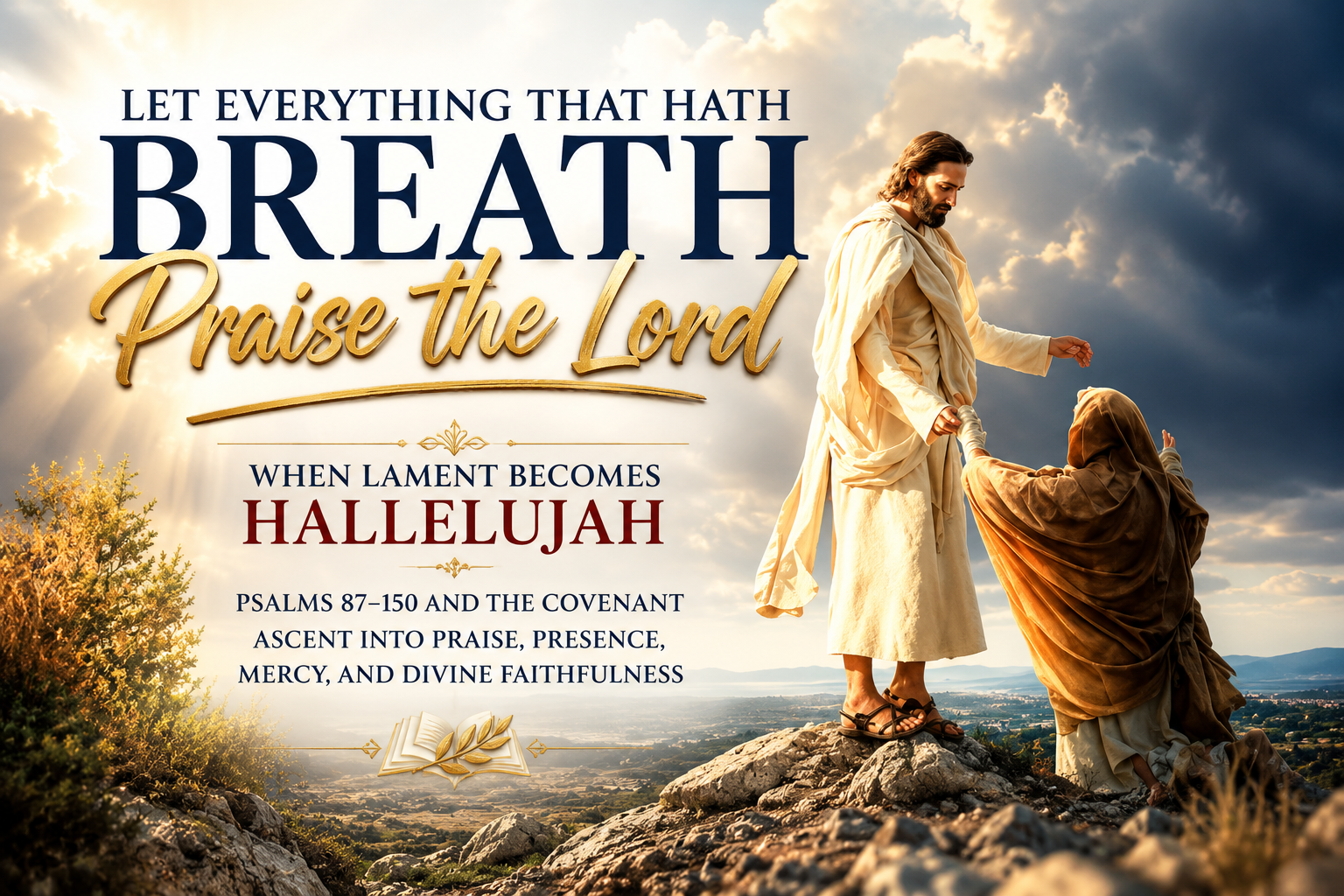
Psalms 87–150 and the Covenant Ascent into Praise, Presence, Mercy, and Divine Faithfulness
The closing movement of the Psalms rises like a liturgical crescendo, but it does not reach hallelujah by pretending that suffering never happened. It carries affliction, exile, mortality, repentance, unanswered questions, and covenant longing into the presence of God. There, pain is neither minimized nor given the final word. Psalms 87–150 teach that biblical praise is more than religious enthusiasm. Praise is covenant memory: the deliberate act of remembering who God is, what He has done, and why His faithfulness remains trustworthy when life feels unsteady.
This Christ-centered Come, Follow Me study focuses on the 2026 reading assignment—Psalms 102–103; 110; 116–119; 127–128; 135–139; and 146–150—while placing those texts within the wider closing movement beginning with Zion in Psalm 87. Together, these psalms reveal the Lord as Creator, covenant Keeper, healer, righteous King, and refuge of the afflicted. They point Christian readers toward Jesus Christ as the enthroned Lord, eternal High Priest, rejected Cornerstone, and compassionate Savior. The Psalter finally summons every instrument, every nation, and “every thing that hath breath” to praise the Lord—not because mortality is painless, but because mercy endures, God reigns, and the road home remains open.
Reading the Closing Psalms as a Covenant Journey
The traditional Jewish name for the Psalter is Tehillim, “Praises.” That title may initially seem surprising because the book contains grief, protest, confession, fear, anger, royal celebration, wisdom instruction, and even prayers that make modern readers uncomfortable. Yet the name tells us where the whole collection is headed. The Psalms do not say that every moment feels praiseworthy. They teach the covenant people how to bring every moment—including the most painful one—before the God who is worthy of praise. The 2026 Come, Follow Me lesson similarly emphasizes that praise can take the form of singing, praying, bearing testimony, and deepening our commitment to follow the Lord.
Biblical scholar Walter Brueggemann famously describes a recurring movement in the Psalms from orientation, through disorientation, into a new orientation. That pattern is not a mechanical formula, and not every psalm moves through all three stages. It is nevertheless a helpful pastoral lens. Faith begins with received assurances about God and the world; suffering then destabilizes what once seemed secure; grace finally creates a renewed confession that has passed through pain rather than bypassed it. The resulting praise is deeper because it is no longer naïve. It has learned that lament can be faithful speech and that worship can survive the night.
The final two books of the Psalter, Psalms 90–106 and 107–150, also answer the crisis left by the apparent collapse of Davidic kingship in Psalm 89. Human thrones fail, generations pass, and Israel experiences exile, but the Lord remains King. Torah still gives light. Zion still represents divine presence and covenant hope. The final five psalms then gather the entire creation into praise. Canonical scholars such as Gerald H. Wilson and the authors of The Book of Psalms have therefore encouraged readers to attend not only to each psalm individually but also to the theological meaning created by the Psalter’s final arrangement. The destination of this prayer book matters: after every lament has been heard, the last canonical word is hallelujah.
A Note on the Reading Range
The official August 31–September 6, 2026, Come, Follow Me assignment includes Psalms 102–103; 110; 116–119; 127–128; 135–139; and 146–150. This study briefly uses Psalms 87–93 as a bridge from Zion to divine kingship and then concentrates on the assigned passages. That wider frame preserves the larger canonical ascent without confusing the supplemental material with the official reading list.
Zion, Mortality, and the Reign of God: Psalms 87–93
Psalm 87 imagines Zion in breathtakingly expansive terms. Egypt—called Rahab here—Babylon, Philistia, Tyre, and Cush are named among the peoples who will be registered as having been born in Zion. Nations once known as rivals or enemies are pictured as belonging within the city of God. The psalm does not erase Israel’s covenant identity; it portrays Zion as the place from which God’s universal purpose radiates. Membership in this holy city is finally established by the Lord, who records the peoples, not by human prejudice or political power. Zion thus becomes both a location and a theological promise: God intends to gather a worshipping family larger than Israel could have imagined.
Psalm 90, the opening prayer of Book IV, turns from the city’s permanence to humanity’s fragility. God has been the dwelling place of His people “in all generations,” but human beings return to dust. “Teach us to number our days,” the psalmist prays, not because life is meaningless, but because mortality should awaken wisdom. Psalm 91 answers with the imagery of refuge beneath divine wings, though it should not be reduced to a promise that faithful people will never suffer. Its poetry confesses that God remains a shelter amid terror, disease, danger, and uncertainty. Psalm 92 turns gratitude into Sabbath worship, and Psalm 93 declares that the Lord reigns above the roaring floods.
Taken together, these psalms begin the final movement with a necessary reordering. Human life is brief, empires are unstable, and chaos is loud, but God’s throne is not shaken. Praise begins when the worshipper stops treating personal control as the foundation of reality and remembers the Lord’s everlasting reign. In temple language, this is an ascent away from the illusion of self-sufficiency and toward the presence of the eternal King.
When Praise Rises from Pain: Psalms 102–103 and 116
Psalm 102 is identified in its superscription as “a prayer of the afflicted, when he is overwhelmed, and poureth out his complaint before the Lord.” The language is painfully embodied. The sufferer’s days disappear like smoke, the heart withers like grass, bones cling to skin, sleep will not come, and isolation feels like a solitary bird on a rooftop. Scripture does not rebuke this worshipper for speaking honestly. The complaint itself becomes prayer because it is addressed to God. Lament is not the abandonment of covenant relationship; it is what covenant faith sounds like when the worshipper refuses to suffer alone.
The psalm turns at verse 12: “But thou, O Lord, shalt endure for ever.” The sufferer’s condition has not instantly changed, yet attention shifts from a vanishing life to God’s enduring reign and from private anguish to Zion’s promised restoration. The Lord will hear the destitute, free those appointed to death, and act in a way that future generations can remember. This turn does not cancel the earlier lament. It places individual pain inside a larger story of divine faithfulness. Even more significantly for Christian readers, Hebrews 1:10–12 applies Psalm 102:25–27 to the Son, confessing the enduring identity and creative sovereignty of Jesus Christ.
Psalm 103 answers affliction with disciplined remembrance: “Bless the Lord, O my soul, and forget not all his benefits.” The psalmist names those benefits—God forgives, heals, redeems, crowns, satisfies, executes righteousness, and shows compassion. The praise is tender because God remembers what we often forget: “he knoweth our frame; he remembereth that we are dust.” Divine mercy is not offered to imaginary people who never break down. It is extended to mortal people whose bodies weaken, whose memories fail, and whose lives require redemption.
At the center of that mercy stands the Hebrew word hesed. The King James Version often renders it “mercy” or “lovingkindness,” but its range can include steadfast love, kindness, loyalty, and covenant faithfulness. Psalm 103:17–18 applies the Lord’s enduring hesed particularly to those who keep His covenant and remember His commandments. This should not be distorted into a cold transaction in which human performance purchases divine love. Rather, hesed names the loyal love by which God binds Himself to His people and continues working to reclaim them. President Russell M. Nelson describes it as a special love and mercy available within covenant relationship, while major Hebrew studies caution that no single English word captures every use of the term. The Church’s Scripture Helps appropriately identifies covenantal love as central to Psalm 103 without pretending that the word has only one mechanical definition.
Psalm 116 then shows what happens when mercy becomes testimony. The worshipper loves the Lord because the Lord has heard his voice. After being surrounded by death and distress, he asks, “What shall I render unto the Lord for all his benefits toward me?” The answer is not repayment, as though grace could be reimbursed. He will receive the cup of salvation, call upon the Lord, fulfill his vows, offer thanksgiving, and testify “in the courts of the Lord’s house.” Praise becomes public covenant witness. The one who cried in private now stands among the people and declares that deliverance belongs to God.
This is why praise in suffering is not spiritual denial. Psalm 102 gives us permission to name what hurts. Psalm 103 trains the soul to remember mercy. Psalm 116 carries gratitude into the worshipping community. President Camille N. Johnson’s message “Jesus Christ Is Relief” harmonizes with this movement: through His Atonement, Christ relieves the burdens of sin and succors us in mortal infirmity. Praise rises because the suffering person is heard, the dusty soul is remembered, and the burdened disciple is not left to walk alone.
Jesus Christ, the Priest-King and Cornerstone: Psalms 110 and 118
Psalm 110 was first heard within the world of Israel’s royal theology. “The Lord said unto my Lord, Sit thou at my right hand” portrays the king receiving delegated authority beside God, while verse 4 joins kingship with priesthood “after the order of Melchizedek.” Responsible Christian interpretation need not deny that ancient royal setting in order to confess the psalm’s fuller canonical significance. The New Testament repeatedly receives the psalm as testimony of Jesus Christ. Jesus cites Psalm 110:1 while questioning assumptions about the Messiah’s identity in Matthew 22:41–45, and Hebrews develops Psalm 110:4 into its sustained proclamation of Christ as the eternal High Priest.
Hebrews does more than attach a proof text to Jesus. It presents Him as the sinless Priest who has passed through the heavens, entered within the veil, and become the Forerunner for His people (Hebrews 4:14–16; 6:19–20; 7:23–28). The enthroned King is also the compassionate High Priest who knows mortal weakness and opens access to God. From a Latter-day Saint perspective, the title “Melchizedek Priesthood” reverently points beyond Melchizedek himself to “the Holy Priesthood, after the Order of the Son of God” (Doctrine and Covenants 107:3–4). Priesthood, temple access, and redemption converge in Christ.
Psalm 118 belongs to the festival collection commonly known as the Egyptian Hallel, Psalms 113–118. Its language celebrates deliverance and entrance through the gates of righteousness. “The stone which the builders refused is become the head stone of the corner” may have evoked Israel, the Davidic king, or a worshipper vindicated by God within the psalm’s first horizon. The New Testament then identifies Jesus as the decisive fulfillment of the rejected-and-exalted stone (Matthew 21:42; Acts 4:10–12; 1 Peter 2:4–7). The canonical development matters: Christian faith does not erase the psalm’s history but sees Israel’s pattern of rejection and vindication gathered up in the crucified and risen Messiah.
The cry “Save now” in Psalm 118:25 translates the Hebrew plea hoshi‘ah na, from which “Hosanna” comes. During Jesus’s triumphal entry, the crowd joins that plea to the blessing of Psalm 118:26: “Blessed is he that cometh in the name of the Lord” (Matthew 21:9). What was sung as a festival prayer becomes a royal welcome. Praise here is doctrinal proclamation. Jesus is not simply a source of inspirational feeling; He is the promised King, the eternal Priest, the rejected Cornerstone, and the One through whom worshippers enter the presence of God.
Psalm 119: Praise as a Path Illuminated by the Word
Psalm 119 is a work of extraordinary poetic discipline. Its 176 verses are arranged in twenty-two stanzas corresponding to the Hebrew alphabet. Each stanza contains eight verses, and every verse within a stanza begins with the same Hebrew letter. The Church’s background resource notes that such a structure could assist memorization in a culture where sacred texts were often learned and transmitted orally. The form also suggests completeness: from aleph to tav, the worshipper brings the whole vocabulary of life under the instruction of God.
The psalm repeatedly uses words translated as law, testimonies, ways, precepts, statutes, commandments, judgments, and word. Yet Torah in Psalm 119 is not merely a list of regulations. It is divine instruction that reveals the path of life. The speaker delights, seeks, remembers, longs, grieves, wanders, repents, and asks to be made alive. Grace and obedience are not rivals here. God must teach, strengthen, enlarge, revive, and seek His servant; the servant responds by treasuring and walking in God’s word.
“Thy word is a lamp unto my feet, and a light unto my path” (Psalm 119:105) is intentionally local imagery. A lamp does not necessarily illuminate the entire road at once. It gives enough light for the next faithful step. The Come, Follow Me manual invites readers to notice words such as walk, path, way, feet, and wander. Restoration scripture expands the same journey imagery: the word of God is represented by the iron rod in Lehi’s dream (1 Nephi 11:25), the covenant path leads through the gate of repentance and baptism (2 Nephi 31:17–21), and Alma urges disciples to walk in the Lord’s straight paths (Alma 7:19–20).
President Russell M. Nelson compares scripture to an authoritative road map that helps disciples identify a wrong turn, repent, make restitution, and return to the strait and narrow path in “Living by Scriptural Guidance.” This is a crucial distinction. Scriptural guidance is not given so that disciples can admire the map while remaining stationary. The word is praised by being trusted, practiced, and obeyed. Praise becomes a way of walking.
Unless the Lord Builds the House: Psalms 127–128
Psalms 127 and 128 are Songs of Ascents, part of the collection associated with pilgrims going up toward Jerusalem. Their attention to labor, home, children, food, and generational blessing shows that temple ascent does not despise ordinary life. Worship orders the household by placing it under God: “Except the Lord build the house, they labour in vain that build it.” The psalm does not condemn planning, work, vigilance, or craftsmanship. It exposes the anxiety of human effort that imagines itself sufficient without divine grace.
Psalm 127 calls children “an heritage of the Lord” and compares the children of one’s youth to arrows in a warrior’s hand. The imagery belongs to an ancient social world in which a large household often contributed to economic survival, continuity, and protection. The Scripture Helps commentary acknowledges this ancient context. Modern readers should therefore receive the psalm’s affirmation of children without turning it into a weapon against those who are single, infertile, childless, grieving, estranged, or part of families whose stories do not fit an idealized picture. A gift remains a gift; it is not a scoreboard of righteousness.
Psalm 128 connects reverence for the Lord with work, table fellowship, flourishing, Zion, and peace across generations. Its vision is covenantal and communal rather than merely private. The Lord’s house and our houses belong together: temple worship should make us more faithful, patient, protective, and loving at home. Praise is not complete when it produces beautiful words in the sanctuary but no mercy at the dinner table.
Praise That Dethrones Idols and Remembers Mercy: Psalms 134–136
Psalm 134 closes the Songs of Ascents by addressing the servants who minister in the Lord’s house at night. Hands are lifted in the sanctuary, blessing ascends to God, and blessing descends from the Maker of heaven and earth. The brief psalm captures the reciprocity of worship: the covenant people bless the Lord, and the Lord blesses His people from Zion. The ascent into the sanctuary sends worshippers back into the world under divine blessing.
Psalm 135 contrasts the living Lord with idols made of silver and gold. These images possess mouths, eyes, and ears but cannot speak, see, hear, or breathe. The warning becomes even sharper when the psalm declares that those who make and trust them become like them. Worship forms the worshipper. What we treat as ultimate slowly gives shape to our desires, habits, imagination, and character.
Modern idols are often less visible than carved statues. Career, money, ideology, influence, technology, appetite, public approval, resentment, and even an idealized image of self can demand the loyalty that belongs to God. Elder Dallin H. Oaks asks whether we are serving priorities or gods ahead of the God we profess to worship in “No Other Gods.” Praise confronts idolatry because it tells the truth about ultimacy. It names the Creator as God and returns every lesser good to its proper place.
Psalm 136 then repeats its central confession twenty-six times: “for his mercy endureth for ever.” The refrain does not float above history. Each repetition is attached to something God has done—creating the heavens, bringing Israel out of Egypt, leading through the wilderness, granting deliverance, and providing food. The psalm teaches a communal discipline of memory. One voice recounts the mighty act; the congregation answers with enduring hesed. Praise becomes a call-and-response testimony that trains the people to recognize the same faithful character of God across creation, exodus, wilderness, and daily provision.
Exile, Intimacy, and the God Who Searches the Heart: Psalms 137–139
Psalm 137 prevents the closing movement from becoming sentimental. Exiles sit beside Babylon’s rivers, weep for Zion, and refuse to turn sacred songs into entertainment for their captors. The psalm ends with a horrifying imprecation against Babylon’s children. That line describes the moral and emotional devastation of conquered people; it does not command disciples to repeat the violence. Faithful interpretation allows the text to expose trauma, rage, and the human desire for retaliation while bringing those emotions before God rather than converting them into private vengeance. Christian readers must finally place such anger under Jesus Christ’s command to love enemies, pray for persecutors, and refuse the cycle of hatred.
Psalm 138 answers exile’s threatened silence with thanksgiving directed toward God’s holy temple. The worshipper praises the Lord for lovingkindness, truth, answered prayer, and strength of soul. Even kings will eventually hear the Lord’s words, and though God is high, He attends to the lowly. Praise here is not escape from trouble: “Though I walk in the midst of trouble, thou wilt revive me.” The psalmist trusts that God will complete His work because His mercy endures.
Psalm 139 brings that divine attention into the most intimate possible register: “O Lord, thou hast searched me, and known me.” God knows sitting and rising, thought and speech, movement and rest. This omniscience can feel threatening if God is imagined only as an accuser, but the psalm’s dominant images are presence and guidance. The divine hand surrounds, leads, holds, and forms. In verse 8, the Hebrew word rendered “hell” in the King James Version is Sheol, the realm of the dead. The point is not that the psalmist has chosen evil as a home; it is that neither heaven’s height nor death’s depth lies beyond God’s reach.
The psalm again contains difficult language in verses 19–22, where the speaker expresses hatred for God’s enemies. The Church’s Scripture Helps reads this as a declaration of undivided loyalty while explicitly directing disciples to the Savior’s higher law of enemy-love. Most importantly, the psalm does not end with the speaker examining everyone else. It ends with an invitation for God to examine him: “Search me, O God, and know my heart.” True praise surrenders the hidden self to divine light and asks to be led “in the way everlasting.”
The Final Hallel: From Personal Testimony to Cosmic Praise in Psalms 146–150
Psalms 146–150 form the closing doxology often called the Final Hallel. Each psalm begins and ends with hallelujah, “Praise the Lord.” The repetition creates acceleration, but each psalm adds a distinct dimension. The final praise of the Psalter is not vague positivity. It is grounded in the Lord’s character, justice, creative power, covenant care, and redemptive action. Detailed studies of the collection’s textual history, including Alma Brodersen’s The End of the Psalter, show that the five-psalm ending is especially clear in the Masoretic form of the Psalter—the Hebrew textual tradition underlying most modern Old Testament translations.
Psalm 146 begins by refusing misplaced trust in princes and mortal power. The Lord, by contrast, made heaven and earth, keeps truth, executes justice for the oppressed, feeds the hungry, frees prisoners, opens blind eyes, raises the bowed down, loves the righteous, protects strangers, and sustains the fatherless and widow. Praise is therefore ethical as well as liturgical. A congregation cannot credibly sing about this God while remaining indifferent to people He defends.
Psalm 147 gathers exiles, heals the brokenhearted, binds wounds, counts stars, governs creation, and gives His word to Israel. Divine greatness is simultaneously cosmic and pastoral. The One who names the stars also notices a shattered heart. Psalm 148 expands the choir to angels, sun, moon, stars, heavens, sea creatures, weather, mountains, trees, animals, rulers, peoples, young, and old. Creation praises by being what God called it to be, while human beings add conscious testimony to the cosmic chorus.
Psalm 149 summons the covenant assembly to sing a new song. Its closing images of judgment are difficult for modern worshippers, yet within the psalm they celebrate the defeat of oppression and the vindication of God’s afflicted people. Such texts must never be recruited to sanctify personal violence or partisan vengeance. Read canonically through Jesus Christ, victory belongs to God, and disciples wage spiritual warfare through truth, holiness, patient witness, and love rather than hatred.
Psalm 150 finally answers four questions. Where should God be praised? In His sanctuary and throughout His mighty heavens. Why should He be praised? For His mighty acts and excellent greatness. How should He be praised? With trumpet, strings, percussion, dance, and resounding cymbals—with the entire range of worship available to the community. Who should praise? “Every thing that hath breath.” The list is not merely an argument about which instruments are permitted in worship. It is a poetic summons to total participation. Nothing that lives is excluded from the call to acknowledge the Giver of life.
The Psalter begins in Psalm 1 with one person choosing between two paths. It ends in Psalm 150 with every breathing creature summoned into one chorus. Between those points lie rebellion, repentance, grief, violence, sickness, exile, rescue, Torah, kingship, temple, and hope. The final hallelujah does not deny any of them. It declares that none of them—not even death—can finally silence the praise due to God.
Four Scholarly Lenses That Deepen the Study
1. The Psalms and Temple Worship
Many psalms are closely connected with temple-centered worship, though scholars rightly debate the precise ritual setting of individual compositions. Sigmund Mowinckel’s liturgical work remains historically influential, but some of his reconstructions are more confident than the available evidence permits. The safer conclusion is substantial rather than totalizing: temple, procession, sacrifice, kingship, covenant renewal, sacred music, and the desire to behold God’s presence are indispensable themes in the Psalter.
Latter-day Saint scholarship adds a productive Restoration lens without requiring every psalm to describe a modern ordinance. Andrew C. Skinner’s “Seeing God in His Temple” traces the Psalms’ longing to seek God’s face in the holy place. Shon D. Hopkin and J. Arden Hopkin’s “The Psalms Sung” shows how lament, thanksgiving, instruction, sacrifice, music, and divine encounter could function together in sacred worship. These studies support a temple pattern of approach, cleansing, covenant, presence, and praise while maintaining appropriate historical caution.
2. Lament and Praise Belong Together
Brueggemann’s categories of orientation, disorientation, and new orientation explain why biblical praise can be robust without becoming shallow. Lament refuses to lie about suffering; thanksgiving recognizes deliverance; praise names God as worthy beyond any single circumstance. Psalm 102’s afflicted prayer, Psalm 103’s remembered mercy, and Psalm 116’s public testimony provide a concentrated example. The movement is not from honesty to denial, but from isolation to covenant memory and renewed trust.
3. Hesed Is Loyal Love in Action
Lexicons and focused studies by scholars such as Katharine Doob Sakenfeld show why hesed cannot be reduced to one English gloss. Depending on context, it may emphasize kindness, mercy, loyalty, steadfast love, or covenant faithfulness. In Psalms 103 and 136, the word describes love revealed through remembered action. God forgives, rescues, guides, feeds, and keeps covenant. President Nelson’s covenant emphasis is therefore pastorally powerful when held together with the term’s broader semantic range: hesed is not sentimental affection but reliable love that acts for the good of the beloved.
4. Christological Reading Honors More Than One Horizon
Psalms 110 and 118 demonstrate how Christian interpretation can honor both an ancient horizon and New Testament fulfillment. A royal or liturgical text could first speak meaningfully within Israel and later become part of the inspired vocabulary by which Jesus and His apostles revealed the Messiah. The New Testament does not merely hunt for isolated predictions. It presents Jesus Christ as the One in whom Israel’s royal, priestly, temple, suffering, and vindication patterns reach their decisive fulfillment. This two-horizon approach strengthens rather than weakens Christ-centered reading because it treats fulfillment as the culmination of a real covenant history.
Five Ways to Make Praise a Covenant Practice
Tell God the truth before trying to sound triumphant
Begin where Psalm 102 begins. Name the grief, fear, loneliness, resentment, confusion, or exhaustion you are actually carrying. Honest lament is not a failure of praise; it clears away religious performance so that genuine trust can grow. Address the complaint to God and remain in the relationship, even when you cannot yet see how the prayer will turn.
Remember specific acts of mercy
Follow the discipline of Psalms 103 and 136 by naming what God has done. General gratitude can remain abstract, but remembered mercy becomes testimony. Write down one act of creation, deliverance, provision, forgiveness, guidance, or sustaining grace. Then connect the gift to God’s character: He acted mercifully because He is merciful.
Identify the rival loyalty shaping your heart
Let Psalm 135 ask what has become functionally ultimate. What receives your first attention, deepest fear, strongest sacrifice, or greatest trust? An idol promises control but cannot breathe life into the worshipper. Repentance dethrones the false god, and praise restores the Lord to the center.
Walk the next illuminated step
Psalm 119 does not promise a floodlight over the entire future. It promises a lamp for the path. Ask what truth you already know but have delayed obeying. The next step may be confession, restitution, forgiveness, a boundary, temple worship, service, study, or a difficult conversation. Praise becomes embodied when the word moves from the page into practice.
Join the congregation’s song
Psalm 150 does not end with a private spiritual experience. It gathers breath, bodies, instruments, generations, and creation into shared worship. Sing even when your voice is imperfect. Bear testimony even when it trembles. Receive strength from someone else’s hallelujah, and lend your faith to someone who can only lament today. Covenant praise is communal ascent.
Questions for Personal Study or Group Discussion
- What does Psalm 102 teach about the difference between faithful lament and unbelief?
- Which “benefit” named in Psalm 103 do you most need to remember right now?
- How do Psalms 110 and 118 deepen your understanding of Jesus Christ as King, Priest, and Cornerstone?
- What competing loyalty does Psalm 135 invite you to place beneath God?
- What is the next step illuminated by Psalm 119’s “lamp” in your present covenant walk?
- How can your praise become more attentive to the oppressed, hungry, brokenhearted, stranger, fatherless, or widow described in Psalms 146–147?
Closing Pastoral Invitation: Breathe His Mercy and Praise the Lord
Let everything that hath breath praise the Lord—not because life is easy, but because God is faithful. Praise is the language of covenant memory, the posture of discipleship, and the breath of a redeemed people. It is the afflicted soul pouring out complaint in Psalm 102, the forgiven soul remembering mercy in Psalm 103, the delivered soul paying vows in Psalm 116, and the wandering soul finding light in Psalm 119. It is the exile refusing to forget Zion, the searched heart surrendering to God, and the whole creation awakening to its Maker.
Above all, Christian praise is centered in Jesus Christ. He is the Lord enthroned at the right hand of God, the High Priest who has entered within the veil, the Stone rejected by builders and exalted as the Cornerstone, and the Savior who knows how to succor His people. In Him, lament is heard, sin can be forgiven, death is not final, and the path home remains open. Elder Dieter F. Uchtdorf teaches in “The Prodigal and the Road That Leads Home” that the Master Healer stands ready to welcome those who return. The Father’s mercy is not exhausted by our wandering.
Bring God your honest breath today. If it comes as a cry, let it be a prayer. If it comes as confession, let it become repentance. If it comes as thanksgiving, let it become testimony. If it comes as song, add it to the worshipping community. Walk the path, enter His presence, remember His mercy, and lift your voice. The Psalter has carried us from lament to hallelujah. Now its final summons becomes ours: “Let every thing that hath breath praise the Lord. Praise ye the Lord.”
Frequently Asked Questions
What does “Let every thing that hath breath praise the Lord” mean?
Psalm 150:6 summons every living being to acknowledge the Creator. Within the psalm, sanctuary, heavens, mighty acts, instruments, movement, and breath all converge in total worship. The verse is both a universal invitation and the theological climax of the Psalter.
Why does the book of Psalms end with praise after containing so much lament?
The final praise does not erase lament. It shows where faithful lament can lead when grief is brought into covenant relationship with God. The canonical movement teaches that pain is real, prayer is heard, God remains King, and suffering does not receive the last word.
How does Psalm 110 point to Jesus Christ?
Psalm 110 portrays an enthroned royal figure and a priest after the order of Melchizedek. Jesus cites the psalm in Matthew 22, and Hebrews interprets its priestly promise as fulfilled in Christ, the eternal High Priest and Forerunner who enters within the veil for His people.
What does hesed mean in Psalm 103?
Hesed has a broad range that includes steadfast love, mercy, kindness, loyalty, and covenant faithfulness. In Psalm 103:17–18 it emphasizes the Lord’s enduring covenant love toward those who keep His covenant and remember His commandments.
Is it wrong to lament when I am supposed to praise God?
No. The Psalms repeatedly model lament as faithful prayer. Lament tells God the truth about suffering while continuing to address Him. Biblical praise becomes stronger, not weaker, when it has passed through honest grief.
Is Psalm 139 describing God as watching us to condemn us?
Psalm 139 emphasizes comprehensive knowledge, but its central images include surrounding, forming, leading, holding, and searching. The psalmist finally invites God’s examination because divine knowledge can expose destructive ways and lead the worshipper into “the way everlasting.”
Annotated Works Cited
Biblical and Non-LDS Scholarship
Brodersen, Alma. The End of the Psalter: Psalms 146–150 in the Masoretic Text, the Dead Sea Scrolls, and the Septuagint. De Gruyter, 2017. De Gruyter. This textual study compares the closing psalms across major ancient witnesses. It is especially valuable for qualifying the common statement that Psalms 146–150 function identically as the Psalter’s ending in every textual tradition.
Brueggemann, Walter. The Message of the Psalms: A Theological Commentary. Augsburg Publishing House, 1984. Brueggemann’s influential orientation–disorientation–new orientation framework explains how lament, thanksgiving, and praise function as forms of faithful speech through changing seasons of life.
deClaissé-Walford, Nancy L., Rolf A. Jacobson, and Beth LaNeel Tanner. The Book of Psalms. New International Commentary on the Old Testament, Eerdmans, 2014. Eerdmans. This major contemporary commentary attends to Hebrew language, literary form, theology, and the canonical shaping of the Psalter. It is useful across Psalms 87–150 and provides an academically responsible foundation for teaching and preaching.
Goldingay, John. Psalms. Volume 3, Psalms 90–150. Baker Academic, 2008. Baker Academic. Goldingay offers his own translation followed by detailed linguistic, historical, and theological commentary. This volume directly covers nearly the entire range of the Come, Follow Me assignment.
Hossfeld, Frank-Lothar, and Erich Zenger. Psalms 3: A Commentary on Psalms 101–150. Translated by Linda M. Maloney, Fortress Press, 2011. Hermeneia. This critical commentary emphasizes the literary relationships among the final psalms and their role within the shape of the Psalter, including the concluding Hallel.
Koehler, Ludwig, Walter Baumgartner, and Johann Jakob Stamm. The Hebrew and Aramaic Lexicon of the Old Testament. Translated and edited by M. E. J. Richardson, 5 vols., Brill, 1994–2000. HALOT Online. This standard academic lexicon supplies the semantic range of important Hebrew terms, including hesed, Torah, and Sheol, and guards against building doctrine on a single English gloss.
Mowinckel, Sigmund. The Psalms in Israel’s Worship. Translated by D. R. Ap-Thomas, 2 vols., Basil Blackwell, 1962. Mowinckel’s work established an influential liturgical approach to the Psalms and remains important for temple, festival, kingship, and worship studies. Some specific reconstructions remain debated and should be used with appropriate caution.
Sakenfeld, Katharine Doob. The Meaning of Hesed in the Hebrew Bible: A New Inquiry. Scholars Press, 1978. Harvard Semitic Monographs 17. This focused semantic study demonstrates that hesed is a relational term whose nuance depends on context. It provides important balance to simplified definitions such as “covenant love” while supporting loyalty and active kindness as central ideas.
Wilson, Gerald H. The Editing of the Hebrew Psalter. Scholars Press, 1985. Wilson’s foundational canonical study argues that the arrangement of the Psalms contributes theological meaning beyond the message of each independent poem. His work is especially relevant to the transition from the crisis of Psalm 89 to divine kingship, Torah, and final praise.
Latter-day Saint Scholarship and Church Sources
Hopkin, J. Arden, and Shon D. Hopkin. “The Psalms Sung: The Power of Music in Sacred Worship.” Ascending the Mountain of the Lord: Temple, Praise, and Worship in the Old Testament, edited by Jeffrey R. Chadwick, Matthew J. Grey, and David Rolph Seely, Religious Studies Center, Brigham Young University, and Deseret Book, 2013, pp. 329–48. This chapter relates the genres and musical performance of the Psalms to ancient temple worship and considers how sacred music prepares worshippers to commune with God.
Johnson, Camille N. “Jesus Christ Is Relief.” Liahona, May 2023, pp. 81–83. President Johnson teaches that Christ relieves the burden of sin and succors His people in mortal infirmity. Her pastoral message directly supports a Christ-centered reading of Psalms 102–103 and 116.
Nelson, Russell M. “The Everlasting Covenant.” Liahona, Oct. 2022, pp. 4–11. President Nelson explains covenant relationship as an everlasting bond and uses hesed to describe the special love and mercy God extends to those who covenant with Him. This source gives the article’s Latter-day Saint application of Psalm 103:17–18.
---. “Living by Scriptural Guidance.” Ensign, Nov. 2000, pp. 16–18. President Nelson compares scripture to a road map that enables disciples to recognize wrong turns, repent, and return to the path leading to eternal life. The message closely aligns with Psalm 119’s path, feet, light, and word imagery.
Oaks, Dallin H. “No Other Gods.” Ensign or Liahona, Nov. 2013, pp. 72–75. Elder Oaks applies the command against idolatry to modern priorities that displace God. His questions provide a direct bridge from Psalm 135’s powerless images to contemporary discipleship.
Skinner, Andrew C. “Seeing God in His Temple: A Significant Theme in Israel’s Psalms.” Ascending the Mountain of the Lord: Temple, Praise, and Worship in the Old Testament, edited by Jeffrey R. Chadwick, Matthew J. Grey, and David Rolph Seely, Religious Studies Center, Brigham Young University, and Deseret Book, 2013, pp. 270–90. Skinner surveys the desire to see God’s face and enter His presence within Israel’s Psalms. The chapter supplies careful support for a Latter-day Saint temple-ascent reading.
The Church of Jesus Christ of Latter-day Saints. “August 31–September 6: ‘Let Every Thing That Hath Breath Praise the Lord.’” Come, Follow Me—For Home and Church: Old Testament 2026, 2026. Accessed 25 Aug. 2026. This is the governing curriculum source for the assigned psalms and its central themes: comfort in suffering, Christological prophecy, the scriptural path, freedom from idols, divine knowledge, and praise.
---. “Psalms 102–103; 110; 116–119; 127–128; 135–139; 146–150.” Scripture Helps: Old Testament, 2026. Accessed 25 Aug. 2026. This background resource explains hesed, the two uses of “Lord” in Psalm 110, Christ’s Melchizedek priesthood, Psalm 119’s acrostic, the ancient setting of Psalm 127, and the challenging hatred language in Psalm 139.
Uchtdorf, Dieter F. “The Prodigal and the Road That Leads Home.” Liahona, Nov. 2023, pp. 86–88. Elder Uchtdorf presents repentance as the courageous return to a Father who welcomes the prodigal. His message strengthens the article’s pastoral conclusion about mercy, homecoming, and renewed praise.


No comments:
Post a Comment