
A Come, Follow Me introduction to Job, Psalms, Proverbs, and Ecclesiastes
Job, Psalms, Proverbs, and Ecclesiastes do not offer one flat explanation of faithful life. They give us an inspired conversation. Job protests any theology that reduces suffering to a predictable equation. The Psalms teach covenant Israel to pray through joy, guilt, abandonment, fear, gratitude, and praise. Proverbs forms moral perception by training the disciple to fear the Lord and choose wisdom over folly. Ecclesiastes exposes the vapor-like instability of mortal achievement and the limits of human control. Read together, these books move repeatedly from order into disorientation and from disorientation toward a renewed, humbler communion with God.
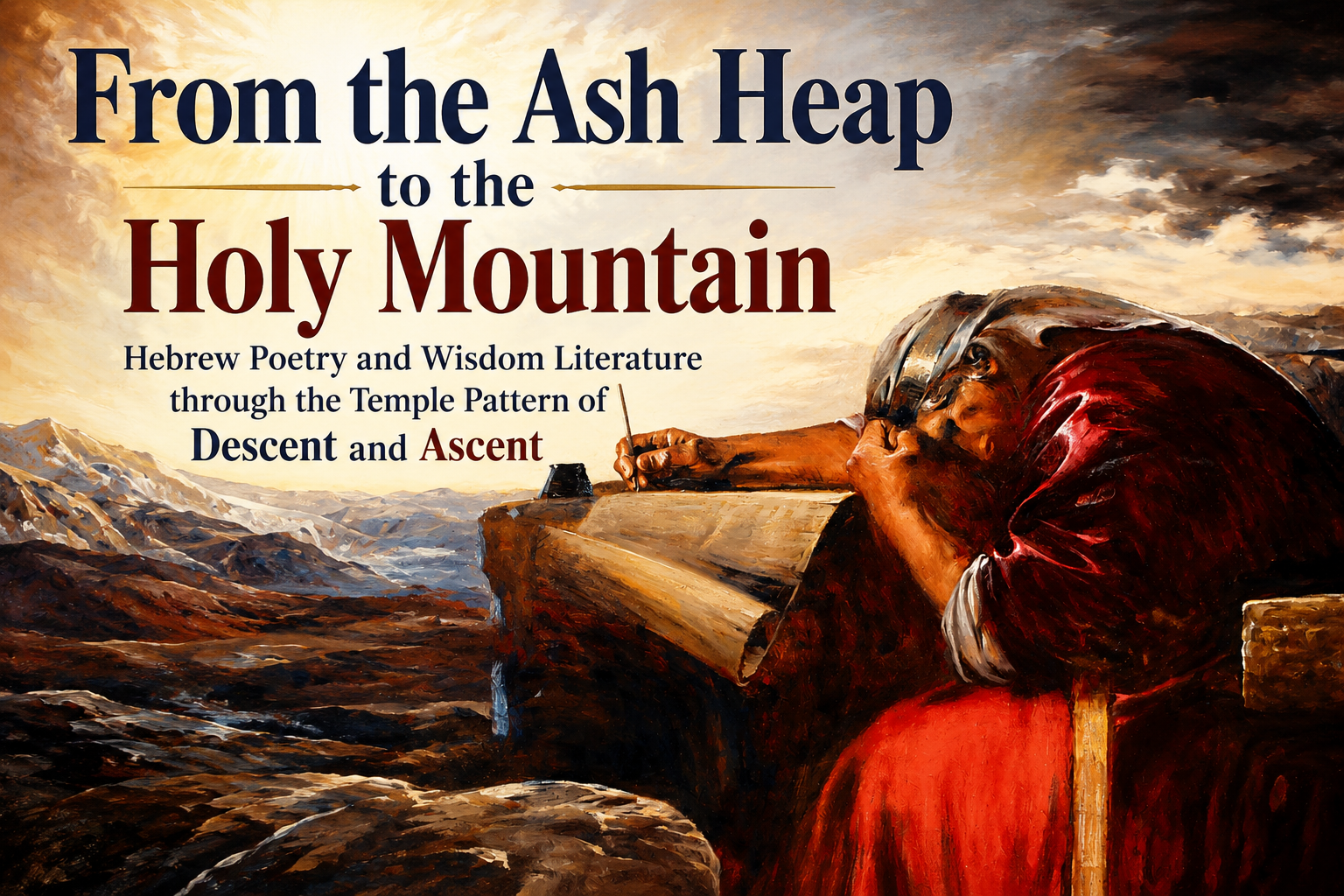
This study proposes the temple pattern of descent and ascent as a theological and devotional framework for that movement. Descent names mortality, estrangement, lament, disorder, and the collapse of false certainty. Ascent names purification, covenant formation, divine instruction, unveiled perspective, and renewed presence. The framework is grounded most directly in the temple setting of many Psalms—especially Psalm 24—but it should not be mistaken for a claim that Job, Proverbs, and Ecclesiastes were all composed as a single temple ritual. Instead, it is a canonical, Christ-centered reading that brings the wisdom books into conversation with Israel’s worship, the plan of salvation, and the Latter-day Saint journey back into God’s presence. The W.I.S.D.O.M. arc developed below provides the series structure: Walk, Invite, Seek, Discern, Observe, and Meet.
When Scripture Stops Telling a Story and Begins Teaching Us to Pray
From Genesis through Esther, much of the Old Testament moves through narrative. People journey, kingdoms rise, covenants are established, families divide, prophets confront kings, and Israel is scattered and gathered. Then the texture of the canon changes. We encounter a righteous sufferer sitting in ashes, worshippers crying from the depths, parents instructing children at the crossroads, and a Teacher watching generations pass beneath the sun. The action has not disappeared, but it has moved inward. Scripture begins to dramatize the life of the soul.
The 2026 Come, Follow Me introduction, “Reading Poetry in the Old Testament,” calls attention to this transition. Beginning with Job, poetic language becomes especially prominent because poetry can express “deep feelings or monumental prophecies” with a memorable concentration that ordinary prose does not always provide. The manual also cautions modern readers that Hebrew poetry is not primarily based on end rhyme. Although rhythm, wordplay, and sound repetition occur in Hebrew, much of that artistry becomes difficult to reproduce in translation. The most visible feature in English is parallelism, the deliberate relationship between adjoining lines or clauses (The Church of Jesus Christ, “Reading Poetry”).
That shift matters spiritually as well as literarily. Narrative frequently tells us what happened; poetry draws us into what an event feels like before God. Narrative may report exile, but lament teaches the exile how to pray. Narrative may describe covenant, but wisdom trains a person to inhabit covenant faithfully. Narrative may recount a visit to the temple, but a psalm can place the worshipper at the gate and ask, “Who shall ascend into the hill of the Lord? or who shall stand in his holy place?” (Psalm 24:3).
This is why Job, Psalms, Proverbs, and Ecclesiastes are indispensable to discipleship. They refuse to protect faith from the pressures of actual life. They ask why the righteous suffer, why the wicked sometimes prosper, whether human labor endures, how desire shapes character, whether God hears prayer, and how a mortal person can stand in the divine presence. These books do not merely give us religious information. They form a people capable of living faithfully when easy answers have failed.
How Hebrew Poetry Works: Parallelism, Intensification, and Sacred Imagination
The familiar explanation that Hebrew poetry “rhymes ideas rather than sounds” is helpful, but it can be too simple. Parallel lines do not merely repeat the same proposition with different vocabulary. Robert Alter emphasizes that the second line often sharpens, specifies, intensifies, or even destabilizes the first. Adele Berlin’s linguistic analysis likewise demonstrates that parallelism can operate through meaning, grammar, sound, word order, and imagery at the same time (Alter; Berlin). The reader should therefore ask not only, “What is repeated?” but also, “What changes when the second line arrives?”
Psalm 29:4 provides an accessible example:
The voice of the Lord is powerful;
the voice of the Lord is full of majesty.
The second line does not merely duplicate “powerful.” It interprets divine power as majesty. The voice is not brute force; it possesses royal glory, beauty, and authority. Proverbs 15:1 uses contrast instead:
A soft answer turneth away wrath:
but grievous words stir up anger.
Here parallelism places two paths beside one another. Speech is never treated as morally neutral; it either de-escalates anger or feeds it. Poetry compresses an entire theology of human communication into one balanced saying.
Biblical poetry also depends upon metaphor. God is shepherd, rock, shield, king, judge, light, refuge, and consuming fire. The righteous become trees planted by water, while the wicked become chaff driven by wind. Wisdom builds a house and prepares a feast; Folly imitates her invitation while hiding death among her guests. Hevel in Ecclesiastes becomes vapor—visible but impossible to grasp, present but unable to be secured. These images do not decorate the theology after the fact. They carry the theology into the imagination, where it can reorder desire and behavior.
Because poetry is compressed, it must be read slowly. A proverb is not a fortune cookie, a lament is not a lack of faith, and a metaphor should not be flattened into a wooden proposition. We listen for repetition, movement, contrast, ambiguity, and emotional pressure. Most importantly, as Come, Follow Me counsels, we allow the symbols and images to build faith in Jesus Christ rather than treating literary study as an end in itself (The Church of Jesus Christ, “Reading Poetry”).
What Is Wisdom Literature?
In its narrower scholarly sense, biblical wisdom literature ordinarily includes Proverbs, Job, and Ecclesiastes, with related texts in the Apocrypha or Deuterocanon such as Sirach and the Wisdom of Solomon. Certain psalms also exhibit wisdom themes and forms, including Psalms 1, 37, 49, 73, 112, and 128. The Psalter as a whole is better described as Israel’s collection of prayer, praise, lament, royal theology, remembrance, Torah meditation, and worship; nevertheless, it is the natural liturgical companion to the wisdom books. It supplies the language by which the questions of wisdom become prayer.
Wisdom literature reflects on the patterned character of life before God. It observes creation, family, labor, speech, sexuality, wealth, justice, suffering, aging, and death. It shares forms and concerns with Egyptian and Mesopotamian instruction, demonstrating that Israel participated in a larger ancient Near Eastern intellectual world. Richard Clifford and Michael V. Fox show that these comparisons illuminate rather than erase Israel’s distinct witness: biblical sages received, tested, adapted, and theologized inherited wisdom in relation to the fear of the Lord (Clifford; Fox, Proverbs 1–9).
The wisdom books also correct one another. Proverbs generally teaches that actions have consequences and that wise habits ordinarily lead toward life. Job demonstrates that this moral order cannot be converted into a mechanical formula by which every sufferer is blamed for hidden sin. Ecclesiastes shows that even wisdom cannot place time, death, or outcome under human control. James Crenshaw’s work on Israelite wisdom repeatedly emphasizes this confrontation with the limits of human understanding, while William P. Brown describes wisdom as a process of character formation awakened by wonder before creation (Crenshaw; Brown).
The resulting scriptural conversation is not a contradiction to be silenced. It is mature revelation. Proverbs teaches us to perceive moral order; Job prevents moral order from becoming cruel simplification; Ecclesiastes breaks our illusion of control; and the Psalms keep the whole argument directed toward God.
The Temple Pattern of Descent and Ascent
The proposed temple framework begins with a historical and exegetical foundation: many psalms were connected with Israelite worship, pilgrimage, sacrifice, music, Zion, and the Jerusalem temple. The biblical books of Chronicles explicitly associate Levitical singers, musical instruments, psalms, sacrifice, and the manifestation of divine glory. Psalms 15 and 24 appear to preserve entrance or procession forms in which a question is asked and worthiness requirements are declared. Psalms 46, 48, 84, 87, and 122 celebrate Zion and the Lord’s dwelling there. The Songs of Ascents, Psalms 120–134, give later worshippers a vocabulary for going up to Jerusalem.
Latter-day Saint scholars have explored these connections carefully. Andrew C. Skinner argues that a significant theme in several psalms is the worshipper’s desire to seek the Lord’s face in His holy house. J. Arden Hopkin and Shon D. Hopkin show how the Psalms functioned as music, prayer, instruction, and liturgy capable of moving worshippers toward communion with God. At the same time, responsible temple interpretation must acknowledge the limits of the evidence. Alex Douglas warns that later sources and suggestive biblical allusions can be valuable, but they can also be overread when used to reconstruct rituals for which detailed evidence has not survived (Skinner; Hopkin and Hopkin; Douglas).
That qualification is essential. This article does not claim that Job, Proverbs, and Ecclesiastes were composed as successive stations in one ancient Israelite endowment. The outer court, holy place, veil, and holy of holies are being used as a disciplined theological analogy, not as a speculative historical reconstruction. The analogy is warranted because the temple dramatizes a movement central to Scripture: from a fallen world toward holiness, from separation toward presence, from sacrifice and purification toward covenant instruction and communion.
For Latter-day Saints, that movement also resonates with the plan of salvation. Church teaching explains that the temple endowment presents the Creation, the Fall, redemption through Jesus Christ, and the human journey back into God’s presence. The Father’s plan sends His children into the stretching conditions of mortality so that, through Jesus Christ, covenant, repentance, sanctification, resurrection, and grace, they may return home transformed (The Church of Jesus Christ, “Endowment”; Kearon). Descent is therefore not the same as defeat, and ascent is never human self-exaltation. We descend into mortality because God’s plan includes embodied growth; we ascend only because Christ descends to redeem, cleanse, raise, and bring us home.
The W.I.S.D.O.M. Arc: A Covenant Journey through the Wisdom Books
The following arc will serve as the structural backbone for this series:
| Movement | Primary text | Wisdom action | Temple-centered emphasis |
|---|---|---|---|
| W | Job | Walk in Covenant Trust | Surrender in the place of sacrifice |
| I | Psalms | Invite God into the Lament | Prayer rising in honest worship |
| S | Proverbs | Seek Wisdom in Refinement | Instruction, light, and holy formation |
| D | Ecclesiastes | Discern Eternity Beyond the Moment | Sacred time and the limits of mortality |
| O | Job 38–42; Psalm 104 | Observe God’s Greater Design | The veil of human certainty is lifted |
| M | Job 42; Psalm 24 | Meet God and Be Restored | Divine presence, covenant identity, and communion |
This arc is not strictly chronological, because wisdom itself is recursive. We may meet God and then find ourselves descending into another season of lament. A proverb may orient us, suffering may disorient us, and revelation may give us a new orientation that is humbler than the certainty with which we began. Walter Brueggemann’s well-known description of the Psalms as songs of orientation, disorientation, and new orientation is helpful here: biblical faith does not remain in one emotional register, and spiritual maturity does not mean avoiding the depths (Brueggemann).
W — Walk in Covenant Trust: Job and the Descent into the Ashes
Job begins with order. He is described as “perfect and upright,” a man who fears God and turns away from evil (Job 1:1). His household is full, his property is abundant, and his spiritual practice includes sacrifices offered on behalf of his children. Then the world collapses. Wealth, family, health, social standing, and the moral predictability of life are stripped away until Job sits among the ashes scraping his wounds.
The literary form reinforces this descent. A prose prologue introduces Job and his calamities, an extended poetic core presents cycles of dialogue and disputation, and a prose epilogue narrates vindication and restoration. John S. Tanner notes that the polished poetic speeches are clearly literary constructions even if one accepts a historical Job behind the text. Carol Newsom describes the book as a contest of moral imaginations because Job, the friends, the wisdom poem, Elihu, and the divine speeches do not all speak in one simple register. The book makes readers inhabit competing explanations before the Lord finally speaks (Tanner; Newsom).
Job’s friends defend a rigid version of retribution theology. God is just; Job suffers; therefore Job must have sinned. Their first premise is true, but their conclusion is false because they treat divine justice as a closed system that they can administer from a distance. They begin by sitting silently with Job for seven days, one of the most compassionate acts in the book. They become dangerous when they abandon presence for accusation and force Job’s life into a theology too small for the evidence.
Job refuses their mechanical explanation. He laments, protests, demands a hearing, invokes legal language, questions God’s governance, and continues to speak toward God even when God seems to be his adversary. This is why the famous wording of Job 13:15 should be handled carefully. The King James Version reads, “Though he slay me, yet will I trust in him,” while other translations render the Hebrew textual tradition, “He will slay me; I have no hope.” The difference turns on two Hebrew forms that sound alike: lo, “not,” and lo, “to him” or “in him.” Yet both readings lead into the same defiant second clause: Job will argue or defend his ways before God. Covenant trust is therefore not passive silence. It is the refusal to leave God’s presence even when the only prayer one has left is a protest.
The 2026 Come, Follow Me lesson captures this tension well by teaching that in Job, questions can coexist with faith. Job’s faith is tested and fiercely questioned, but it is never replaced by the friends’ tidy certainty or by complete abandonment of God. He insists that his Redeemer or Vindicator—his go’el—lives and that he will ultimately see God (Job 19:25–27). In its immediate setting, go’el carries the legal and familial sense of one who defends a person’s cause; within the Christian canon, the language rightly opens toward Jesus Christ, the living Redeemer who vindicates, resurrects, and restores (The Church of Jesus Christ, “Yet Will I Trust”).
Within the temple analogy, Job occupies the outer court: the place of sacrifice, exposure, surrender, and cleansing. His ashes are not themselves an Israelite ordinance, and we should not pretend that they are. Yet they become a fitting theological image of mortality, where false securities die and the worshipper learns that covenant faith cannot be reduced to prosperity. Job walks not because the path is explained but because he still directs his case toward God.
I — Invite God into the Lament: The Psalms and Covenant Honesty
If Job teaches us to argue our case before God, the Psalms give us the grammar for doing so. The Psalter contains hymns of praise, thanksgiving songs, royal psalms, wisdom psalms, Zion songs, historical rehearsals, penitential prayers, and individual and communal laments. The 2026 Come, Follow Me lesson describes the Psalms as a window into the souls of ancient worshippers: we learn what they feared, how they felt about God, and how they found peace. Remarkably, their words also become a window into us (The Church of Jesus Christ, “The Lord Is My Shepherd”).
Lament is not the opposite of faith. Lament addresses God precisely because relationship still exists. Psalm 13 begins, “How long wilt thou forget me, O Lord? for ever?” and ends with trust in divine mercy. Psalm 22 cries, “My God, my God, why hast thou forsaken me?” yet continues to rehearse God’s past faithfulness and anticipates praise in the congregation. Psalm 77 asks whether God’s mercy has ceased, then deliberately remembers His wonders. The movement is not emotional denial; it is pain carried into covenant memory.
Claus Westermann identifies lament and praise as two fundamental modes of Israelite prayer. Patrick Miller likewise describes biblical prayer as a movement in which people cry out from need, God answers with presence or deliverance, and the petitioner responds with trust and doxology (Westermann; Miller). Brueggemann presses the covenant implication even further: a community that permits only praise eventually silences one party to the relationship. Biblical lament resists that spiritual unreality by making room for grief, anger, confusion, confession, petition, and hope.
Parallelism intensifies this prayer. “The Lord is my light and my salvation; whom shall I fear?” is followed by “the Lord is the strength of my life; of whom shall I be afraid?” (Psalm 27:1). Light becomes salvation; salvation becomes strength; fear is named twice so that trust may answer it twice. The poetic line does not move us away from distress but through it.
Within the temple analogy, lament corresponds to the ascent of prayer. The altar of incense in the holy place later becomes a biblical symbol of prayers rising before God (Psalm 141:2; Revelation 5:8; 8:3–4). The point is not that every lament psalm was sung at that altar, but that prayer transforms descent into approach. Sorrow becomes an offering when it is honestly directed toward the Lord.
This movement reaches its Christological depth in Jesus. On the cross He prays Psalm 22:1 and Psalm 31:5. The Messiah does not redeem human anguish by pretending it is painless; He enters it, voices it, bears it, and carries it through death toward resurrection. Christian lament is therefore not despair without horizon. It is honest prayer offered through the One who descended below all things and rose again.
S — Seek Wisdom in Refinement: Proverbs and the Formation of Holy Desire
Proverbs begins the formative stage of ascent. “The fear of the Lord is the beginning of knowledge” (Proverbs 1:7), and “the Lord giveth wisdom” (Proverbs 2:6). Wisdom is more than intelligence, information, or social cleverness. It is the disciplined capacity to perceive God’s moral order and to live skillfully within it.
This formation happens through repeated choices. Proverbs addresses speech, work, money, friendship, sexuality, anger, parenting, leadership, justice, teachability, and care for the poor. Its paired lines train discernment by placing life and death, diligence and sloth, humility and pride, truthful speech and deception beside one another. The sayings are brief because they are meant to become portable—remembered at the precise moment when desire must become decision.
Proverbs 1–9 dramatizes that decision through Lady Wisdom and Lady Folly. Both call from visible places; both offer a house and a meal; both invite the inexperienced to enter. Their invitations may initially sound similar, but their destinations are opposite. Wisdom’s feast leads to understanding and life, while Folly’s stolen pleasures conceal the dead (Proverbs 9:1–18). Michael V. Fox’s work on these chapters shows how personified Wisdom gathers the book’s intellectual, moral, and theological vision into a public summons that demands a response (Fox, Proverbs 1–9).
The ancient Near Eastern background deepens this picture. Israelite proverbs share forms and even close analogies with Egyptian instructions such as the Instruction of Amenemope. Inspiration did not require Israel to possess no cultural neighbors. It enabled covenant Israel to receive the world’s observations about conduct and place them under a decisive theological claim: wisdom begins with reverence for the Lord. Common grace is gathered into covenant accountability.
Proverbs must nevertheless be read as wisdom, not as an unconditional promise attached to every circumstance. “Train up a child in the way he should go” (Proverbs 22:6) articulates the ordinary moral power of formation; it does not erase a child’s agency or guarantee that faithful parents will never experience heartbreak. Diligence ordinarily yields fruit, integrity ordinarily builds trust, and gentle speech ordinarily turns away wrath. Job and Ecclesiastes remain beside Proverbs in the canon so that wise patterns do not become weapons against those whose lives do not follow the expected result.
Within the temple analogy, Proverbs belongs in the holy place, where lamp, bread, and incense suggest illumination, sustenance, and ordered devotion. Wisdom may be compared with the lamp’s light because it exposes the path and forms holy perception, but the comparison remains theological rather than a claim that Proverbs explicitly identifies Wisdom with the menorah. The essential point is refinement: God does not merely remove us from the ash heap; He teaches us how to become people capable of dwelling in holiness.
D — Discern Eternity Beyond the Moment: Ecclesiastes and the Limits of Control
Ecclesiastes enters the conversation like a cold wind through an open door. Proverbs speaks confidently about the patterns of wise living, while Qoheleth—the Teacher, Gatherer, or Assembly Speaker—tests what can actually be secured “under the sun.” Pleasure fades, wealth passes to another, labor is forgotten, injustice occupies courts, wisdom cannot prevent death, and generations disappear into the same earth from which they came.
The book’s signature word is hevel. The King James Version famously renders it “vanity,” but the word’s concrete sense is breath, vapor, or mist. It can suggest transience, insubstantiality, futility, enigma, or even absurdity depending on context. Michael V. Fox argues that Qoheleth is especially troubled by life’s contradictions—events that violate the moral coherence human beings expect—while C. L. Seow stresses that hevel cannot be grasped or controlled (Fox, A Time to Tear Down; Seow). Life is not necessarily worthless; it is resistant to possession.
That distinction matters. Ecclesiastes is not preaching nihilism. It is dismantling the illusion that mortality can be mastered. “To every thing there is a season, and a time to every purpose under the heaven,” yet humanity cannot “find out the work that God maketh from the beginning to the end” (Ecclesiastes 3:1, 11). God has placed eternity in the human heart, but not exhaustive comprehension in the human mind. The proper response is not frantic control but reverence, gratitude, wise enjoyment of God’s gifts, and faithfulness within the time one has been given.
The 2026 Come, Follow Me lesson wisely reads Proverbs and Ecclesiastes together. Proverbs declares, “Trust in the Lord with all thine heart” (Proverbs 3:5), while Ecclesiastes concludes, “Fear God, and keep his commandments” (Ecclesiastes 12:13). Life is better when we trust and obey the Lord, though neither book promises that mortality will therefore become simple or painless (The Church of Jesus Christ, “He Shall Direct Thy Paths”).
A Latter-day Saint eternal perspective can place Qoheleth’s observations within a larger revealed plan, but it should not make us careless with the Hebrew text. Dana M. Pike, for example, cautions that the “spirit” returning to God in Ecclesiastes 12:7 is better understood in its immediate context as life-breath; the verse should not be made to carry the whole doctrine of premortal spirit identity by itself. Restoration scripture teaches premortality clearly elsewhere. Responsible exegesis allows those clearer revelations to supply the doctrine while permitting Ecclesiastes to speak in its own ancient idiom (Pike).
Within the temple analogy, Ecclesiastes brings us into the discipline of sacred time. The worshipper cannot command the seasons, compel revelation, or grasp eternity by mortal calculation. This is ascent through relinquishment. We become wiser when we stop demanding that God’s entire design fit inside the moment we presently occupy.
O — Observe God’s Greater Design: Job 38–42 and Psalm 104
After chapter upon chapter of argument, the Lord answers Job “out of the whirlwind” (Job 38:1). Yet God does not provide the causal explanation Job and the reader expect. He asks questions about the earth’s foundations, the sea’s boundaries, morning light, snow, constellations, rain, desert lands, mountain animals, birds, Behemoth, and Leviathan. The effect is not a divine science quiz. Job is being invited to see a creation whose complexity, wildness, beauty, danger, and providential care exceed the narrow retribution formula defended by his friends.
Revelation replaces explanation without making suffering trivial. Carol Newsom describes the divine speeches as creating an experience of the sublime: the reader is not handed a simple proposition but imaginatively relocated within a world far larger than the dispute. William P. Brown similarly finds wonder at the heart of biblical wisdom. The Lord’s questions expose human limitation, but they also unveil a cosmos in which God delights in creatures that provide no obvious economic benefit to humanity (Newsom; Brown).
Psalm 104 becomes a fitting companion. God stretches out the heavens, sets boundaries for the waters, provides springs for animals, causes grass to grow, appoints moon and sun for seasons, feeds living creatures, and renews the earth by His spirit. “O Lord, how manifold are thy works! in wisdom hast thou made them all” (Psalm 104:24). The psalm resembles Genesis in its celebration of ordered creation, but its form is worship. Cosmology becomes doxology.
This is the unveiling moment in the temple arc. The veil lifted is first the veil of human self-sufficiency. Job is not shown every reason for his pain, but he is shown the God whose wisdom sustains a world that Job never created and cannot govern. Faith is re-centered from “I understand why” to “I have encountered the One whose wisdom exceeds mine.”
For Latter-day Saint readers, divine design also includes the plan of salvation. Mortality’s opposition is real, the Fall brings separation and death, and no mortal achievement can reverse those conditions. Jesus Christ stands at the center of the Father’s plan because His Atonement and Resurrection overcome both spiritual and physical death. The wisdom books do not reveal every stage of that plan on their own, but they cultivate the humility required to receive it.
M — Meet God and Be Restored: Job 42 and Psalm 24
Job’s climactic confession is relational: “I have heard of thee by the hearing of the ear: but now mine eye seeth thee” (Job 42:5). He has moved from inherited propositions, through suffering and protest, into encounter. The book’s resolution is not that Job finally learns what secret sin caused his suffering. God rebukes the friends because they did not speak rightly about Him as Job did, commands them to seek Job’s intercession, and publicly vindicates the very sufferer they had accused (Job 42:7–9).
Even Job 42:6 deserves exegetical humility. Traditional translations read, “I abhor myself, and repent in dust and ashes,” but the Hebrew does not explicitly contain the word “myself,” and the verb translated “repent” can also carry the sense of reconsidering or being comforted. Scholars therefore debate whether Job retracts his case, changes his mind concerning mortal “dust and ashes,” or finds a severe form of consolation after encountering God. What is clear is that Job’s perspective changes in the presence of the Lord, and the Lord vindicates Job over against the friends’ false accusations.
Psalm 24 gives this encounter an explicitly temple-centered form:
Who shall ascend into the hill of the Lord?
or who shall stand in his holy place?
He that hath clean hands, and a pure heart. (Psalm 24:3–4)
The movement is upward toward the “mountain of the Lord,” a Hebrew expression linked to the temple. Skinner summarizes older and modern scholarship that treats Psalm 24 as an entrance or procession psalm, perhaps performed antiphonally as worshippers approached the sanctuary. The final call—“Lift up your heads, O ye gates”—welcomes the King of Glory into His dwelling (Skinner).
The 2026 Come, Follow Me lesson joins temple ascent directly to the Savior’s cleansing power. Clean hands and a pure heart are not a declaration that disciples must make themselves flawless before they may approach. They name outward integrity and inward holiness that become possible through repentance, covenant faithfulness, and the grace of Jesus Christ. Restoration is therefore more than receiving replacement possessions, as though Job’s second prosperity could erase his first children or make trauma mathematically disappear. Restoration culminates in right relationship: God speaks, Job sees, the friends are corrected, prayer is offered, and life becomes possible again.
Within the temple analogy, this is the holy of holies—the presence of the Divine King. Yet the ascent does not end in private spiritual escape. Job must pray for his friends. The one who suffered under their accusations becomes their intercessor. Communion with God returns the disciple to the community with greater compassion, truthful speech, and a ministry of reconciliation.
The Wisdom Journey and the Plan of Salvation
The W.I.S.D.O.M. arc can now be seen as a pattern of covenant transformation:
| Wisdom movement | Mortal and covenant experience | Plan-of-salvation resonance |
| Walk in Covenant Trust | We enter opposition without possessing every answer. | Mortality is a sphere of agency, embodiment, testing, and growth. |
| Invite God into the Lament | We bring sin, grief, fear, and longing into prayer. | Christ descends into suffering and makes repentance, healing, and reconciliation possible. |
| Seek Wisdom in Refinement | We submit habits, desires, speech, and relationships to divine instruction. | Covenants and the Holy Ghost form a sanctified people. |
| Discern Eternity Beyond the Moment | We release the illusion that mortal time contains the whole story. | Premortality, postmortal life, resurrection, judgment, and eternal progression widen the horizon. |
| Observe God’s Greater Design | Revelation re-centers life in God’s wisdom rather than human control. | The Creation, Fall, Atonement, and gathering belong to one redemptive design centered in Christ. |
| Meet God and Be Restored | Holiness culminates in presence, identity, intercession, and communion. | Through Christ, God’s children may return to His presence and receive eternal life. |
This mapping is an interpretive synthesis, not a claim that each wisdom book explicitly teaches every stage of the restored plan. Job does not offer a systematic account of premortality, Proverbs does not outline postmortal kingdoms, and Ecclesiastes does not provide a complete doctrine of resurrection. What these books do is prepare the moral and spiritual imagination to receive the plan. They expose the need for redemption, train covenant fidelity, humble human pretension, awaken desire for a living Redeemer, and direct the worshipper toward the presence of God.
The temple provides a comparable synthesis. Sacrifice without instruction would leave the worshipper forgiven but unformed. Instruction without sacrifice would turn wisdom into self-salvation. Sacred time without divine presence would become empty ritual. Presence without covenant holiness would become presumption. The complete movement requires the grace of Christ, the response of the disciple, and the transforming fellowship of God.
Jesus Christ at the Center of Biblical Wisdom
A Christian reading of the wisdom books reaches its proper center in Jesus Christ, but Christ-centered interpretation should illuminate the Old Testament rather than erase it. Job first addresses the crisis of innocent suffering within Israel’s wisdom tradition. The lament psalms first give Israel words for covenant distress. Proverbs first forms a community in the fear of the Lord. Ecclesiastes first confronts the limits of life under the sun. We honor those ancient meanings before tracing how the New Testament gathers their patterns into Christ.
Jesus is the righteous sufferer who refuses both sin and false accusation. He is the worshipper who prays Israel’s Psalms, the Son in whom divine Wisdom is embodied, the Teacher greater than Solomon, the Good Shepherd of Psalm 23, the King of Glory of Psalm 24, and the Word through whom creation holds together. Paul calls Christ “the power of God, and the wisdom of God” (1 Corinthians 1:24), while the Gospels portray Him descending into death and ascending in resurrection and glory.
Most importantly, Christ makes the temple movement possible. He does not wait at the top of the mountain for mortals to climb by unaided moral effort. He descends—into flesh, sorrow, temptation, Gethsemane, crucifixion, burial, and the depths of human estrangement—then rises and draws His covenant people upward. In Him, wisdom is not merely knowing how the world works. Wisdom is walking the covenant path with the One who is “the way, the truth, and the life” (John 14:6).
A Practical W.I.S.D.O.M. Method for Personal and Family Study
As you study Job, Psalms, Proverbs, and Ecclesiastes, use the W.I.S.D.O.M. arc as a set of interpretive questions rather than a demand that every chapter fit the same pattern.
Walk in Covenant Trust
Ask what the passage assumes about God before the crisis begins and what happens when that assumption is tested. Notice whether trust is expressed as quiet endurance, protest, obedience, waiting, or continued speech toward God. Covenant trust is not the absence of questions; it is the refusal to let unanswered questions become the final lord of one’s life.
Invite God into the Lament
Identify the emotion the text brings before God. Look for the lament’s address, complaint, petition, remembrance, confession, vow, or turn toward praise. Then allow the passage to enlarge your own prayers, especially where religious habit has trained you to speak politely while hiding what is actually happening in your heart.
Seek Wisdom in Refinement
Watch for contrasts between two paths, two kinds of speech, two desires, or two destinations. Ask what habit the passage is trying to form and what kind of person repeated obedience would create. Read proverbial outcomes as reliable moral patterns while allowing Job and Ecclesiastes to guard against simplistic guarantees.
Discern Eternity Beyond the Moment
Mark references to time, death, generations, labor, memory, and human limitation. Ask what the passage says can be enjoyed as God’s gift and what it says cannot be controlled. Let Restoration revelation widen the horizon, but do not use later doctrine to bypass the ancient writer’s honest confrontation with mortality.
Observe God’s Greater Design
Attend to creation imagery, divine questions, cosmic order, wildness, and wonder. Ask how the text challenges an anthropocentric view in which God’s only purpose is to explain or manage your immediate circumstances. Revelation often changes the scale of the question before it supplies an answer.
Meet God and Be Restored
Look for presence, seeing, hearing, blessing, clean hands, pure heart, opened gates, intercession, and renewed community. Ask how Jesus Christ makes that approach possible and what covenant response His grace requires. Genuine encounter should return us to ordinary life more truthful, compassionate, teachable, and willing to pray for others.
Devotional Reflection: Where Are You in the Ascent?
Some readers begin this series in Job’s ashes. Their prayers have not been answered in the way they expected, their loss cannot be explained by a religious slogan, and the confident voices around them sound more like Job’s friends than ministers of grace. Scripture does not ask those readers to pretend that the ash heap is a garden. It gives them inspired words for grief and assures them that honest questions can coexist with covenant faith.
Others begin in Proverbs. Life may not be collapsing, but character is being decided through speech, work, relationships, sexuality, money, resentment, and teachability. For them, wisdom means allowing the Lord to refine desire before a crisis exposes what repeated choices have created. The holy place is not dramatic, but its steady light reveals the next faithful step.
Still others recognize themselves in Ecclesiastes. They have accomplished something, lost something, aged, watched seasons change, or discovered that success cannot be held forever. Qoheleth does not mock their longing for permanence. He exposes every counterfeit eternity so that mortal gifts may be received with gratitude rather than worshipped as gods.
Wherever we begin, the invitation is not to ascend by pretending we have never descended. The invitation is to bring the whole mortal experience—dust, lament, discipline, unanswered questions, passing time, and awakened wonder—into covenant relationship with Jesus Christ. The King of Glory does not merely stand behind the gate. He is the Shepherd who walks through the valley with us, the Redeemer who lives, and the Wisdom of God who leads us home.
Covenant Application
During this study, choose one practice that corresponds to your present place in the W.I.S.D.O.M. arc. If you are in Job, write the question you have been afraid to bring before God and offer it honestly in prayer. If you are in the Psalms, pray one lament aloud until its language becomes your own. If you are in Proverbs, identify one repeated habit of speech or desire that needs refinement. If you are in Ecclesiastes, receive one ordinary gift without trying to possess or prolong it. If you are standing with Job before the whirlwind, spend time observing creation without making yourself its center. If you are approaching Psalm 24, ask the Savior to cleanse both your hands and your heart so that covenant worship changes the life you carry back into the world.
The purpose of wisdom is not to make us impressive. It is to make us faithful. We walk, invite, seek, discern, observe, and meet because God has already acted in Jesus Christ to open the way from mortality to immortality, from estrangement to covenant belonging, and from the ash heap to the holy mountain.
Frequently Asked Questions about Hebrew Poetry and Wisdom Literature
What books are considered wisdom literature in the Old Testament?
Proverbs, Job, and Ecclesiastes form the central wisdom corpus in the Protestant Old Testament, while Psalms contains several wisdom psalms and functions as the prayer and worship companion to the wisdom tradition. Catholic and Orthodox canons also include Sirach and the Wisdom of Solomon. Song of Songs is sometimes discussed with the wisdom books because of its canonical location and literary associations, although scholars classify its genre in different ways.
Does Hebrew poetry rhyme?
Biblical Hebrew poetry can use rhythm, sound repetition, wordplay, and other aural effects, but it is not primarily defined by the end rhyme familiar to many English readers. Its most recognizable translated feature is parallelism, in which adjoining lines repeat, contrast, sharpen, complete, or intensify one another. Imagery, terseness, altered syntax, and patterned repetition are also central to its poetic force.
Were all the Psalms written for temple worship?
No. The Psalter developed over time and contains texts associated with many settings, including personal prayer, royal life, instruction, pilgrimage, communal crisis, thanksgiving, and worship. A substantial number of psalms have clear or plausible temple connections, but responsible interpretation should not assign every psalm to a reconstructed ritual without evidence.
Is the descent-and-ascent pattern an ancient Israelite ritual sequence?
Psalm 24, the Songs of Ascents, Zion psalms, pilgrimage traditions, and several liturgical psalms genuinely connect ascent with the temple and divine presence. The larger W.I.S.D.O.M. sequence in this article is a canonical and theological synthesis rather than a claim that Job, Psalms, Proverbs, and Ecclesiastes formed one historical rite. It uses the temple’s movement from sacrifice and purification toward presence as a disciplined framework for discipleship.
How do Job and Ecclesiastes relate to Proverbs?
Proverbs teaches reliable patterns of wise conduct, but Job demonstrates that those patterns cannot be turned into a formula that blames every sufferer. Ecclesiastes adds that wisdom is valuable but cannot conquer death, guarantee outcomes, or place time under human control. Together, the three books form a mature conversation about moral order, innocent suffering, human limitation, reverence, and trust.
How can Latter-day Saints read these books through the plan of salvation?
Latter-day Saints can recognize resonances between wisdom’s descent and ascent and the revealed journey through premortality, mortality, death, resurrection, judgment, and return to God. That reading should remain centered in Jesus Christ and should respect what each Old Testament passage says in its own literary and historical context. The restored plan expands the horizon of the text; it should not be used to manufacture Hebrew meanings that the text itself does not bear.
Annotated Works Cited
Alter, Robert. The Art of Biblical Poetry. Revised ed., Basic Books, 2011. Hachette Book Group. Alter’s literary study explains how biblical poetry uses parallelism, intensification, narrative sequence, imagery, and repetition. It is especially useful for moving beyond the oversimplified claim that the second poetic line merely restates the first.
Berlin, Adele. The Dynamics of Biblical Parallelism. Revised and expanded ed., Eerdmans, 2008. Eerdmans. Berlin analyzes parallelism linguistically across semantic, grammatical, lexical, and phonological dimensions. Her work provides the technical foundation for reading Hebrew poetry as an interlocking artistic system rather than as ornamental repetition.
Brown, William P. Wisdom’s Wonder: Character, Creation, and Crisis in the Bible’s Wisdom Literature. Eerdmans, 2014. Eerdmans. Brown interprets Proverbs, Job, and Ecclesiastes through wonder, character formation, creation, and crisis. His approach is particularly valuable for understanding the divine speeches in Job as an invitation to perceive a world larger than human utility or rigid retribution.
Brueggemann, Walter. The Message of the Psalms: A Theological Commentary. Augsburg Publishing House, 1984. Internet Archive catalog record. Brueggemann’s categories of orientation, disorientation, and new orientation offer a durable theological account of how the Psalms accompany changing seasons of life. The framework strongly supports this article’s descent-and-ascent reading while preserving the Psalter’s emotional realism.
Clifford, Richard J. The Wisdom Literature. Abingdon Press, 1998. Abingdon Press. Clifford introduces the principal wisdom books, their rhetoric, and their ancient Near Eastern analogues. He helps readers understand wisdom as a diverse international tradition that Israel received and reshaped within its own theological world.
Crenshaw, James L. Old Testament Wisdom: An Introduction. 3rd ed., Westminster John Knox Press, 2010. Westminster John Knox Press. Crenshaw surveys the wisdom tradition and its biblical and comparative contexts, with particular attention to theodicy, protest, and the limits of human knowledge. His work guards against harmonizing the tensions among Proverbs, Job, and Ecclesiastes too quickly.
Douglas, Alex. “The Garden of Eden, the Ancient Temple, and Receiving a New Name.” Ascending the Mountain of the Lord: Temple, Praise, and Worship in the Old Testament, edited by Jeffrey R. Chadwick, Matthew J. Grey, and David Rolph Seely, Religious Studies Center, Brigham Young University, and Deseret Book, 2013, pp. 36–48. Religious Studies Center. Douglas explains the promise and danger of reconstructing ancient temple practice from biblical allusion, later Jewish texts, and comparative sources. His methodological caution informs this article’s distinction between a historical liturgy and a theological temple analogy.
Fox, Michael V. Proverbs 1–9: A New Translation with Introduction and Commentary. Anchor Bible, vol. 18A, Doubleday, 2000. Yale University Press. Fox offers detailed philological and literary analysis of the book’s opening instructions, including Lady Wisdom, Lady Folly, the fear of the Lord, and Egyptian wisdom traditions. The commentary is a major resource for understanding Proverbs as intellectual, moral, and theological formation.
---. A Time to Tear Down and a Time to Build Up: A Rereading of Ecclesiastes. Eerdmans, 1999. Internet Archive catalog record. Fox argues that Qoheleth’s central crisis is the absurdity or contradiction that appears when life violates expected moral coherence. His study clarifies why hevel cannot be reduced to modern notions of vanity or simple meaninglessness.
Hopkin, J. Arden, and Shon D. Hopkin. “The Psalms Sung: The Power of Music in Sacred Worship.” Ascending the Mountain of the Lord: Temple, Praise, and Worship in the Old Testament, edited by Jeffrey R. Chadwick, Matthew J. Grey, and David Rolph Seely, Religious Studies Center, Brigham Young University, and Deseret Book, 2013, pp. 329–48. Religious Studies Center. The authors examine psalm genres, Levitical music, temple worship, and the capacity of sacred song to move worshippers from lament toward trust and communion. They also distinguish firmly grounded temple associations from more tentative ritual proposals.
Kearon, Patrick. “God’s Intent Is to Bring You Home.” Liahona, May 2024. The Church of Jesus Christ of Latter-day Saints. Elder Kearon presents mortality, the Atonement of Jesus Christ, covenant fidelity, redemption, and return to God as parts of a divine plan designed to bring God’s children home. His teaching provides an authoritative Latter-day Saint foundation for the plan-of-salvation synthesis used in this article.
Miller, Patrick D. They Cried to the Lord: The Form and Theology of Biblical Prayer. Fortress Press, 1994. Internet Archive catalog record. Miller studies prayers for help, divine response, praise, trust, confession, intercession, and other biblical prayer forms. His work supports the reading of lament as an active expression of faith and covenant relationship rather than spiritual failure.
Newsom, Carol A. The Book of Job: A Contest of Moral Imaginations. Oxford University Press, 2003. Oxford Academic. Newsom treats Job as a polyphonic work in which different voices and genres embody rival moral visions. Her reading of the divine speeches highlights the sublime and helps explain why encounter and transformed perception matter more than a simple causal answer to suffering.
Pike, Dana M. “The ‘Spirit’ That Returns to God in Ecclesiastes 12:7.” Let Us Reason Together: Essays in Honor of the Life’s Work of Robert L. Millet, edited by J. Spencer Fluhman and Brent L. Top, Religious Studies Center and Deseret Book, 2016, pp. 189–204. Religious Studies Center. Pike models careful Latter-day Saint exegesis by distinguishing Restoration doctrine from what a particular Hebrew phrase can establish in its original context. His essay is especially important for avoiding proof-texting Ecclesiastes 12:7 as though it independently contained a complete doctrine of premortality.
Seow, C. L. Ecclesiastes: A New Translation with Introduction and Commentary. Anchor Bible, vol. 18C, Doubleday, 1997. Princeton Theological Seminary publication record. Seow’s major commentary analyzes Qoheleth’s Hebrew, historical setting, literary form, and theology. His treatment of hevel as something ephemeral, enigmatic, and resistant to control is foundational for a nuanced reading of Ecclesiastes.
Skinner, Andrew C. “Seeing God in His Temple: A Significant Theme in Israel’s Psalms.” Ascending the Mountain of the Lord: Temple, Praise, and Worship in the Old Testament, edited by Jeffrey R. Chadwick, Matthew J. Grey, and David Rolph Seely, Religious Studies Center, Brigham Young University, and Deseret Book, 2013, pp. 270–90. Religious Studies Center. Skinner gathers biblical and scholarly evidence for the association of the Jerusalem temple with seeking and seeing the face of God. His close attention to Psalms 15, 24, 63, and other temple texts provides the strongest Latter-day Saint scholarly basis for the ascent-to-presence motif.
Tanner, John S. “‘Hast Thou Considered My Servant Job?’” Sperry Symposium Classics: The Old Testament, edited by Paul Y. Hoskisson, Religious Studies Center, Brigham Young University, and Deseret Book, 2005, pp. 266–82. Religious Studies Center. Tanner combines literary sensitivity with Restoration theology, addressing Job’s genre, structure, suffering, integrity, and enduring spiritual relevance. He treats the book’s questions as an essential part of its power to deepen compassionate discipleship.
The Church of Jesus Christ of Latter-day Saints. “August 10–16: ‘Yet Will I Trust in Him’: Job 1–3; 12–14; 19; 21–24; 38–40; 42.” Come, Follow Me—For Home and Church: Old Testament 2026, 2026. ChurchofJesusChrist.org. This lesson frames Job as a faithful exploration of suffering in which questions and trust coexist. It also connects Job’s trials with Jesus Christ as Redeemer and with latter-day revelation on adversity, agency, and God’s larger perspective.
---. “August 17–23: ‘The Lord Is My Shepherd’: Psalms 1–2; 8; 19–33; 40; 46.” Come, Follow Me—For Home and Church: Old Testament 2026, 2026. ChurchofJesusChrist.org. This lesson emphasizes trust, messianic interpretation, creation praise, sacred music, and the temple ascent of Psalm 24. It explicitly relates the “hill of the Lord” to the temple and teaches that the Savior helps worshippers become pure enough to enter God’s presence.
---. “Endowment.” Gospel Topics. ChurchofJesusChrist.org. This official overview explains that the endowment teaches the Creation, the Fall, redemption through Jesus Christ, and the journey back to God’s presence. It establishes the doctrinal basis for relating temple worship to the full plan of salvation.
---. “September 7–13: ‘He Shall Direct Thy Paths’: Proverbs 1–4; 15–16; 22; 31; Ecclesiastes 1–3; 11–12.” Come, Follow Me—For Home and Church: Old Testament 2026, 2026. ChurchofJesusChrist.org. The lesson reads Proverbs and Ecclesiastes as complementary witnesses: one stresses the blessings of divine wisdom, while the other acknowledges mortality’s uncertainty and grief. Their shared conclusion is reverent trust in God and obedience to His commandments.
---. “Thoughts to Keep in Mind: Reading Poetry in the Old Testament.” Come, Follow Me—For Home and Church: Old Testament 2026, 2026. ChurchofJesusChrist.org. This official introduction explains the prominence of poetry beginning with Job, distinguishes Hebrew poetry from rhyme-based expectations, and introduces parallelism with biblical examples. It also directs readers to seek Jesus Christ through Old Testament symbols, images, and inspired truths.
Westermann, Claus. Praise and Lament in the Psalms. Translated by Keith R. Crim and Richard N. Soulen, Westminster John Knox Press, 1981. Westminster John Knox Press. Westermann’s classic study treats lament and praise as the primary movements of Israelite prayer and worship. It clarifies the structural and theological transition by which distress is voiced, divine help is sought, and praise emerges without denying the reality of suffering.
Scripture note: Unless otherwise indicated, biblical quotations follow the King James Version. Hebrew terms are transliterated for general readers.


No comments:
Post a Comment