Showing posts with label Biblical Wisdom. Show all posts

Sunday, September 6, 2026

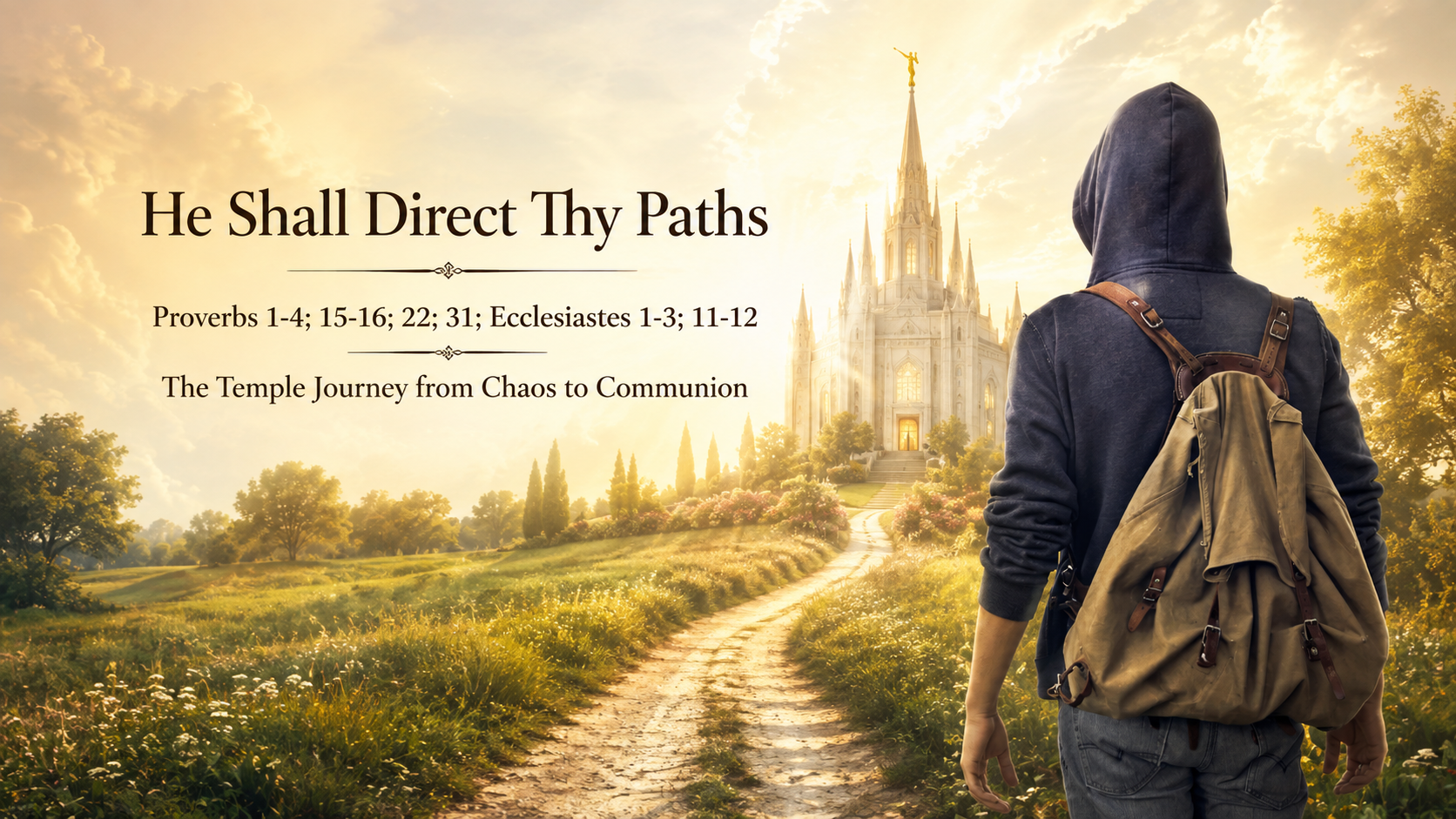
He Shall Direct Thy Paths: Proverbs & Ecclesiastes

He Shall Direct Thy Paths: Proverbs & Ecclesiastes

Proverbs 1-4; 15-16; 22; 31; Ecclesiastes 1-3; 11-12

The Temple Journey from Chaos to Communion

Proverbs teaches us how to walk wisely; Ecclesiastes asks whether wisdom is enough when life remains temporary, unfair, and beyond our control. Together, these books move the covenant disciple from moral formation to eternal perspective, from confidence in human calculation to reverent dependence upon God. Their unity is not a simplistic promise that righteous people will never suffer. It is the deeper testimony that life becomes rightly ordered when the Lord, rather than the isolated self, becomes its center.

This concluding study in the W.I.S.D.O.M. arc follows the appointed Come, Follow Me reading for September 7-13, 2026: Proverbs 1-4; 15-16; 22; 31 and Ecclesiastes 1-3; 11-12. Through Hebrew exegesis, Christ-centered exposition, Latter-day Saint scripture, and respected Jewish and Christian scholarship, we will trace a devotional temple movement from the two paths of wisdom and folly to the final summons to fear God, keep His commandments, and prepare for judgment. The destination is not intellectual mastery but communion: "Trust in the Lord with all thine heart ... and he shall direct thy paths" (Proverbs 3:5-6).

Introduction - When the Road Ahead Disappears

Most of us want God to give us a map. We want the next turn identified, the dangerous roads marked, and the destination guaranteed before we take the first step. Proverbs 3 offers something more demanding and more intimate. It does not promise that we will see the entire road. It promises that when we trust the Lord with the whole heart, refuse to make our own understanding the final authority, and know Him in all our ways, He will make the path straight before us.

That promise matters because discipleship is rarely lived on roads we fully understand. We make decisions with incomplete information. We pray through grief that has not resolved. We obey while consequences remain uncertain. We try to speak gently in a culture trained to reward outrage. We labor faithfully while Ecclesiastes reminds us that achievement, pleasure, wealth, reputation, and even human wisdom cannot defeat mortality. The human problem is not merely that we need better information. The deeper problem is that we are tempted to trust our own perspective as though it were complete.

Proverbs and Ecclesiastes meet us inside that tension. Proverbs says that creation possesses a moral grain: humility, diligence, fidelity, generosity, disciplined speech, and reverence ordinarily lead toward life. Ecclesiastes then refuses to let those observations harden into a mechanical formula. The wise still die. The righteous do not always receive immediate reward. Time overtakes every achievement. Much of life remains hevel - vaporous, fleeting, difficult to grasp. Biblical wisdom therefore matures when it moves beyond technique and becomes covenant trust.

This is why the final installment of our W.I.S.D.O.M. journey must end where the biblical books themselves end: not in admiration of the wise person, but in reverence before God. We have learned to Walk, Invite, Seek, Discern, Observe, and Meet. Each movement has carried us through the recurring wisdom pattern of descent and ascent: from Edenic estrangement into mortal confusion, from lament into remembrance, from self-reliance into surrender, and from the limits of human sight into the presence of the God who sees the whole way.

The 2026 Come, Follow Me manual wisely places Proverbs and Ecclesiastes in conversation. Proverbs teach that life is ordered by divine wisdom; Ecclesiastes asks what faithful life looks like when that order cannot be easily seen. Their combined witness is neither naive optimism nor cynical despair. It is covenant realism: life is temporary and often perplexing, yet it is lived before God, received as His gift, and made eternally significant through trust, obedience, repentance, and Jesus Christ.

Anchor Scripture - Proverbs 3:5-6

Trust in the Lord with all thine heart; and lean not unto thine own understanding.
In all thy ways acknowledge him, and he shall direct thy paths.

The movement of these verses is deliberate. Trust replaces self-sufficiency. The whole heart replaces divided allegiance. Knowing God in every way replaces the habit of confining Him to explicitly religious moments. The promise is not that God will endorse every route we prefer; it is that He will straighten the road of a life yielded to Him.

Sunday, August 23, 2026

"I Will Declare What He Hath Done for My Soul" | COME FOLLOW ME - OLD TESTAMENT 2026 | Psalms 49-86

"I Will Declare What He Hath Done for My Soul" | COME FOLLOW ME - OLD TESTAMENT 2026 | Psalms 49-86

The Temple Pattern of Descent, Ascent, and Exaltation in Israel's Hymnal of Redemption

"Come and hear, all ye that fear God, and I will declare what he hath done for my soul." - Psalm 66:16 KJV


This study reads the selected Psalms 49-86 as a canonical and theological journey through mortality, sin, lament, repentance, remembrance, redemption, and public witness. These poems do not form a single authored liturgy; they cross the boundary between Books II and III of the Psalter and include wisdom instruction, penitential prayer, individual and communal lament, historical recital, royal hope, and testimony. Read together, however, they trace a temple-shaped movement from estrangement toward the presence of God. Psalm 49 exposes the inability of wealth or human power to ransom life from death; Psalm 51 turns confession into a prayer for divine re-creation; Psalms 63, 69, and 77 give faithful language to abandonment and distress; Psalms 66, 71, and 78 transform remembered deliverance into covenant testimony; and Psalms 72, 85, and 86 direct personal restoration toward righteous kingship and Zion. The Book of Mormon intensifies this pattern in Alma 36, Alma 26, Alma 34, and Alma 42, where anguish gives way to joy through Jesus Christ and redeemed experience becomes missionary proclamation. The central claim is that biblical ascent does not deny descent. The worshipper rises by bringing mortality, guilt, fear, and unanswered questions into covenant relationship with the God who alone can redeem, cleanse, heal, and receive the soul. Psalm 66:16 therefore becomes more than a memorable line: it is the vocation of a redeemed people.

Scripture and method note. Biblical quotations follow the King James Version unless otherwise noted. This article distinguishes the psalms' ancient literary setting, their Christian canonical fulfillment in Jesus Christ, and their Latter-day Saint resonance. "Exaltation" is used first for being lifted into divine presence, covenant joy, and praise; restored doctrine gives that movement its fuller horizon in eternal life with God.

The Psalms as the Soul's Ascent Back to Eden

The soul does not merely want relief from pain. At its deepest level, it longs for the presence of God - for the wholeness, communion, and holy order represented by Eden. That longing is one reason the Psalms remain indispensable. They do not speak only from the summit of faith. They also pray from the pit, the wilderness, the sickbed, the battlefield, the guilty conscience, and the long night when God seems silent. The Psalter gives covenant people permission to bring the whole truth of mortal life into worship.

Calling the Psalms Israel's "temple hymnal" captures something essential, but it also requires care. Many psalms are rooted in sanctuary worship, sacrifice, procession, royal ceremony, pilgrimage, and public praise. Others may have begun in personal or communal crisis before being gathered for liturgical use. Sigmund Mowinckel emphasized the Psalms' setting in Israel's worship, while Claus Westermann stressed the dynamic relationship between lament and praise. James Luther Mays therefore describes the Psalms as both scripture and liturgy: ancient prayers that became the prayerbook of later communities (Mowinckel; Westermann; Mays).

The temple lens becomes especially fruitful when joined to the pattern of descent, ascent, and exaltation. The biblical sanctuary represents ordered creation and the divine dwelling among humanity; temple worship moves symbolically toward holiness and presence (Levenson 275-98). In the Psalms, that movement is often existential rather than architectural. The worshipper descends into fear, sin, mortality, exile, or confusion; ascends through remembrance, repentance, sacrifice, trust, and covenant appeal; and is lifted into renewed joy, praise, divine fellowship, and testimony. Walter Brueggemann's well-known categories of orientation, disorientation, and new orientation offer a closely related account of the spiritual world of the Psalter (Brueggemann).

This pattern does not mean that every psalm begins in Eden, passes through a fixed ritual sequence, and ends in triumph. Hebrew poetry resists mechanical outlines. Its parallel lines deepen, contrast, intensify, and sometimes destabilize one another. Yet across Psalms 49-86, a recurring theological grammar becomes visible: false securities fail, the soul cries out, God's mighty acts are remembered, mercy opens a path, and the redeemed worshipper declares what God has done. The result is a spiritual autobiography of redemption, not because all the psalms were written by one person, but because generations of worshippers can find their own descent and ascent within Israel's inspired songs.

Monday, May 18, 2026

We Must Test the Spirits of Recovery and Sobriety

We Must Test the Spirits of Recovery and Sobriety

When recovery meets revelation, discernment becomes a moment of thriving in sobriety. We test substances for purity — why not spirits? The same vigilance that guards sobriety must guard faith. The relapse of the soul begins when we stop testing what we trust.

We find ourselves in a time when the mantra of “to thine own self be true” echoes throughout recovery circles, highlighting a growing trend that prioritizes subjective authenticity over absolute truths. This modern movement in recovery and sobriety often veers away from the profound spiritual truths embedded in Scripture and the Christian faith, diluting the very essence of what it means to be truly free.

In this era of counterfeit light, our culture is awash with spiritual noise—false prophets promising quick fixes, hollow promises of peace, and fleeting joys that inevitably fade. Many are turning to a version of recovery that embraces personal desire and subjective experience over divine guidance and genuine transformation.

Yet, Christ calls us to something deeper. He invites us not into cynicism or despair but into a clear and sober understanding of our identity in Him. True sobriety is not merely the absence of substances; it is the presence of a spirit anchored in truth. It is about discerning the lies that this world offers and embracing the flawless truth of God’s Word.

As we embark on this journey of genuine recovery, let us challenge the shallow waters of modern self-discovery and dive into the depths of spiritual sobriety. Surrendering to Christ means shedding the noise of empty promises and embracing the clarity that comes from knowing Him. True recovery is about reclaiming our lives from distraction, grounding ourselves in faith, and walking in the light of His truth.

In a world saturated with uncertainty, let us hold fast to the enduring hope found in Christ, where true transformation begins and lasting sobriety thrives. Are you ready to embrace a recovery journey that leads to true freedom?

Anchor Verse: "Beloved, do not believe every spirit, but test the spirits to see whether they are from God; for many false prophets have gone out into the world." - 1 John 4:1, NRSVUE

Tuesday, February 10, 2026

CFM Feb 9-15: Genesis 6-11; Moses 8 - “Noah Found Grace in the Eyes of the Lord”

CFM Feb 9-15: Genesis 6-11; Moses 8 - “Noah Found Grace in the Eyes of the Lord”

Every generation eventually reaches a moment when it looks around and whispers, “Something is wrong with the world.” In these times, violence feels all too normal, permeating the fabric of society and influencing our daily lives. The mockery of faith becomes a fashionable trend, with belief systems ridiculed and disregarded as obsolete or irrelevant. Covenant identity, once held as sacred and unbreakable, is now treated as merely optional, leading many to question their values and commitments.

Amidst this unsettling atmosphere, the quiet, steady voice of God seems drowned out by the cacophony of a culture sprinting toward self-destruction. The distractions and temptations of the modern world are many, each vying for our attention and allegiance, leaving little room for genuine reflection on our spiritual existence.

Genesis 6–11 is not ancient history. It’s a mirror reflecting our current realities. Within these verses, we can find resonating truths about the human condition and the inherent struggles we face in a world rife with chaos. The narratives captured in these chapters hold profound relevance today, illustrating the timeless nature of our challenges and the critical need for divine intervention amidst suffering and despair.

Moses 8 is not merely a prelude to the Flood; it functions as a prophetic commentary on what true discipleship can look like when the world is collapsing around you. This text invites readers to consider their own paths and the steadfastness required to remain faithful in the face of overwhelming adversity. The examples set forth serve as reminders that unwavering dedication to one’s beliefs can be both a source of strength and a beacon of hope in dark times.

Noah’s story is not merely a story about a simple boat; it is an embodiment of a God who passionately refuses to give up on His children. The narrative illustrates the depths of divine love and commitment, showing that even when humanity falters, God’s covenant remains steadfast. It’s about a covenant that refuses to die despite the floods of life that threaten to engulf us. It’s about grace that finds us, even when the world is drowning in despair, offering a lifeline steeped in hope, redemption, and the promise of a new beginning. This grace reminds us that no matter how far we stray, we are never beyond the reach of divine mercy and love.