Showing posts with label Come. Show all posts

Sunday, September 6, 2026

Every Season Under Heaven: Ecclesiastes, Temple Covenants, and the Journey to Immortality

Every Season Under Heaven: Ecclesiastes, Temple Covenants, and the Journey to Immortality

Ecclesiastes is not Scripture’s surrender to meaninglessness. It is the wisdom of mortality—the testimony of a world east of Eden, where work exhausts, injustice wounds, pleasure fades, and death exposes the limits of every human attempt at permanence. Yet Qoheleth’s repeated word hebel is better pictured as vapor than as absolute nihilism: life “under the sun” is fleeting, elusive, and impossible to master. Through the poem of appointed times in Ecclesiastes 3, the book teaches disciples to receive mortal seasons as gifts they cannot control but can faithfully inhabit. Read within the full canon and through a Restoration lens, Ecclesiastes traces a temple-shaped movement from Edenic belonging, through mortal descent and covenant formation, toward judgment, resurrection, immortality, and life in Christ. Its final summons— “Fear God and keep his commandments”—does not solve every riddle. It teaches us how to live faithfully within them.

Some seasons arrive with invitations; others arrive with diagnoses, funerals, layoffs, broken trust, unanswered prayers, or the slow realization that the future will not look like the life we planned. We gladly quote, “A time to weep, and a time to laugh,” but the beauty of Ecclesiastes 3 can make us forget how severe the poem really is. It includes birth and death, planting and uprooting, healing and killing, embracing and separation, war and peace. Qoheleth is not decorating a calendar. He is naming the mortal world in which change is relentless and control is largely an illusion.

Ecclesiastes meets us precisely there. Its burden is not that nothing matters, but that nothing mortal can be made permanent by human grasping. Achievement cannot arrest death. Wealth cannot guarantee enjoyment. Wisdom cannot control outcomes. Even righteousness does not make mortality predictable. The Hebrew word hebel, traditionally rendered “vanity,” literally evokes breath or vapor: visible for a moment, real but ungraspable, present and already passing. Qoheleth dismantles the fantasy that we can secure eternal identity with temporary things.

That dismantling can become sacred preparation. When the false foundations collapse, the disciple can receive identity as covenant gift rather than personal construction. Ecclesiastes moves from Edenic echoes to dust, from dust to reverence, and from reverence toward divine judgment. Christian Scripture then answers Qoheleth’s deepest ache in the resurrected Christ, who entered the mortal descent, passed through death, and ascended in immortal glory. Restoration scripture widens that canonical horizon by locating earthly life between premortal belonging and resurrected continuation. Every season becomes neither random fate nor automatic blessing, but a mortal sphere in which agency, grace, covenant loyalty, and holy desire form a people capable of dwelling with God.

Ecclesiastes Is the Wisdom of Mortality

The 2026 Come, Follow Me manual places Proverbs and Ecclesiastes in productive tension. Proverbs often teaches that divine wisdom produces flourishing; Ecclesiastes replies that lived experience is not always so tidy. Qoheleth can devote himself to wisdom and still discover grief and “vexation of spirit” (Ecclesiastes 1:17–18). The manual therefore asks whether meaning is possible when life appears “vain, temporary, and uncertain,” and it answers by joining Ecclesiastes 12:13 to Proverbs 3:5: fear God, keep His commandments, and trust the Lord. Life with Christ is better, though mortality is not thereby made painless or predictable.

That distinction prevents two opposite misreadings. Ecclesiastes is neither a manifesto of atheistic despair nor a sentimental promise that every event will become pleasant if we wait long enough. It is wisdom spoken from within creaturely limits. The title identifies its speaker as Qoheleth, a term related to assembly and conventionally translated Teacher or Preacher. His royal Solomonic persona tests wisdom, pleasure, projects, wealth, reputation, and labor. Each experiment exposes the same boundary: human beings cannot produce lasting “gain” from beneath the sun because time, contingency, and death eventually take everything from their hands.

The phrase “under the sun” is therefore a crucial boundary marker. It names life as experienced from within the closed horizon of mortality. From that vantage point, generations come and go, the sun rises and sets, rivers run endlessly, memory disappears, and human striving circles back upon itself (Ecclesiastes 1:3–11). The world resembles Eden and yet is no longer Eden. Gardens can be planted, fruit enjoyed, marriage cherished, wisdom pursued, and work accomplished; nevertheless, thorns remain, sweat accompanies bread, domination distorts relationships, and everybody returns to dust. Ecclesiastes is the wisdom of Genesis 3 experienced from the inside.

Sunday, August 16, 2026

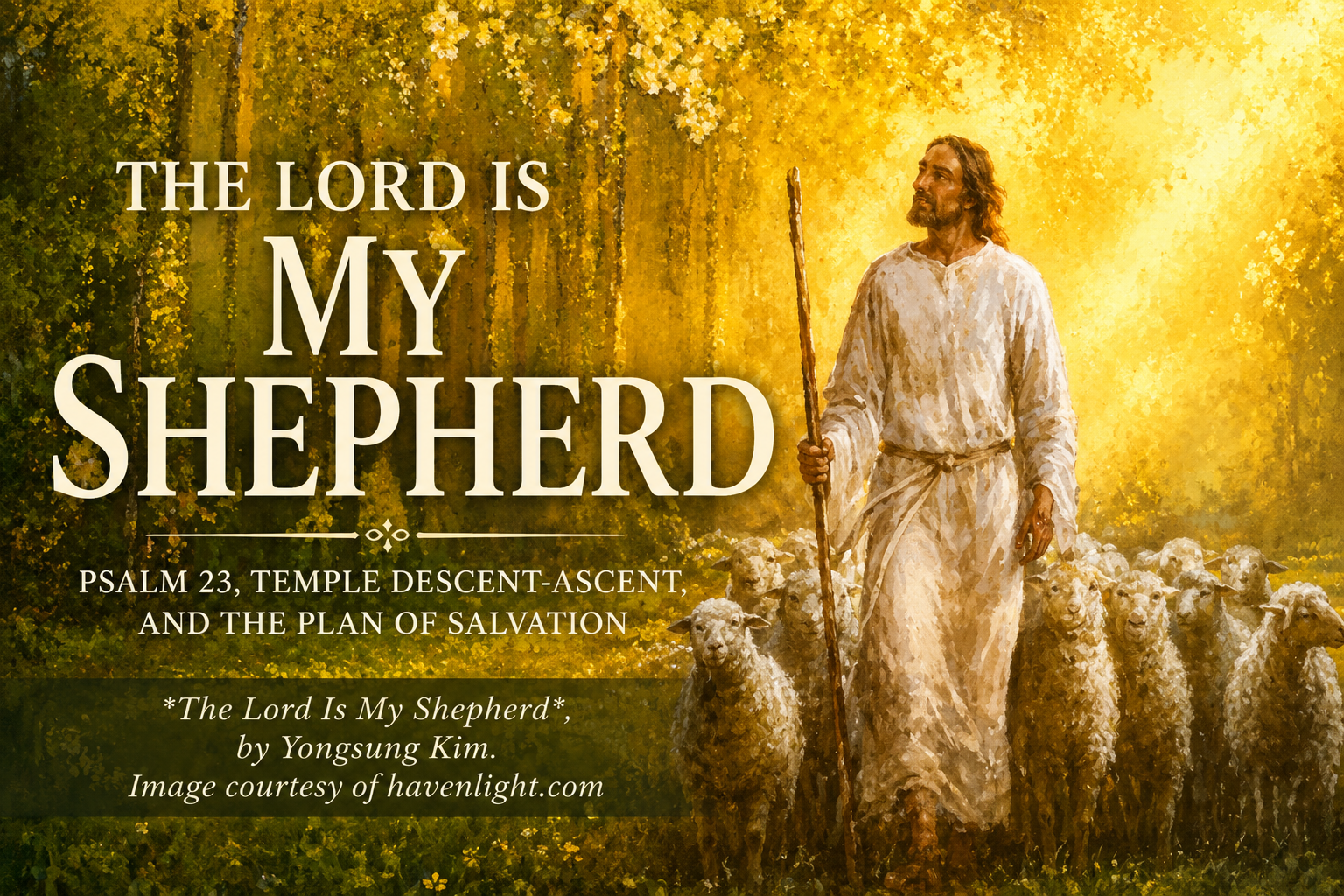
"The Lord Is My Shepherd": Psalm 23, Temple Descent-Ascent, and the Plan of Salvation

"The Lord Is My Shepherd": Psalm 23, Temple Descent-Ascent, and the Plan of Salvation

A Come, Follow Me Study for August 17-23, 2026: Psalms 1-2; 8; 19-33; 40; 46

"For thou art with me." - Psalm 23:4

Most of us first learned Psalm 23 as a psalm of comfort. We hear it at funerals, repeat it in hospital rooms, and reach for it when grief has stripped life down to its most difficult questions. That use is neither accidental nor misplaced. Yet Psalm 23 does more than assure us that God will remain near when we die. It poetically traces an entire journey: the Lord provides, restores, guides, accompanies, protects, welcomes, anoints, and finally brings the worshipper into His house.

That movement makes Psalm 23 especially meaningful for Latter-day Saints. Its imagery can be read as a temple-shaped journey from ordered life into mortal darkness and then upward into covenant fellowship and the presence of God. Read within the immediate sequence of Psalms 22-24, the pattern becomes even more striking: lament and suffering in Psalm 22, the Shepherd's presence in Psalm 23, and ascent to the holy hill with the King of glory in Psalm 24. Nancy deClaissé-Walford's intertextual study similarly argues that these three neighboring psalms form a powerful statement of trust when read together (deClaissé-Walford 139-52).

This interpretation requires one careful qualification. Psalm 23 is not demonstrably a word-for-word transcript of an ancient Israelite temple ceremony, and the full Latter-day Saint plan of salvation should not be projected backward into every Hebrew phrase as though the psalmist were writing a systematic doctrinal manual. Psalm 23 is commonly classified as a psalm of trust or confidence, while a pilgrimage setting that culminates at the temple remains a respected scholarly proposal rather than an uncontested conclusion (Smith 61-66; Tappy 255-80). The temple and plan-of-salvation reading offered here is therefore a disciplined canonical and theological synthesis: it begins with what the Hebrew poem says, follows the intertextual patterns the Psalter supplies, reads the psalm through Jesus Christ, and then asks how Restoration scripture enlarges its hope.

What Come, Follow Me Actually Assigns for August 17-23

The official 2026 reading is often abbreviated as "Psalms 1-46," but the assigned passages are selections rather than every chapter in that range: Psalms 1-2; 8; 19-33; 40; and 46. The manual invites readers to notice the Psalms' vivid images of the Savior, including the green pastures, still waters, rod, staff, and overflowing cup of Psalm 23. It then connects Psalm 24's "hill of the Lord" with the temple and with preparation to enter the presence of God (Come, Follow Me).

The broader three-week schedule is also selective. August 24-30 covers Psalms 49-51; 61-66; 69-72; 77-78; and 85-86, while August 31-September 6 covers Psalms 102-103; 110; 116-119; 127-128; 135-139; and 146-150. Keeping the actual readings clear strengthens the study because it allows Psalm 23 to function as the focal text for this week without forcing an artificial structure onto every psalm from 1 through 46.

Saturday, August 8, 2026

From the Ash Heap to the Holy Mountain: Hebrew Poetry and Wisdom Literature through the Temple Pattern of Descent and Ascent

From the Ash Heap to the Holy Mountain: Hebrew Poetry and Wisdom Literature through the Temple Pattern of Descent and Ascent

A Come, Follow Me introduction to Job, Psalms, Proverbs, and Ecclesiastes

Job, Psalms, Proverbs, and Ecclesiastes do not offer one flat explanation of faithful life. They give us an inspired conversation. Job protests any theology that reduces suffering to a predictable equation. The Psalms teach covenant Israel to pray through joy, guilt, abandonment, fear, gratitude, and praise. Proverbs forms moral perception by training the disciple to fear the Lord and choose wisdom over folly. Ecclesiastes exposes the vapor-like instability of mortal achievement and the limits of human control. Read together, these books move repeatedly from order into disorientation and from disorientation toward a renewed, humbler communion with God.

This study proposes the temple pattern of descent and ascent as a theological and devotional framework for that movement. Descent names mortality, estrangement, lament, disorder, and the collapse of false certainty. Ascent names purification, covenant formation, divine instruction, unveiled perspective, and renewed presence. The framework is grounded most directly in the temple setting of many Psalms—especially Psalm 24—but it should not be mistaken for a claim that Job, Proverbs, and Ecclesiastes were all composed as a single temple ritual. Instead, it is a canonical, Christ-centered reading that brings the wisdom books into conversation with Israel’s worship, the plan of salvation, and the Latter-day Saint journey back into God’s presence. The W.I.S.D.O.M. arc developed below provides the series structure: Walk, Invite, Seek, Discern, Observe, and Meet.